

Biosphere Expeditions: An adventure in citizen science
Feet set firmly apart on the deck, hands clutching the rail in front of me, knees flexed, I swayed back and forth, side to side as the boat rocked alarmingly, riding up the waves and then smacking down the other side. The sea did its best to flick us, an annoying little flea, off its back. In my head, the theme song from “Gilligan’s Island” ran on repeat.
Fingers aching, knees complaining, but loving the salty breeze on my face, I was serving as port lookout on the foredeck. My job was to spot the “blows”: whales surfacing from deep below, exhaling as they surface.
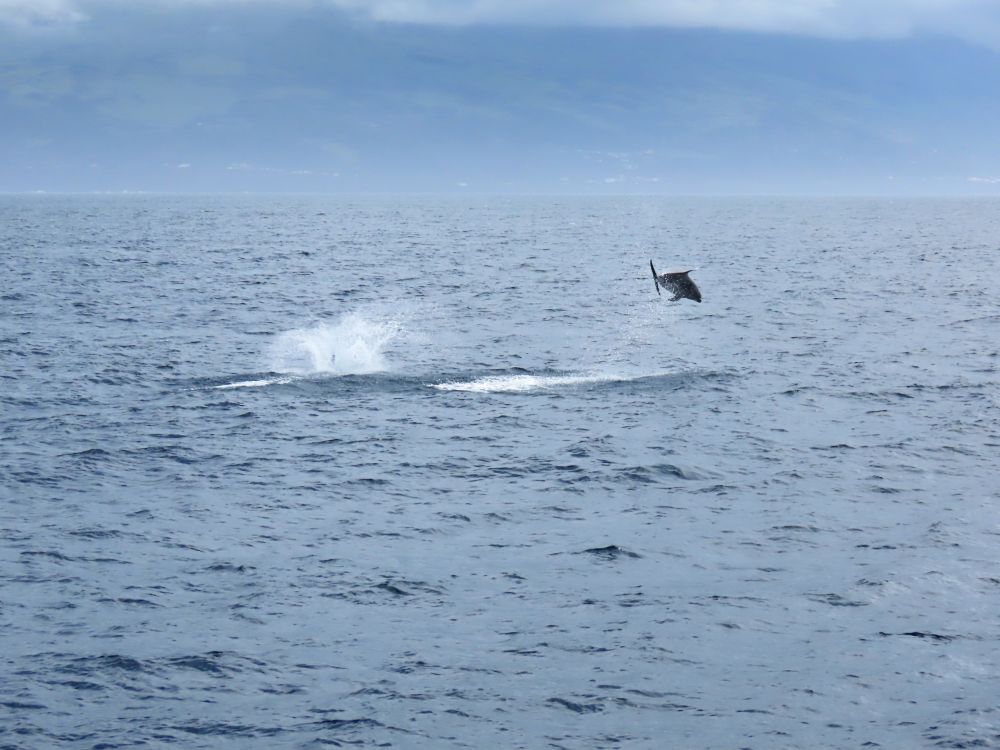
It turned out I’m terrible at spotting whales. Almost without fail, someone else on the boat spotted them first. To be honest, it didn’t matter to me; being out there on the sea was exhilarating, and I realized I was smiling.
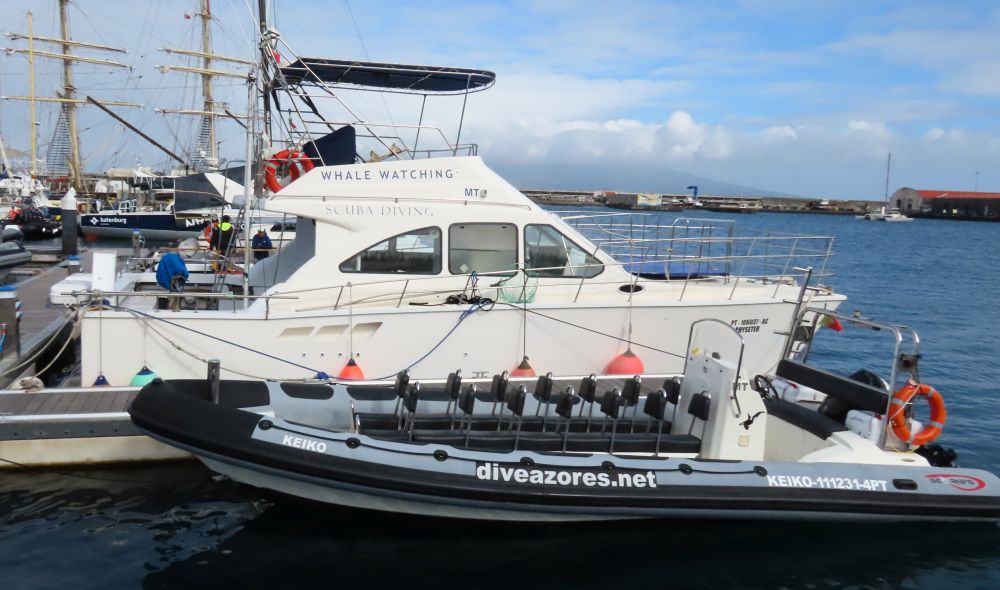
The Physeter is a whale-watching boat based on Faial Island in the Azores. That’s a small group of volcanic islands belonging to Portugal, sitting in the middle of the northern Atlantic Ocean.
It wasn’t exactly a whale-watching trip, though, even if we did spend our six sea days (of a nine-day expedition) watching out for whales and dolphins. We – the ten “citizen scientists” on the boat – were taking part in a Biosphere Expeditions project. The point wasn’t just to see the animals, but to collect as much data as we could about them. In other words, we were taking part in “citizen science.”
Note: I should point out here that I was partially sponsored by Biosphere Expeditions on this trip. To be more specific, they waived the expedition contribution. I still paid for my flights to Faial Island, hotel nights before and after the trip, and I also needed to spend some money for clothing appropriate to what I’d be doing.
Disclosure: This article contains affiliate links. Making a purchase through an affiliate link will mean a small commission for this website. This will not affect your price. Privacy policy.
What is citizen science?
Have you ever taken part in an annual bird count? This is a common example of “citizen science,” where lots of people help collect data for scientific studies. It is enormously helpful because the more data scientists have, the more reliably they can draw conclusions from those data.
When you do that bird count in your backyard, that’s an example of volunteering. But when you travel in order to volunteer, it’s often called “voluntourism.” I’ve written about voluntourism before, expressing my concerns about whether it might harm more than it helps, and sometimes it does. But when I was doing research for that article, I stumbled on the Biosphere Expeditions website and their article, Voluntourism: Top Ten Tips. Their projects struck me as an example of a good kind of voluntourism, though Biosphere does not like to be seen as a voluntourism company. That’s how I eventually ended up on this little boat in the middle of the Atlantic.
What does Biosphere Expeditions do?
Biosphere Expeditions is a non-profit organization that combines citizen science with voluntourism. It supports a range of scientific projects by organizing groups of “citizen scientists” – who pay for the privilege – to help scientists collect data. All of these projects have to do with wildlife conservation, and the money the citizen scientists pay helps support the projects.
Biosphere Expeditions doesn’t set up the projects themselves; they just find ones they can help. They recruit the citizen scientists and organize the expedition, arranging accommodations and meals for the citizen scientists. An expedition leader – a Biosphere staff member – is responsible for logistics and leading the participants, and sometimes Biosphere pays for equipment if, for example, something breaks down.
At the moment, Biosphere Expeditions is supporting seven projects around the world, but some projects go on for longer than others, so sometimes they offer more choices. Each has different goals, but it’s usually about understanding a particular species: its habitat, its distribution, its numbers, its migration patterns, and/or its behavior. Such information can be used for things like determining what land should become a reserve or how steps taken in the past have affected populations of particular species. You can read about what the expeditions have achieved over the years here and dive into their publications here.
While our project involved studying whales, dolphins and other sea animals, mainly by spotting them and then photographing their tail fins, on some of these projects, the citizen scientists are unlikely to see the target species. Their project in Germany, for example, is focused on wolves in Lower Saxony. Wolves are rather secretive and rare, but the project can still study them through their scat and tracks, as well as their prey species. A fellow participant on this Azores trip took part in the wolves project and loved it because it was exciting to work as what she called “a wildlife detective.”
Other projects at the moment, besides the whales in the Azores and the wolves in Germany, look at biodiversity at Vwaza Marsh in northern Malawi or Cape Floral Kingdom in South Africa, coral reefs and whale sharks in the Maldives, brown bears in Sweden or snow leopards in Kyrgyzstan. All are in beautiful places, but this is definitely not tourism: it’s voluntary citizen science work.
Biosphere Expeditions project in the Azores
The goal of the Azores expedition is primarily to monitor the whales and dolphins that live around the archipelago or pass through on their migrations around the Atlantic. The money the participants pay does two things: provides their accommodations, food and the all-round organization of the expedition and, more importantly, pays for the boat, its skipper and its fuel for up to five and a half days on the ocean. Three groups of nine days each in a row are scheduled in the spring, before the normal whale-watching season gets started in earnest. This allows the collection of more data than would normally be possible within the summer season.
Scientist Lisa Steiner leads the project, which is now in its 20th year. Biosphere’s support in recruiting the citizen scientists allows Lisa to focus on data collection and analyzing more data than she can manage on her own. She collects some data by guiding whale-watching trips during the summer tourist season, but the expedition allows much more to be collected. This is partly because of the added weeks before the whale-watching season, and partly because we were able to record many more different bits of information.
While this is Biosphere’s 20th year supporting the Azores research, the project has been going on even longer. The data it collects, though, is only a small part of a much larger collaborative effort. Scientists all around the Atlantic, from Norway down to the Canary Islands and Cape Verde and across to North America, collect data about whale and dolphin movements, behavior and about individual animals. Using various apps and websites, they share the information with each other.
This means, of course, that the information we collected was not going to have immediate effect, but would be available for scientists, Masters students, and PhD students for many years to come.
How do you know where to find the whales?
The Azores has an interesting history of whaling, which I’ll write about separately. Unlike in the old days, when whalers from places like Nantucket and Martha’s Vineyard spent months on large ships hunting whales and processing the carcasses, Azorean whalers worked from the shore. On Faial and Pico Islands, people called vigias served as lookouts on high points of land. As long as the weather was fairly clear, they could spot the “blow” of whales. They’d signal down to the villages and the whalers would rush to their small boats to go out, find the whale and harpoon it to drag it back to land for processing.
Whaling in the Azores ended in 1984, and gradually whale watching replaced whale hunting. The earliest whale-watching companies hired the vigias back, and to this day they pay spotters, who watch from the same positions as always, but have better equipment – very powerful and heavy binoculars, these days. The vigias, on seeing a whale, radio its location and species to the whale-watching boats. That’s how we knew where to find the whales. The communication goes both ways, though; our skipper would report back and tell the vigias about any random sightings too.
My experience on the Biosphere Expedition in the Azores
Training
On the day we started the expedition, we assembled at 11:00 for an introduction and to check into our accommodations, a guesthouse right on the old harbor of the town of Horta. After lunch, we started our training, which filled the rest of the day and the following morning. We learned about the project as a whole, the different species of whales and dolphins, the equipment we’d be using to collect the data, what the tasks were that we’d be doing, safety precautions, and how our work week would be organized, both at the guesthouse and on the boat.
Sea days
The expedition involves a planned total of six sea days. It may be fewer if the weather makes it too dangerous to go out, or if it’s too foggy.
On the first sea day we finished our training in the morning and then spent about four hours at sea. On each of the other five days, we spent up to seven hours at sea. For comparison, the typical whale-watching tour is only a single three-hour trip, and the goal is entertainment. The guide will take the tourists to see whales, and they might watch them for perhaps 15 minutes before moving on to find other animals such as dolphins.
Our sea days, by contrast, besides being longer, were, in a way, slower. When we spotted whales – usually following a tip from a vigia – the skipper, Pedro, would slow the boat, but not turn off the engine. That would allow him to avoid the worst of the sudden movements the large swells would cause.
Collecting data
We would watch and photograph and record data. Compared to a standard whale-watching tour, we often stayed much longer because for some species of whales it was necessary to see and photograph the flukes (tail fins) for the research. That meant waiting for each whale to decide to take a deep dive, which could take a long time.
We didn’t just sit on a boat and spot whales, though. We each had an assigned task on the boat, and those tasks rotated each day.
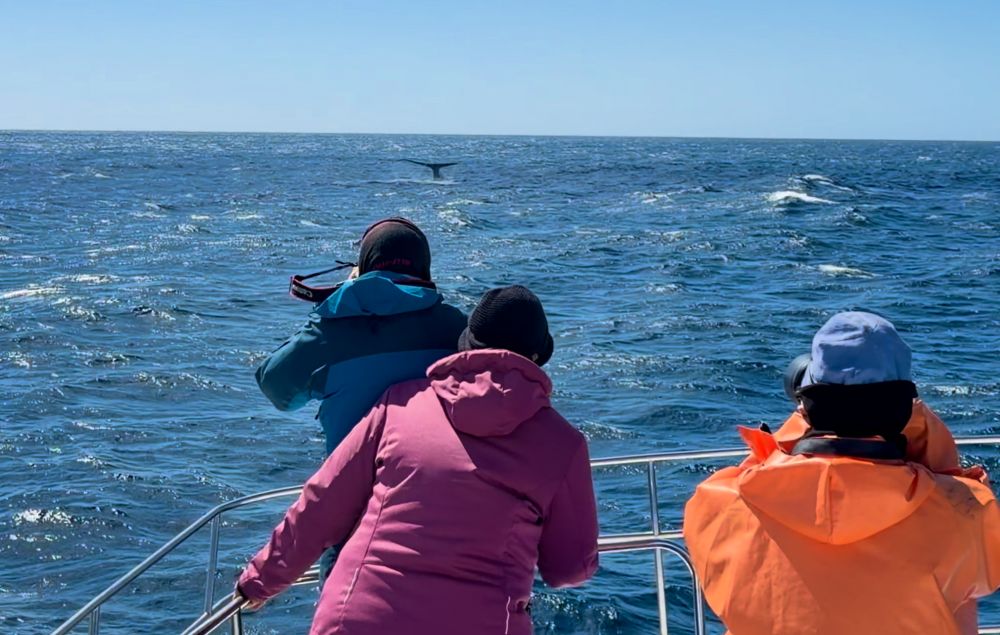
Lookouts: Three of us were assigned to be lookouts each day. Two (port lookout and starboard lookout) stood at the front of the boat (weather permitting). The other was “aft lookout” on the upper deck to watch behind us as we moved along. What really happened, though, is that everybody helped look out for animals.
Photographer: This was a particularly important role. One person each day had the task of using a big camera provided by Biosphere Expeditions. One of the lookouts helped by bracing the photographer, which meant they held the person between their arms, like a bear hug from behind, but with both hands holding the railing. Pushing against the photographer’s back, they pinned the photographer against the railing so they could use both hands to operate the camera. Without this help, it was near impossible to get photos; the boat bobbed about continually on the swells, and we all had to have at least one hand on the rail at all times.
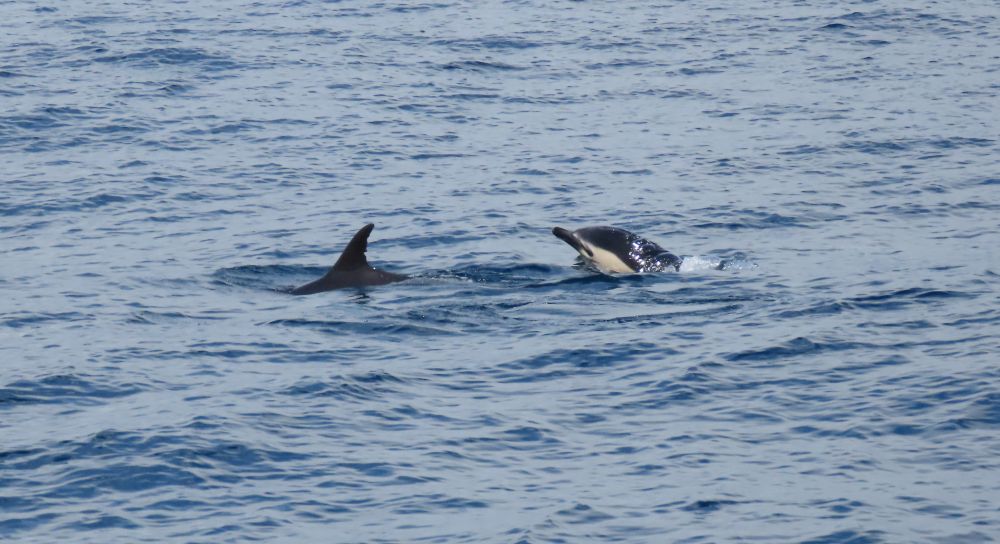
At the same time, Lisa, the scientist, took photos too, as did many of the rest of us, when we were done with our assigned tasks. She was more successful, I’d say, at getting good photos. Her decades of experience on whale-watching boats meant she could, at times, manage to stand and focus her camera without holding the rail.
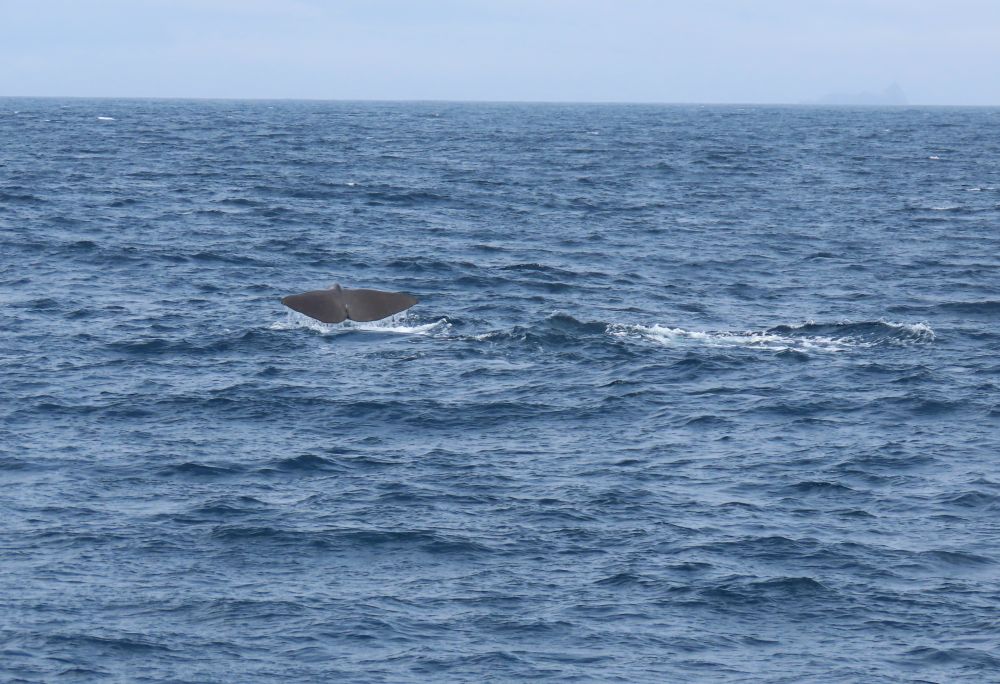
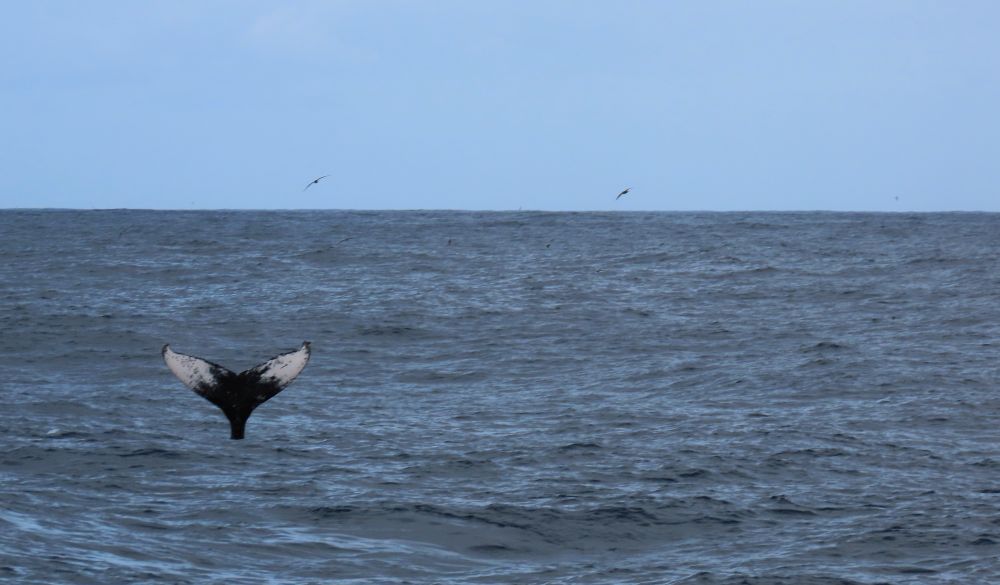
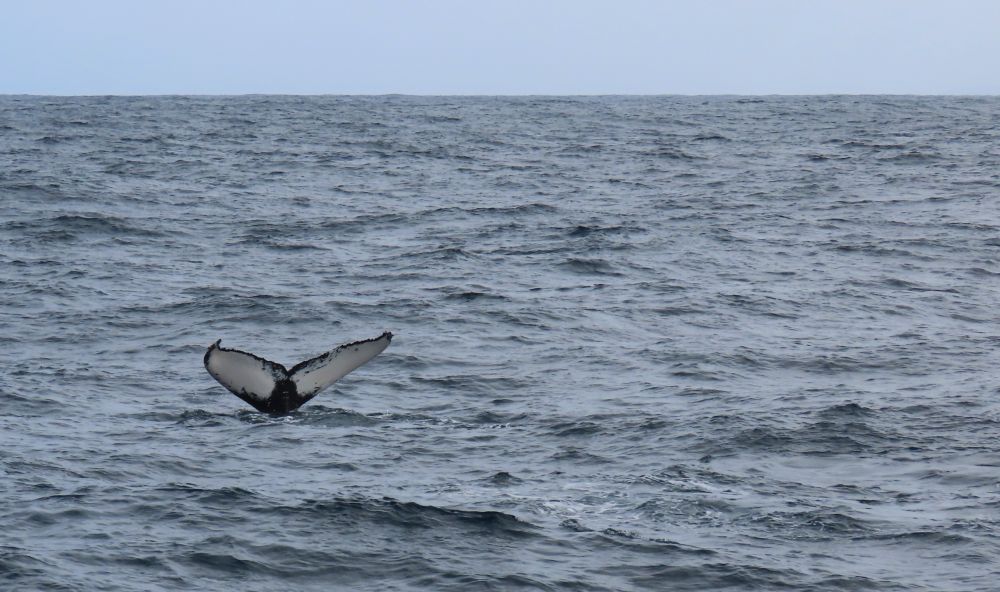
Individual animals have unique markings: injuries to flukes (tail fins) on whales, scratches on dolphins, cuts on dorsal fins, etc. Identifying individual whales and matching them across different locations is how scientists have come to understand, for example, how sperm whales migrate around the Atlantic.

Notice the patterns and colors on the tail of this humpback … 
… quite different from this humpback’s tail.
Data collectors: The rest of us collected the data in two different apps (for two different projects in two different places), a GPS log, and a data sheet. The various data points included things like the species, the precise location, number of animals, what they were doing (socializing, feeding, traveling, etc.), how many calves we spotted, other whale-watching boats nearby, the weather, the wind direction, the surface water temperature, the sea conditions, and more.
One participant took the surface water temperature whenever certain whales and dolphins were spotted. If a whale happened to poop close by – this didn’t happen over our six sea days – one person had the task of scooping up and bagging a sample to go to a scientist at the University of the Azores.
Processing the data
Returning to the guesthouse in the afternoon, most of the citizen scientists had two hours or so free before dinner. Two of us, though, had work to do after the day on the ocean: the photographer and the person responsible for the data sheet.
The photographer had to look over the photos from the day, deleting the ones that didn’t include the animals. This may sound silly, but we were traveling on the open sea, and it was rough at times. It’s hard to operate a camera when both you and the subject – the whale or dolphin – are moving!
After deleting the many blurry photos and photos of water, the photographer had to upload the rest to the computer, choosing a “top 10” for showing to the whole group in the evening meeting.
The person who had kept the data sheet that day also had some computer work to do: entering the data into an Excel sheet.
Evening debrief
After dinner most days, we all came together in the lounge of the guesthouse for a debrief. Our expedition leader, Craig, would show the photographer’s best photos, and Lisa would show hers – consistently better than any of ours. We’d also see a map of our day’s travels, and both Craig and Lisa would add any comments about how the day went, as well as sharing any information we needed for the next day.
Often the debrief included an informational session, either from Lisa about her research, or from invited speakers from the University of the Azores to tell us about what they were investigating. These presentations helped us see how the data we collected could help in increasing understanding of whale and dolphin behavior. One researcher told us, for example, about a study of how whale-watching boats affect behavior. Another analyzed why two different dolphin species inhabit the same place within an ecosystem but at slightly different periods. A third scientist looked at how different sperm whale groups have different “codas” or click patterns. These are, in effect, dialects, and they affect their mating behavior.
A typical sea day
Sea days on this expedition were very full.
- Get up, get dressed and eat breakfast by about 8:00. (Get up earlier if you have the breakfast set-up task.)
- Walk to the harbor – a flat walk of about a kilometer – and be there at the set time. Usually we needed to be there at 8:45.
- Stay on the boat, traveling to whale sightings and collecting data, until it’s time to return to the harbor. Arrival back anywhere from 15:00 to 17:00.
- Walk back to the guesthouse for a shower. With all the spray and, possibly, rain, you need it! Change to street clothes.
- You might have 2-3 hours of free time to take a walk, go shopping, phone home, or just take it easy in the lounge with a cup of tea.
- Dinner at 19:00 at the guesthouse or a restaurant.
- Tidy up, if that’s your assigned task.
- Debrief.
- Generally, everyone is so tired after dinner and debrief that they go straight to bed.
For those who like numbers, here’s a statistical look at the expedition:
- We spent anywhere from 3.6 hours on the boat on the first sea day to 7.2 hours on the last sea day. The grand total boat time was 36.3 hours over six sea days.
- The shortest distance we traveled on the boat was 59 km (37 mi) on the first day, and the longest was on the second sea day at 198 km (123 mi). The total over the 6 sea days was 753 km (468 mi).
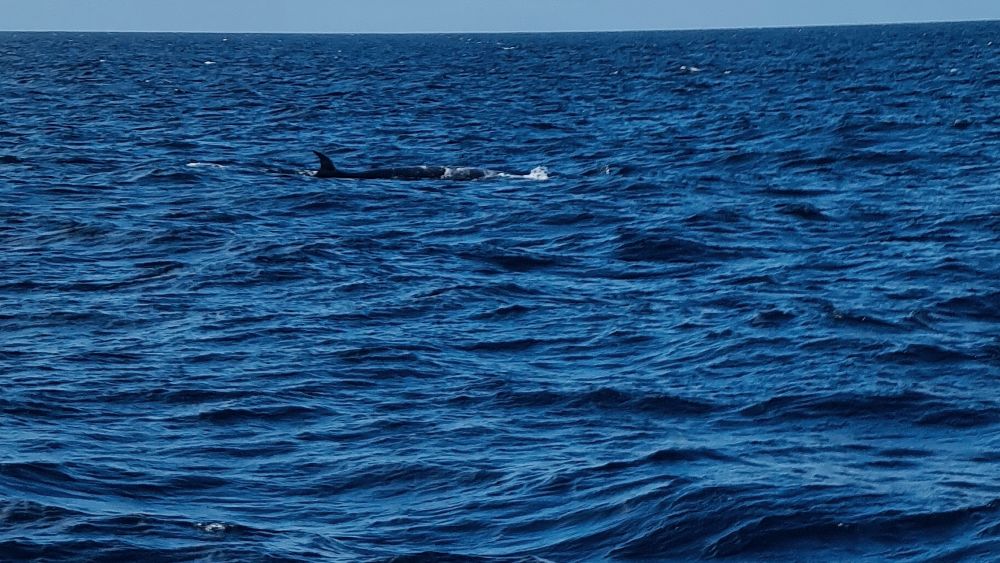
- We had a total of 52 encounters with 8 different species of whales and dolphins: bottlenose and common dolphins; blue, humpback, sei, minke, Cuvier’s beaked, and sperm whales. We had the most encounters with sperm whales, seeing 69 of them in 28 encounters. How many animals there were at each encounter varied from 1 (a blue whale) to an estimated 420 common dolphins (over 11 encounters).
The map below, courtesy of Biosphere Expeditions, shows the routes we took over the six sea days. The various symbols mark where we encountered animals. The day we went between Pico and Sao Jorge gave us the calmest waters. You’ll notice that south of Pico, we zigzagged quite a bit. That’s because the rough water with high swells, combined with the way the wind was blowing, made it dangerous to steer straight across the waves back to Faial.
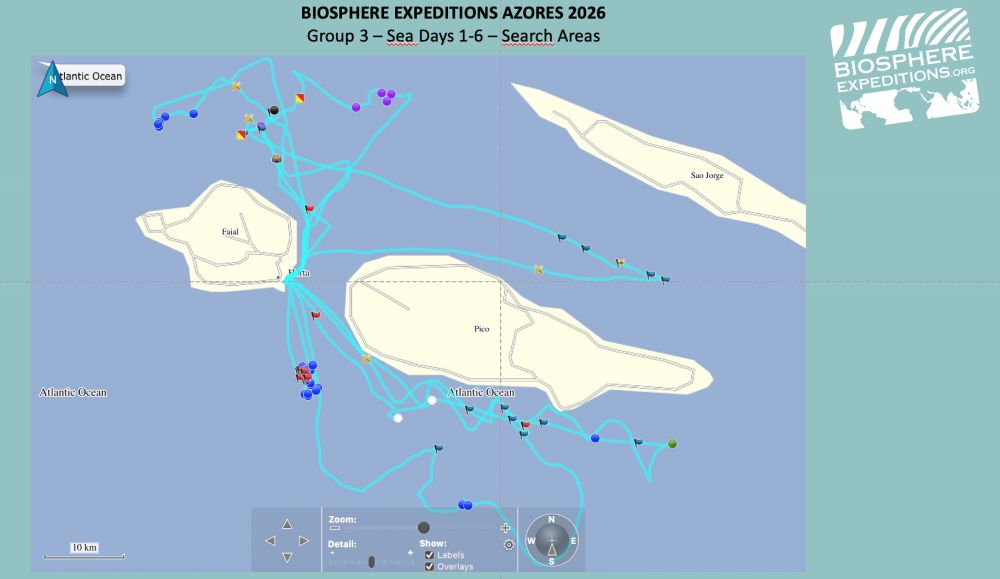
This is truly the open ocean; there’s nothing west of here until you reach Delaware in the US.
Land days
The whole expedition, in theory, includes 2 half-day training days, 5½ sea days, and two land days. The sea days, though, are weather-dependent: there might be fewer than planned.
We spent a large part of one of the land days processing data. This included tasks like studying a large file full of whale or dolphin pictures to match up photos of single individuals. In my case, another participant and I traced the outlines of sperm whale flukes for a program that sorts them by outline. Just those few relaxed hours processing the photos felt like a real education. It showed us how massive this database is and how much work has to be done to create it.
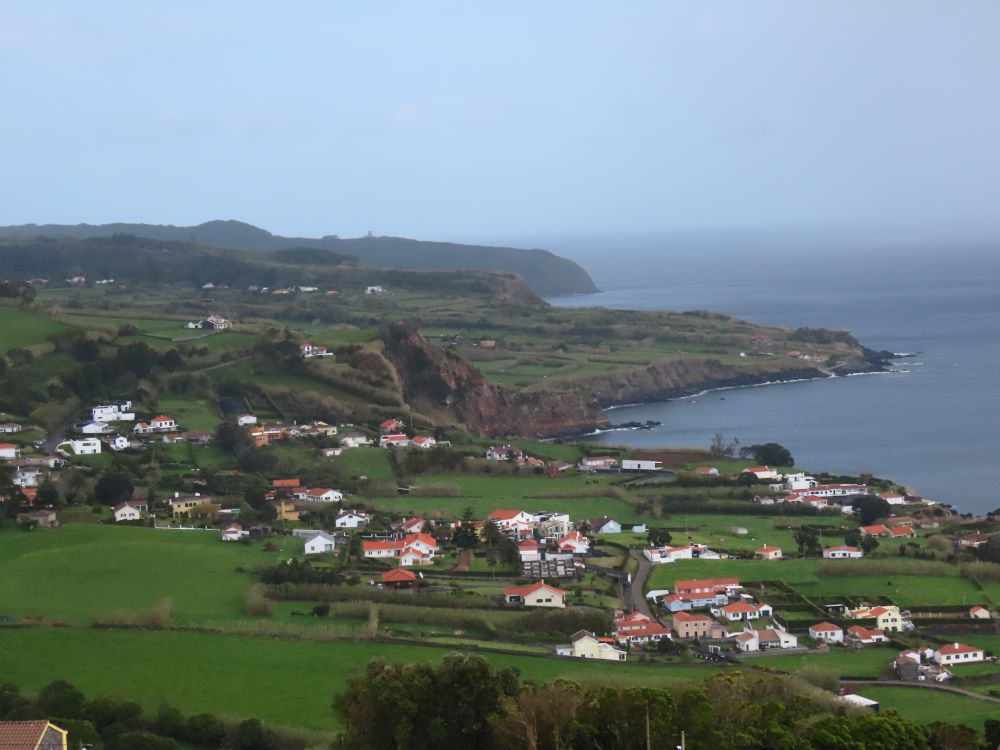
The other land day was free. I ended up renting a car and driving around the island with three other participants. We took lots of photos – Faial Island is absolutely beautiful! – and visited a volcano museum as well.
Accommodations and food
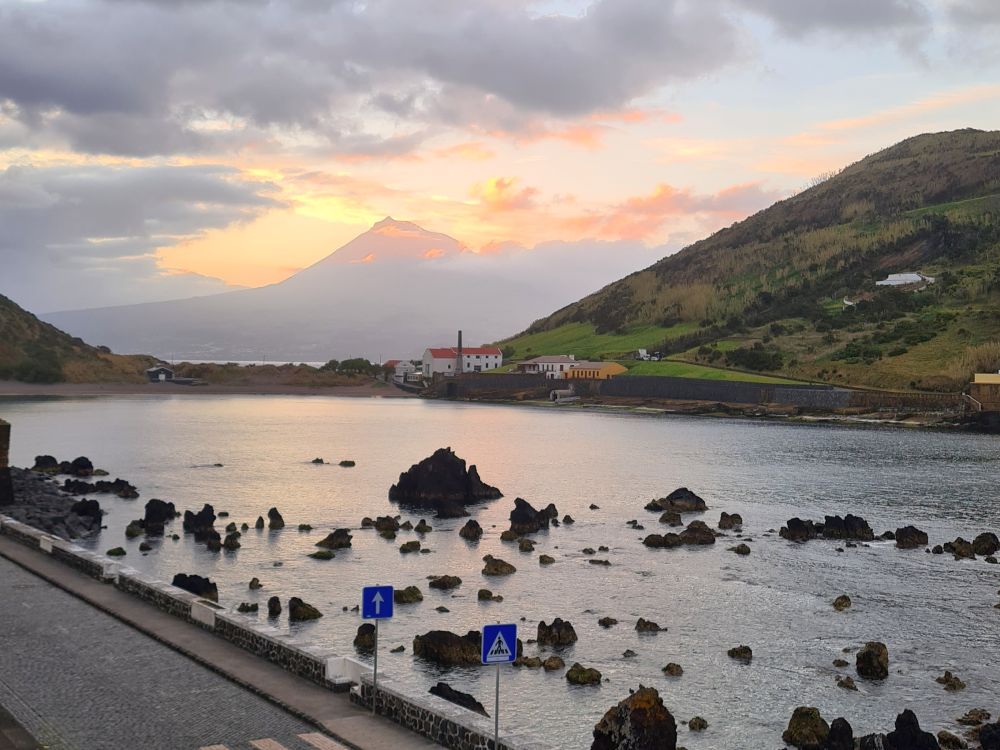
On this particular Biosphere Expeditions project, the conditions were very comfortable for us, the expedition team. The guesthouse where we stayed in Horta, the capital of Faial Island, is called Monte da Guia. It offers big, clean hotel rooms with en-suite bathrooms. Those of us traveling solo shared the room with another participant. On the upper floor was a lounge and dining room with a gorgeous view over the old harbor of Horta, backed by a view of the mountain of Pico Island next door.
Breakfast was buffet-style: bread, cheese, jam and other spreads, yogurt, fruit, cereal, and so on. Coffee and tea are always available.
We were expected to pitch in, making our own breakfast, tea or coffee and packing up our own lunch. We also did a few tasks according to a set roster. That meant setting up for breakfast one morning and cleaning up afterwards, and the same thing on the nights we ate dinner at the guesthouse. Since there were ten of us rotating these tasks, none of it was burdensome at all. Often people pitched in, even when it wasn’t their turn.
While we packed up sandwiches, fruit and water bottles for lunch, many of us ate nothing on the boat. For some, it had to do with seasickness – eating made it worse, so they didn’t. I didn’t get seasick, and I did eat some of my food on the boat. Most days, though, it got so bumpy that it was too hard to eat and hold on at the same time.
Dinner was at 19:00 each evening, either catered at the guesthouse or at a restaurant. Biosphere Expeditions has a strict vegetarian (not vegan) food policy, so the restaurant nights were our chance to try out the local seafood or meat. However, only vegetarian food was covered by Biosphere Expeditions, so if we chose a meat or seafood dish, this involved an extra cost.
The people on a Biosphere Expeditions project
Every group is different, of course, so I can only tell you about mine. We were ten of us from eight countries: the US, the UK, Germany, France, Switzerland, Australia and the Netherlands (me). The age range, I’d guess, was from the mid-30s to 64 (again, me). All of them were kind, idealistic, and enthusiastic. Dinners together were a delight. I assume that anyone who signs up for any of these expeditions is likely to be just as kind, idealistic and enthusiastic.
Is a Biosphere Expeditions project worth doing?
This was my main question before the trip. I wondered if what the participants do on these expeditions is really of use. The short answer is: yes. The expedition in the Azores – there are three groups of nine days each in a row each spring before the tourist season really gets started – get Lisa more time on the water and more data than she could possibly collect herself.
But the benefits are wider than that because the data are available to other researchers in the Azores and around the Atlantic, both now and in the future. These expeditions only contribute a few weeks of observations each spring, but as they say, every little bit helps.
The fact is that scientific research – other than research that might earn a profit eventually – is chronically underfunded. The University of the Azores or any of the other participating universities can’t possibly afford to hire people to do these tasks. On top of that, the boat rental, the skipper’s pay and the fuel for each day on the sea all come at a high cost. What the citizen scientists pay to take part covers these costs and provides the labor for free. In return, they get an amazing and very unusual whale-watching experience.
Whether it’s worth it for you is another question. Do you want to go whale-watching or do you want to contribute to whale research? The former is tourism (and much easier!); the latter is scientific work. On the other hand, you’ll learn a lot about how researchers gain knowledge about these elusive creatures who roam the oceans. I was astonished by how much data has been collected and the kinds of conclusions that can be extracted from that data.
I travel a lot and mostly I’m just doing it for my own entertainment. I’ve seen whales twice before: once on a whale-watching trip in Iceland, and once on a snorkeling trip in Martinique. Both were memorable, but this expedition was much more immersive and intense. Make sure, if you choose to take part, that you’re willing to prioritize the work over the fun for the duration of the expedition.
And there’s no shame in not joining an expedition; you can still support the research on a three-hour commercial whale-watching tour like this one. They collect data too: just not as much.
How to choose a Biosphere Expeditions project
The Biosphere Expeditions projects are all different. Each has different expectations of the citizen scientists and studies different animals in a range of different places. Make sure to read all the information on the Biosphere Expeditions website before you decide on which you want to do.
You might choose by which animals interest you most or what kind of landscape you prefer. If you like whales and dolphins and being on the sea, then the Azores expedition is the one to choose. Go for the snow leopard expedition in Kyrgyzstan if you enjoy walking in the mountains. If you are a qualified diver, think about the coral reef project in the Maldives.
Do you want to actually see the target species you are studying? You’ll likely see the target species in the Azores, but also in the Maldives, Malawi and South Africa. You’re very unlikely to see the bears in Sweden, the wolves in Germany, or the snow leopards in Kyrgyzstan, but these projects take you to beautiful landscapes.
You could also choose by the level of fitness that’s required. Besides that I like whales and dolphins and being on the water, the Azores project suited me because I’m not very fit at all. I was worried that the ones that require a lot of walking might be too much for me, and I didn’t want to hold other people back. The wolf project in Germany covers flat ground, the bear project in Sweden involves walking in a flat or gently rolling landscape, while the snow leopard project in the Tien Shan mountains in Kyrgyzstan involves mountain hiking.
If you have more time to travel, connect your citizen science expedition with whatever regular tourism you want to do. For instance, if Sweden is a place you’d like to see, the brown bear project there would be the one to choose. Add your sightseeing before or after the expedition.
Another way to choose would be to consider what level of comfort you’d like. On the Tien Shan snow leopard project and the Vwaza Marsh project in Malawi, you’ll stay in a tented camp. The Maldives coral reef project probably has the most luxurious set-up: a live-aboard boat. The South Africa, Germany, Sweden and Azores projects all include comfortable but not luxurious accommodations.
On a side note, I haven’t participated in the Biosphere Expeditions project in Malawi, but I have visited Vwaza Marsh several times because I lived in Malawi for two years back in the 1980s and visited again in 2012. It’s definitely worth seeing for a truly off-the-beaten-path safari-type experience. I would add, though, that you should plan extra days to go see Nyika National Park, which is further north from there. It’s among my favorite places in the whole world. And while you’re in the area, go see the colonial-era Livingstonia as well.
Advice about the Biosphere Expedition in the Azores
All of the Biosphere Expeditions descriptions include detailed information that you should read carefully. Follow their advice for things like what to pack.
For the Azores one, I can add a few bits of advice:
What to pack
There’s waterproof and there’s water-resistant. Make sure your outerwear is waterproof. My brand-new travel pants, it turned out, are water-resistant. Fortunately, I was able to borrow a pair of waterproof overalls.
If you look up the weather in the Azores, you’ll think “This is quite mild. I don’t need all of this warm gear that they’re recommending.” You’ll be wrong! It’s much colder out on the open sea because of the wind and the spray. The boat moves fast between sightings, and rolls and rocks a lot. Even if it’s not raining, you’re likely to get wet.
Expect to wear a warm hat and a neck gaiter that is big enough to pull up over your face, and is fleece-lined. Gloves are useful too. Apply sun lotion on your face. Wear sunglasses with a strap around your head or neck, so you can just pull them off as needed and let them hang. A cord for your phone would be wise too.
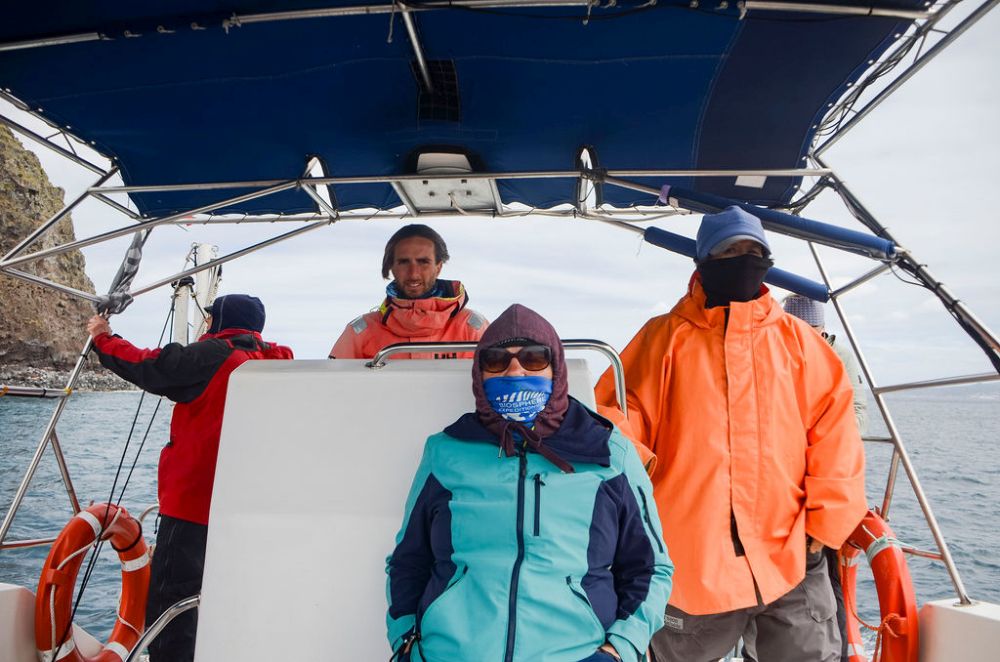
Non-slip, waterproof shoes are important too. The deck gets wet, so it gets slippery.
One of the other participants, Amí, who knows much more about outdoor wear than I do, suggests layering: thermals or long johns as the base layer, made of merino wool or synthetic, but make sure it’s quick drying and moisture wicking. Cotton would keep you warm, but stays wet. Then on top of that, the middle layer should be a fitted long-sleeve top – also moisture wicking and quick drying – and “technical pants” that fit rather snugly. Again, they need to be quick drying material.
For the outer layers, wear a medium-weight fleece with a full-zip front and a hood, with a rain jacket over that. And add rain pants too, preferably the kind with 3-layer waterproof protection. Amí said she brought the 2-layer kind, which worked for occasional spray, but eventually the water soaked through. She also suggests full-cushion wool socks, but I wore my everyday cotton socks inside waterproof boat shoes and that worked well.
You don’t need to pack your whole wardrobe, though. Two sets of clothes for sea days and two or three for land days would be enough, plus underwear and pajamas. Wear the heaviest things and the largest shoes on the plane and you can still travel carry-on only, as I did on this trip. We used the washers and dryers in the guesthouse to rinse and dry our outerwear, and no one sees what you’re wearing underneath it anyway. Bring two pairs of shoes: non-slip for the boat, and regular walking shoes for the rest of the time.
The expedition information emphasizes bringing meds for seasickness. Take that seriously! About half of our group got sick at least once, but all but one were able to alter the dosage or active ingredient and felt better by the second or third sea day. Be aware that you will not be brought back to land if you’re sick, unless it’s a real emergency. If you’re seasick, you’ll just have to endure it for the whole day.
Accommodations before and after the expedition
Since the expedition’s first day starts in the morning, you’ll need accommodations for at least the night before it starts. I stayed at a guesthouse called Casa da Baía, right in the center of the capital, Horta, overlooking the harbor. It was very comfortable and perfectly clean, with friendly staff and a good breakfast. You’ll find plenty more places to stay in Horta, which gets a lot of visitors over the summer but not so many in this off-season period.
Being flexible
The schedule for sea or land days, meals and everything else can change based on the weather or other circumstances. If someone suffering from seasickness can’t carry out their assigned task, you might need to take it over. Unless you come with a partner or friend, you might need to share a room with a stranger (of the same gender). It’s an intense experience and you’ll be interacting with the other participants for the duration of the expedition. Do your best to be flexible and generally agreeable.
Having said that, this isn’t like a group tour where all sorts of people, including really annoying and demanding types, might be taking part. These citizen scientists, while from diverse places, ages and experiences, are united in why they are taking part. It practically guarantees that your interactions will be pleasant and you might form some real friendships.
About Faial Island
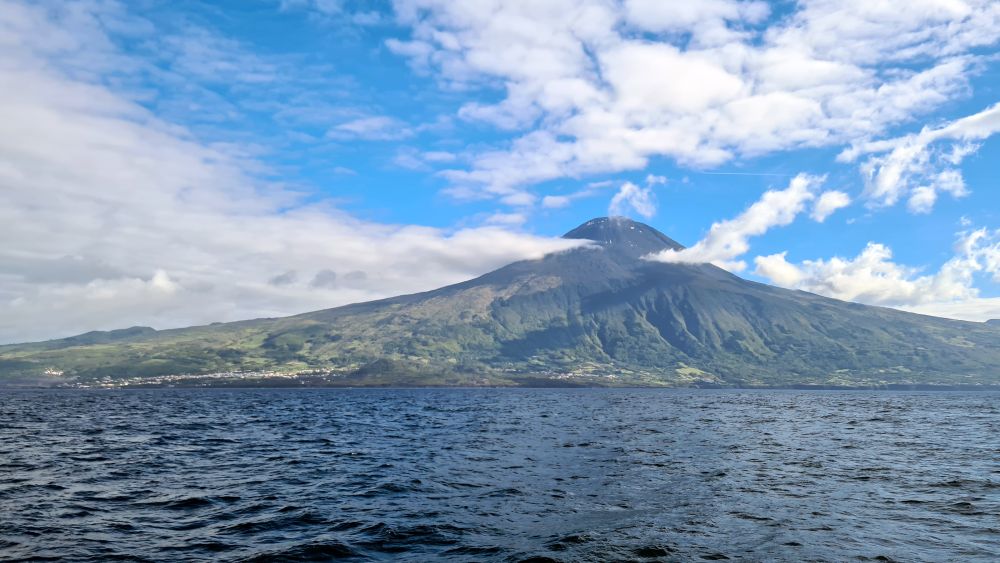
The mistake I made – besides the lack of waterproof trousers – was not to schedule extra days in the Azores. It’s such a beautiful place, but I only had my one free day to see Faial Island. I saw Pico Island from the boat and, more distantly, São Jorge Island. The other islands in the archipelago are further away. I would have liked to spend more days so I could see more of them properly.
Horta, the biggest town on Faial Island, has a charming seaside vibe. The houses are made of the dark volcanic rock that forms the island, usually covered with plaster and painted in white or pastels. The streets and sidewalks are remarkably clean and well-kept. Clearly the locals take pride in what they produce locally, whether that is handicrafts or food. That means Horta is home to some great restaurants serving local beef or lamb, locally-produced cheese, and freshly-caught fish. And, by the way, all of the fish caught in the Azores is line-caught, not taken by trawlers.
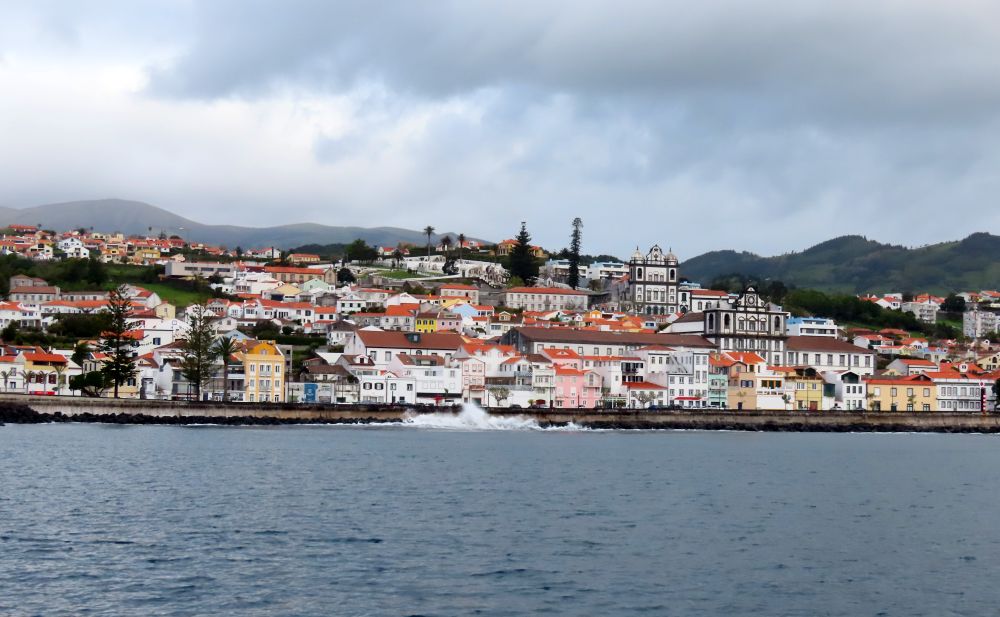
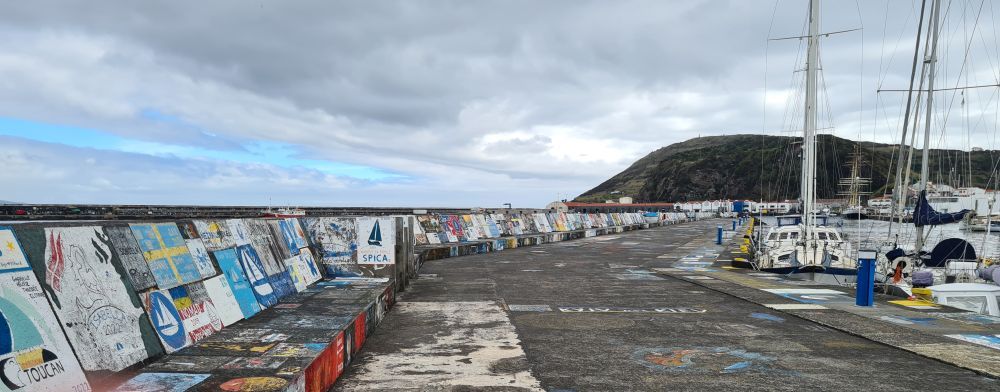
In contrast to the tidiness of the city’s streets, the concrete walls that surround the harbor appear, at first sight, to be covered with graffiti. In fact, these painted patches are mementos of the various ships that have arrived here. Take a walk along the pier and see how many different countries they represent.
Make time to see some of Faial Island’s museums while you’re there. I saw the Capelinhos Volcano Interpretation Centre at the “new volcano,” a caldera created by a 1957-58 eruption at the western tip of the island. It covers both that eruption and the volcanic origins of all the islands. In Horta town, I visited the Porto Pim Whaling Station Museum. It’s housed in the building where, in the 20th century, the whale carcasses were processed into lubricating oil and fertilizer. The history is fascinating, but be warned: the film about how whales were killed and processed is pretty gory.
I didn’t get a chance to see the other two museums in town: the Horta Museum covers both the work of local artists and the history of the island. The Scrimshaw Museum, upstairs above Peter Cafe Sport, has a collection of skillfully-engraved whale bones and teeth.
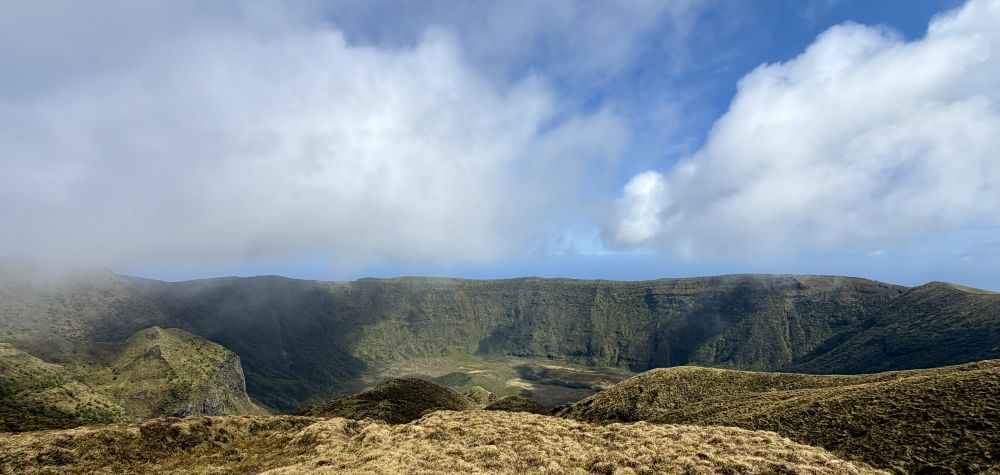
In the center of the island is a large volcanic mountain with a deep crater. You can drive up to a parking lot just under its edge. From there, walk through a short tunnel to a lookout point with railings, where you can see down into the crater. Your other option is to climb a short stairway to the very edge and walk a path around the crater. Be careful, though: it’s windy up there, and much of the path has no railing at all.
Pick up information about Faial Island at the glass-sided visitor information office in a tree-shaded square right on the harbor. Especially if you take a day to drive around the island, their maps will come in handy. You’ll want a whole day because there are lots of places to stop for views over the island and/or the sea.
Getting there
The only way to get to the Azores is to fly, unless you happen to own an ocean-going boat of your own. You can fly to the capital at Ponta Delgado on São Miguel Island, then fly from there to Horta on Failal in about an hour. The other route is to fly to Lisbon in Portugal and from there to Horta, which takes about three hours. There’s a ferry line as well, but it only connects Faial to the two closest islands: Pico and São Jorge. The others are just too far away to make a ferry route profitable.
My thoughts on returning home
All of that rocking and rolling on the waves was exhausting. My hands hurt from gripping the rails so tightly. I had bruises from the times a sudden movement took me by surprise and I banged up against the railing. My leg and arm muscles ached from standing at the railings, bending and leaning to compensate for the boat’s irregular movements: riding up the swelling waves and clunking down into the valleys between them. I got very few pictures because of having to hang on with one hand and operate the camera with the other – and only very quickly because one hand was generally not enough to stay standing.
Do I regret going on this expedition? Not at all! Despite my discomfort, being on that little boat on the open sea was exhilarating. It felt like a great adventure, with the bonus of actually contributing in a small way to a very large-scale and long-term citizen-science project. I made some new friends, enjoyed breathing in the clean sea air for a week and a half, and, of course, I got to see lots of whales and dolphins. Definitely worth the time and money.
Are you considering going on one of the Biosphere Expeditions projects? What attracts you? What worries you? Add your thoughts below!
My travel recommendations
Planning travel
- Skyscanner is where I always start my flight searches.
- Booking.com is the company I use most for finding accommodations. If you prefer, Expedia offers more or less the same.
- Discover Cars offers an easy way to compare prices from all of the major car-rental companies in one place.
- Use Viator or GetYourGuide to find walking tours, day tours, airport pickups, city cards, tickets and whatever else you need at your destination.
- GetTransfer is the place to book your airport-to-hotel transfers (and vice-versa). It’s so reassuring to have this all set up and paid for ahead of time, rather than having to make decisions after a long, tiring flight!
- Buy a GoCity Pass when you’re planning to do a lot of sightseeing on a city trip. It can save you a lot on admissions to museums and other attractions in big cities like New York and Amsterdam.
- Ferryhopper is a convenient way to book ferries ahead of time. They cover ferry bookings in 33 different countries at last count.
- I’ve become an affiliate for VisitorsCoverage travel insurance, mostly because you should ALWAYS have travel insurance when you travel! You may be young and healthy and never get sick, but the fact is, sh*t happens, and it’s worse if you don’t have insurance!
Other travel-related items
- Get an e-sim! It’s really awkward to have to rely on WIFI when you travel overseas. An e-sim is a great alternative to paying high roaming fees for your home provider. Both GigSky and Holafly have worked well for me, so it’s worth comparing them. Holafly offers unlimited data, but if you won’t use that much, GigSky might be more cost-effective. For both companies, I’ve sometimes needed help from their customer service to get the e-sim working, but both companies have great customer service, so it wasn’t a big deal. Download either of their apps and activate it when you need it.
- Another option is a portable wifi modem by WifiCandy. It supports up to 8 devices and you just carry it along in your pocket or bag! If you’re traveling with a family or group, it might end up cheaper to use than an e-sim. Use the code RACHELSRUMINATIONS for a 10% discount.
- I’m a fan of SCOTTeVEST’s jackets and vests because when I wear one, I don’t have to carry a handbag. I feel like all my stuff is safer when I travel because it’s in inside pockets close to my body.

Rachel Heller is a writer living in Groningen, the Netherlands. She is the owner and primary author of this website, Rachel’s Ruminations, a travel blog focused on independent travel with an emphasis on cultural and historical sites/sights. Read more here about her and about this website. All photos in her articles are her own, unless otherwise specified. Rachel also owns and operates a website about World Heritage travel.
It was so great to share this experience with you Rachel! Fantastic article.
Thanks!