

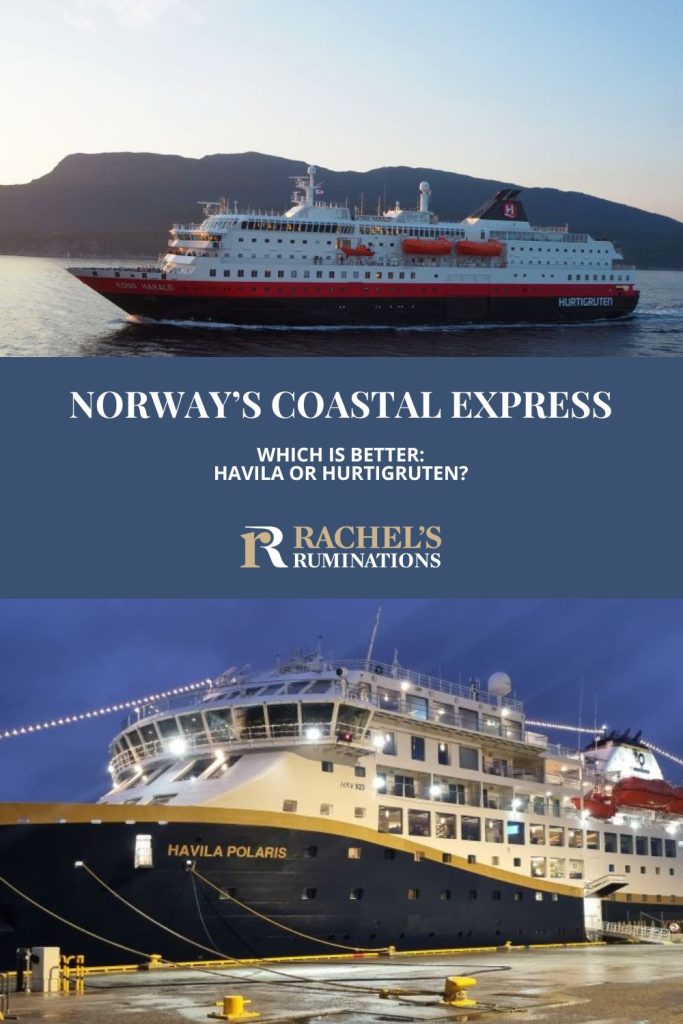
Havila vs Hurtigruten on the Norway coastal route: Which is better?


I’ve experienced two trips up the coast of Norway – one on a Hurtigruten ship and one on a Havila Voyages ship. I greatly enjoyed them both, and the Norwegian coastline is absolutely gorgeous, no matter the season. I just came back from the Havila trip, and I’d go again in a heartbeat. Now, though, I think it’s time to answer the question I’m getting from anyone who hears I’ve done both. Which is better: Hurtigruten or Havila?
Disclosure: This article contains affiliate links. Making a purchase through an affiliate link will mean a small commission for this website. This will not affect your price. Privacy policy.
And another disclosure: For the Hurtigruten cruise, the company sponsored my husband and me to the extent that we got a press discount. On the Havila voyage, we were fully sponsored. Nevertheless, all opinions are my own and neither company has any influence over what I choose to write.
Hurtigruten and Havila both ply the Norwegian coastal route from Bergen in the south all the way to Kirkenes in the far north. They stop at 34 coastal towns along the way, and deliver cargo and passengers between them: a necessary service, especially in the harsh winters in the north. At the same time, they operate as cruise lines, carrying tourists along with the cargo.
Hurtigruten has been doing this the longest: about 130 years. Havila’s first coastal voyage was in 2021, so for the first time, Hurtigruten has competition.
In 2019, my husband and I took the one-week Hurtigruten northward cruise in July. We took the Havila northward cruise in December 2025. Despite the different seasons, I can still compare the ships, the cabins, the food, and everything about the onboard experience.
Read my review of the Hurtigruten cruise and my review of the Havila trip.
TL;DR
I loved both. I did notice some differences that make me prefer Havila over Hurtigruten.
How are Hurtigruten and Havila similar?
The Norwegian Coastal Express route
Both fleets travel the same route in a 12-day round-trip journey. I’m not sure why it’s called an express; it’s not fast, taking a week, more or less, in each direction. Both stop at the same ports along the way, from Bergen up to Kirkenes and back. At the bigger towns, the stop is long enough to get out and have a look around, but most stops are very quick.
Hurtigruten offers two additional routes as well. The North Cape Line is essentially the same, but leaves from either Oslo or Hamburg and turns around at the northernmost point of Norway at the town of Honningsvåg. The Hamburg routes are operated entirely in German.
The other voyage Hurtigruten offers is Bergen to Honningsvåg, but instead of continuing to Kirkenes, it goes on to the Arctic island of Svalbard, making two stops there.
In the past, Hurtigruten operated expedition voyages as well, to places like Greenland and Iceland, but not anymore. It recently split off its excursion business to become a separately-branded enterprise called HX Expeditions, though both are still part of Hurtigruten Group.
A side-by-side comparison of the ships
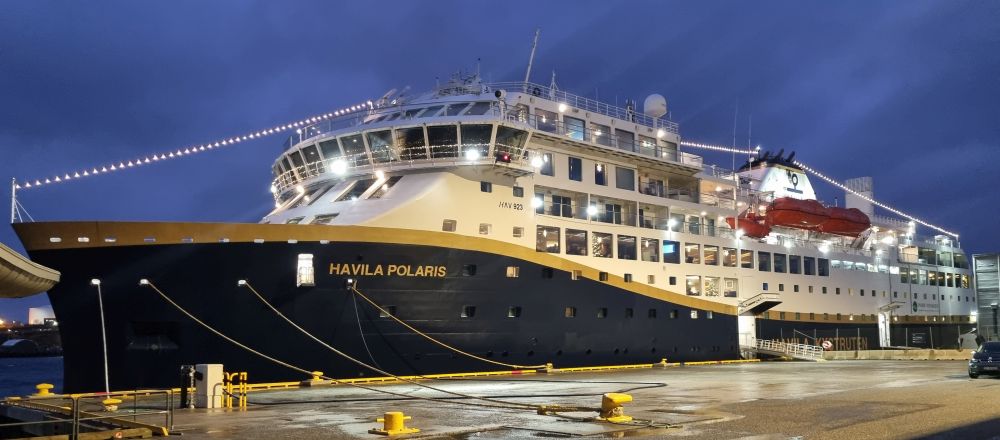
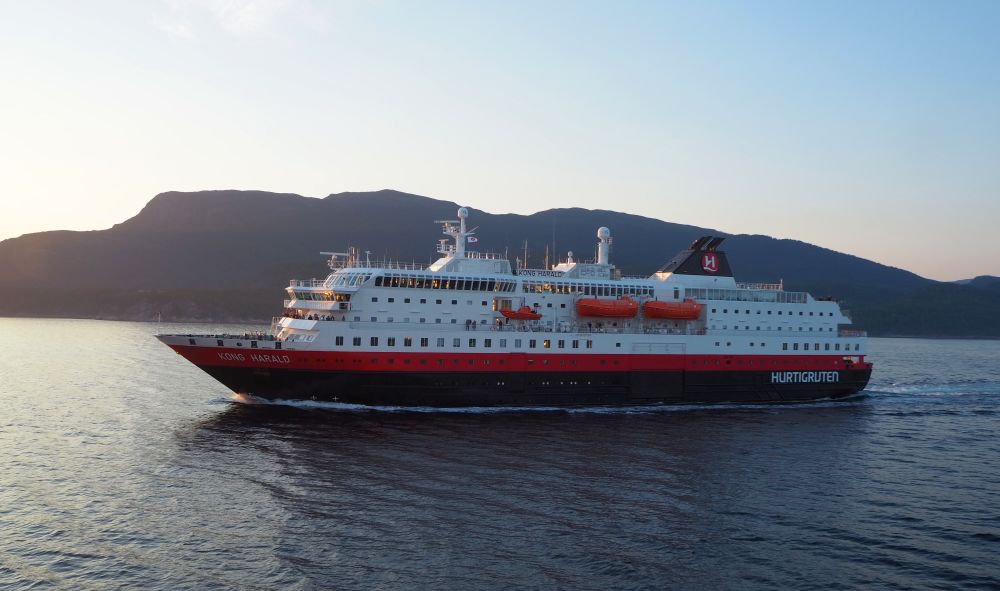
So far, Havila has four ships, while Hurtigruten has ten. I’ve only been on one of each: the Havila Polaris and the Hurtigruten Nordnorge.
Nevertheless, I think I can draw some general conclusions about their similarities. It seems easiest to present them in table form.
| Havila | Hurtigruten | |
|---|---|---|
| Age of ships | First built and sailed between 2021 and 2023. | Built between 1983 and 2003. Last refurbished between 2020 and 2025. |
| Hybrid | All 4 ships | 4 of the 10 ships |
| Capacity | 640 passengers | 490-650 passengers |
| Décor | Understated Norwegian-inspired décor: lots of wood and earth tones. | |
| Gym | Yes | Yes |
| Sauna | Yes | Yes, except for the Vesterålen. |
| Hot tubs | Yes | Yes, in 6 of the 10 ships. |
| Pool | No | Only on the Finnmarken. |
| Restaurants | 1 main (included), 1 fine dining (extra charge), 1 café. | 1 main (included), 1 fine dining (extra charge), 1 café (no fine dining restaurant on Vesterålen). |
| Meals | Emphasize locally-sourced, fresh produce; consistently excellent quality. | |
| Service | Excellent and professional on both. | |
| Cabins | Range from basic, ferry-cabin-like inside cabins to large, roomy suites. Hurtigruten has more different choices within the range (See below). | |
| Laundry room for passenger use | Yes | Yes, except on the Vesterålen. |
| Northern Lights guarantee | Yes | |
| Northern Lights alarm | Yes | |
| Excursions | Very similar offerings on both, with similar pricing. | |
| Pricing | Havila is generally cheaper, but Hurtigruten offers more choices because of the wider variety of ships and cabins. | |
How are Havila and Hurtigruten different?
Despite how similar our two experiences were, there are some key differences: the location of the promenade deck, the cabin sizes, and each company’s approach to sustainability.
The promenade deck
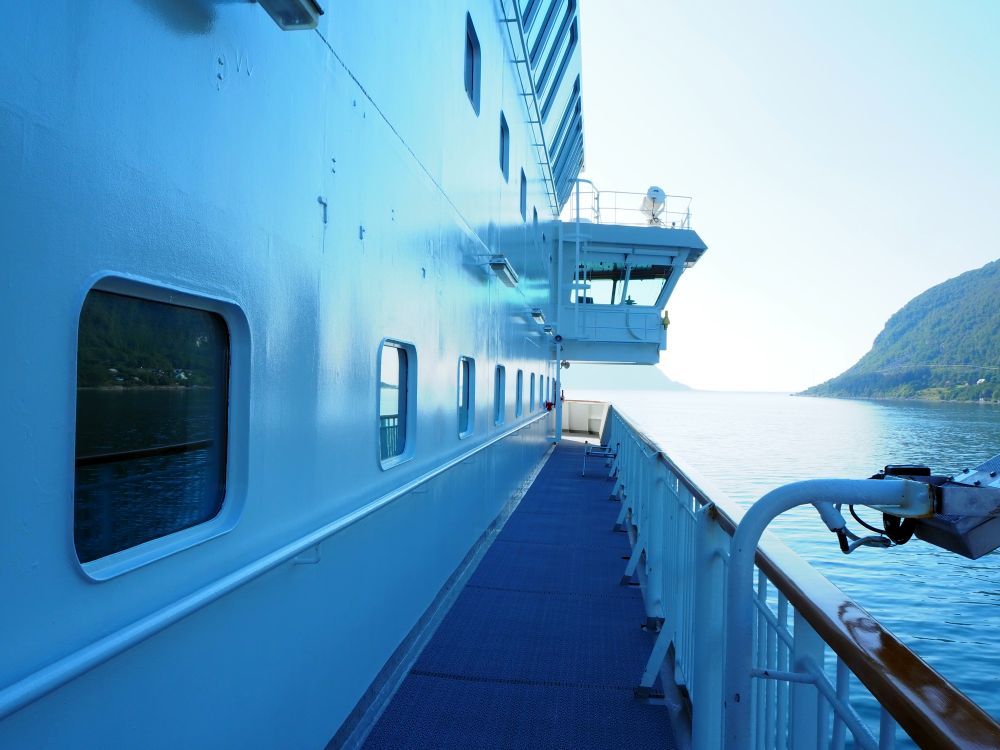
This is the least important of the differences I noticed. On the Hurtigruten ships, the promenade deck – the only part of the ship where you can walk outside around the entire perimeter of the ship – is on Deck 5 or 6. The only exception is their smallest ship, the Vesterålen, which, as far as I can figure out, has no promenade deck.
Normally, I wouldn’t have noticed any problem with having the promenade walkway around a middle level of the ship. The advantage of this placement is that the ship blocks the wind in some places. The problem is that the walkway passes right by cabin windows. On our Hurtigruten voyage in the middle of the summer, our cabin was on Deck 5 of the Nordnorge, where the promenade walkway was. This wasn’t a problem for us; we spent very little time there, and we just closed the curtains as needed. However, I would guess that it might feel less comfortable during a winter voyage when it’s dark so much of the time. Check, if you book a Hurtigruten trip, that your cabin does not look out on the promenade deck.
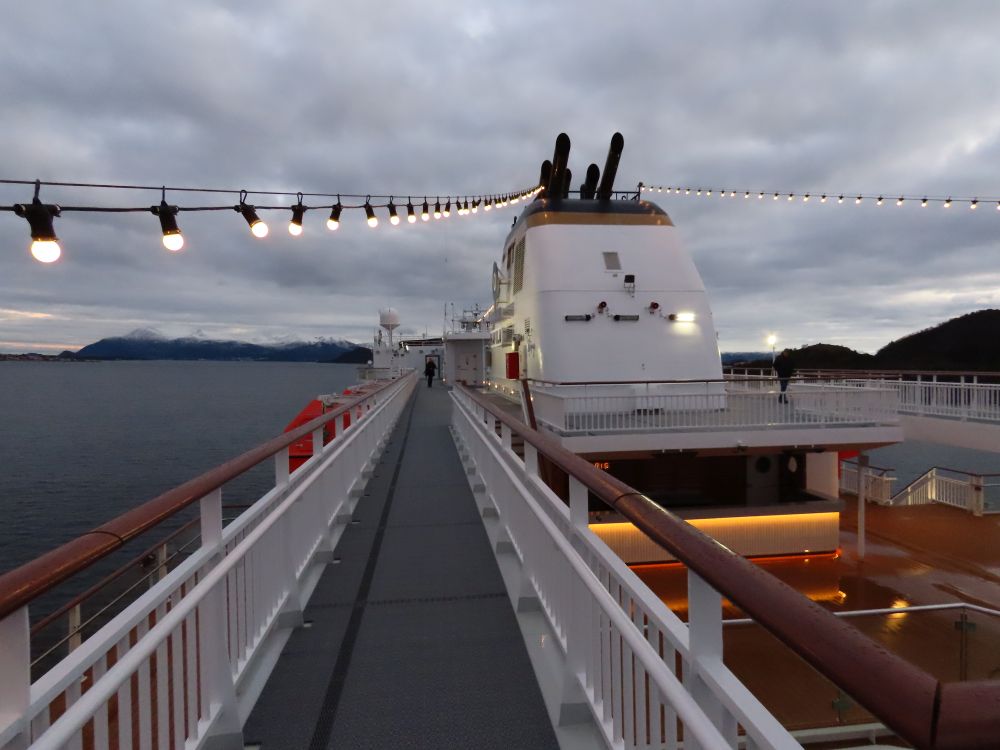
By contrast, the promenade deck on the Havila ships is at the very top, on Deck 9, where there are no cabins. I liked this location because I felt like I was so much higher up that I could see further, and there was nothing blocking my view when I saw the Northern Lights. It does mean that it’s windier up there as you walk.

The Deck 9 walkway on the Havila Polaris. The Deck 5 walkway on the Hurtigruten Nordnorge.
Cabins
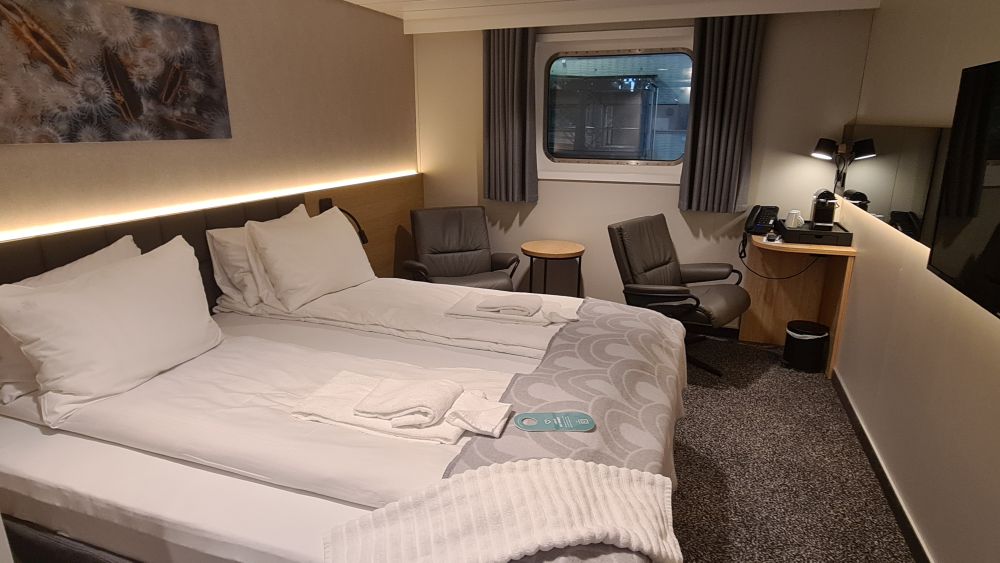
A more important difference is the size of the cabins. Our cabin on the Havila Polaris was distinctly bigger than our cabin on the Hurtigruten Nordnorge. I wasn’t sure, though, if perhaps they were a different “class” of cabin, so I did a deep dive into Hurtigruten’s website to see their range of cabins.
It turns out that on both ships, we had the same “class” of cabin: one step down from the premium cabins (a variety of suites, junior suites, and mini-suites). They were both outside cabins with one window on deck 5. Both cabins had good storage space, with lighting and outlets on both sides of the bed. Both had tea-making equipment and a tv with similar channels. I liked the understated décor in both, with good blackout blinds. The shampoo and conditioner provided in pump bottles in the showers were good quality. And both cabins were spotlessly clean.
However, our “Arctic Superior” cabin on the Hurtigruten Nordnorge measured 11 m2 (118 ft2). The “Seaview Superior” cabin on the Havila Polaris is 15-16 m2 (161-172 ft2). Despite holding a king-size bed, it offered distinctly more room to move around – no sliding sideways to get past the bed on the Havila ship. Not all Seaview Superior cabins have a king-size bed; some have a queen or double or twin beds, but they’re all in the same 15-16 m2 range.
The Hurtigruten bathroom was smaller too: the kind you see on ferries, with the shower in a corner, while the Havila bathroom was roomier.

Havila’s Seaview Superior. Hurtigruten’s Arctic Superior.

I’m ignoring the suites, which vary greatly in size and configuration on both fleets, and accessible cabins, which are larger than regular ones. Looking at just the standard types and, in the case of Hurtigruten, showing the range of sizes across all ten ships, here is a direct comparison, using their own names for the cabins:
| Havila cabin types and sizes | Hurtigruten cabin types and sizes |
|---|---|
| Seaview Superior: 15-16 m2. | Arctic Superior: 8-12 m2. |
| n/a | Arctic Superior large double (only on Trollfjord, Midnatsol and Nordnorge): 16-24 m2. |
| n/a | Polar Outside: 7-13 m2. |
| Interior: 8-10 m2. | Polar Inside: 7-13 m2. |
Clearly the interior cabins are pretty much the same, but the top end of the non-suite cabins are bigger on Havila.
On both fleets, some cabins in all classes can house three or four people, but that doesn’t mean they are bigger cabins. Adding people usually involves either a bunk that folds from a wall or a sofa bed. In general, if you’re a light sleeper, opt for a cabin higher up in the boat, since loading and unloading cargo can involve some thumping and noise. Choose an interior cabin on a lower level and near the center of the ship if you get seasick easily.
Prices vary even within each class of cabin on both fleets, depending on things like location within the ship, configuration of the space, whether the view is obstructed or not, number of beds and their sizes, and number of people in the cabin. However, at least as of this writing, Hurtigruten is generally more expensive. If you’re thinking of booking one or the other, though, it’s worth checking both and watching any discounts they’re offering. And if you’re considering a Hurtigruten voyage, look at the Polar Outside as an alternative to the Arctic Superior.
Sustainability
Sustainability is clearly an important aspect of the competition between Havila and Hurtigruten, both of which have made it a focus of their operations, especially when you compare them to traditional cruise lines.
The race toward zero-emissions travel
Both coastal Norway route companies are working toward a goal of zero emissions. The Norwegian government sets a maximum emissions standard each time the contract is renewed, but both companies are, I think, well aware that that emissions standard will continue to get stricter.
Hurtigruten and Havila say that their hull designs reduce drag and that their systems have increased efficiency to reduce power usage.
Four of Hurtigruten’s current fleet (the Finnmarken, the Kong Harald, the Nordlys, and the Richard With) are hybrid ships, with plans to convert more in future. These operate on a combination of diesel and battery packs, charged when they are docked. All of their ships plug in at the longer dock stops, so for the period of time that they sit in harbors they produce no emissions. The energy from the charging stations comes mostly from hydropower.
All of Havila’s four ships are hybrids, operating on a combination of LNG (liquefied natural gas) and battery packs. They charge the battery packs at the docks too, also mostly from hydropower. They say that they can cruise for four hours using the on-board batteries alone with zero emissions.
Hurtigruten’s fuel
Hurtigruten uses diesel, but has begun mixing diesel with biodiesel, a renewable fuel. Biodiesel produces significantly lower CO2 emissions than fossil fuels, a reduction of between 40% and 69% (Source).
Biodiesel is produced mostly from vegetable oils. In other words, crops are grown specifically for biodiesel production. The crops absorb carbon dioxide from the atmosphere as they grow. However, the CO2 re-enters the atmosphere when the biodiesel is used, and so do the emissions from processing and transporting it. It’s certainly better than fossil fuels, though, especially when you count the CO2 that the crops absorb. Its primary byproduct is glycerin, which, once it goes through a purification process, has a range of industrial applications.
Hurtigruten, however, says that their first fully biodiesel-fueled voyage, which happened in October 2025, used “‘HVO100’ (Hydrotreated Vegetable Oil), which is waste-based advanced biofuel” (source). If they move to this for all their ships as soon as possible, it’s a great improvement in terms of climate effects. Fuel made from waste is much better, making use of waste and allowing farmland to be used for food crops instead. The problem is ensuring a supply of waste oils, and that supply shouldn’t require high transportation costs.
Havila’s fuel
Havila’s ships, on the other hand, use Liquefied Natural Gas (LNG): a fossil fuel, but with 25% lower CO2 emissions than regular diesel (source). Havila claims, though, that the number is closer to 35% because of efficiency in their use of fuel. Like Hurtigruten, they are moving to a renewable fuel instead: biogas.
The trip I took in December 2025 on Havila was their very first Coastal Express voyage using biogas instead of LNG. Biogas comes from waste: things like manure, sewage and waste from food production. The gases that the waste would normally release into the atmosphere are captured and liquefied into biogas, which can be used with the same technology that uses LNG. In other words, Havila will not have to retrofit their ships, just as Hurtigruten can use biodiesel in their current diesel-burning systems.
Havila isn’t running their ships on biogas yet, because they don’t have the supply yet. They’re working on a series of biogas production facilities along the coast of Norway, and say that by 2028 their fleet will run entirely on biogas. At that point, they’ll be climate-neutral.
Which fuel is better?
There’s a good argument to be made that biogas is better than biodiesel. Both reduce emissions compared to traditional fuel used in shipping, but biogas costs less energy to produce, reduces waste in landfills, reduces the release of methane and carbon dioxide into the atmosphere from that waste, and also creates a natural fertilizer as its only by-product.
Biodiesel usually relies on crops planted for its production. On the other hand, if Hurtigruten manages to switch entirely over to biodiesel that’s made from waste and that requires little transportation, that changes the equation. In that case, they’ll be entirely climate-neutral as well.
In September 2025, the two companies shared the top environmental ranking by the Nature and Biodiversity Conservation Union (NABU). NABU, however, condemns cruises across the board as unsustainable, and while Havila and Hurtigruten topped the list, they still only got 7.5 of the possible 15 points in their ranking.

Future plans for fueling ships
Hurtigruten’s fleet is older, and they’re gradually upgrading the ships, with four hybrid ships to date. I don’t know a) when they’ll all be able to run on biodiesel and batteries, b) how much of that biodiesel will come from waste rather than crops, and c) how close their suppliers of the biodiesel will be to coastal Norway.
Hurtigruten has also announced that by 2030 they’ll have built a new ship with zero emissions. It’ll have huge batteries that can be charged in ports using hydropower, and it’ll be equipped with both wind and solar sails. That’s an exciting prospect, and if it works, I hope it’s something the traditional cruise lines are watching.
Havila has similar long-term plans, stating that they will have reached zero emissions by 2030 through the adoption of biogas combined with greater efficiency and other measures. It claims that once hydrogen power is “approved for commercial sailing,” they’ll convert their ships to that. It’s unclear when that can happen.
Food waste
The two companies have worked on sustainability in other aspects of their operations besides fuel. They emphasize using local ingredients from local farms and fisheries. That means their food is fresher, and using local producers reduces transportation costs too.
Hurtigruten has moved to smaller portion sizes. They collect their food waste. Then, at the Stamsund port stop, they add it to a composter, which converts it to fertilizer in 24 hours. A particular farm nearby uses the fertilizer on crops, then sells the crops back to Hurtigruten. The plan is to extend this effort to other farms along the coast.
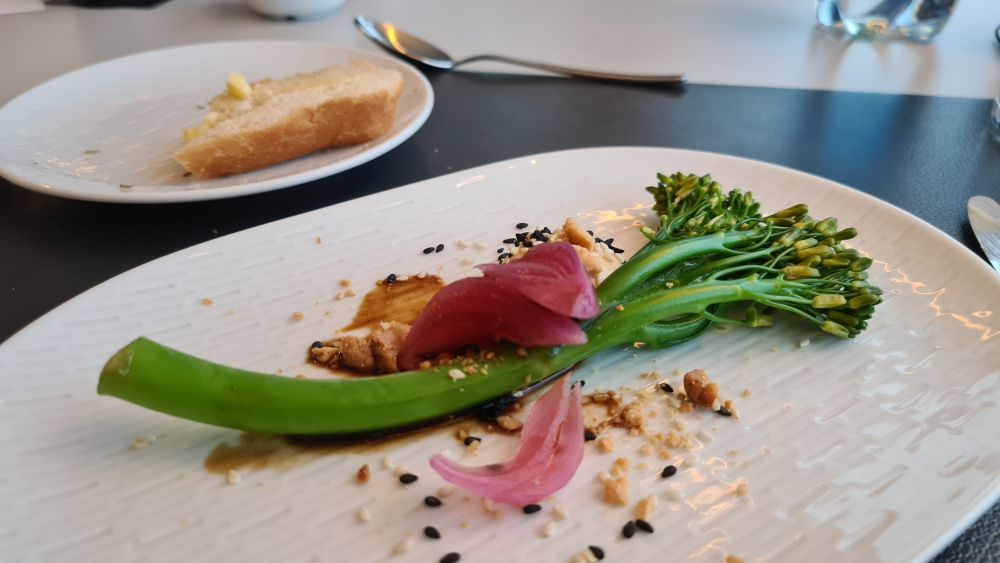
Havila does an interesting thing in its meal service to reduce food waste. All three meals each day are served from a menu, though breakfast also has a buffet. The servings are very small, and Havila encourage guests to order just what they know they’ll eat. Then, if they’re still hungry, they can order more. Besides the fact that this reduces food waste considerably (They claim it’s down below 75 grams per person per day.), I found that it made it easier to choose foods I wasn’t entirely sure of. I could try unfamiliar dishes without committing to eating (or wasting) a lot of food.
Other sustainability efforts
Both companies have reduced the use of single-use plastic. Both also use heat recovery from their engines to heat the water used in the showers and hot tubs, as well as to heat the interior spaces on the ship. In Hurtigruten’s case, the extent of these efforts will vary from ship to ship, with the four hybrid ships being the most sustainable.
Havila vs Hurtigruten: Which is better?
My preference is for Havila, but the difference isn’t huge. I enjoyed both cruises enormously. They were at different times of the year: I took the Hurtigruten in late July and the Havila in early December, so the circumstances outside the ships were very different. Even though the Hurtigruten ships are older, they refurbish them often enough that there was no difference between the two in terms of my experience of the interior, the atmosphere, and cleanliness. Service was excellent on both; so was the food.
However, in other aspects of my experience as a passenger, Havila has the edge. The ships are new and have larger cabins – at least the ones with windows – and the promenade deck is in a better place in this new design. The way they deal with reducing food waste also gets my preference: the very small portions and table service at every meal. Our cabin was on Deck 5 on both trips, and on the Havila ship I heard less of the thumping and bumping when we stopped at ports in the middle of the night, presumably because the ship is newer. And Havila is generally cheaper, at least as of this writing.
The difference is less if you book an interior cabin. On both fleets these cabins are very similar in size. And the location of the promenade won’t matter if you have an inside cabin.
Both companies are making efforts toward zero-emissions operations, and I think both are better in terms of sustainability than any other cruise out there. Within the next two or three years, I think that Havila will be ahead once it’s running its full fleet on biogas rather than LNG.
In the longer term, though, it’s less clear. I don’t know how soon hydrogen operation will be feasible, or how long it will take to convert the Havila ships to working on hydrogen.
As for Hurtigruten, it has converted four of its ships into hybrids. Will it convert the others, or just wait until 2030 when its zero-emission ship is ready? And will that just be a single ship? How long will it take for them to convert or replace the other nine ships so they produce no emissions across the whole fleet? The answers to these questions are key if your preference is for the one that is closest to zero emissions.
Havila is urging the Norwegian government to do more, saying “stricter environmental requirements should be an absolute minimum requirement in the next tender period for the coastal route” (source). I’m curious to see where they both stand when that happens, and what requirements the government sets for climate neutrality or zero emissions.
In the meantime, if you like cruise travel that’s less polluting and without the bells and whistles of most cruises, I doubt you could do better anywhere than taking a Norway coastal cruise on a Havila or Hurtigruten ship.
Is this something you’ve done? Or is it something you’re considering? Leave a comment below!
My travel recommendations
Planning travel
- Skyscanner is where I always start my flight searches.
- Booking.com is the company I use most for finding accommodations. If you prefer, Expedia offers more or less the same.
- Discover Cars offers an easy way to compare prices from all of the major car-rental companies in one place.
- Use Viator or GetYourGuide to find walking tours, day tours, airport pickups, city cards, tickets and whatever else you need at your destination.
- Bookmundi is great when you’re looking for a longer tour of a few days to a few weeks, private or with a group, pretty much anywhere in the world. Lots of different tour companies list their tours here, so you can comparison shop.
- GetTransfer is the place to book your airport-to-hotel transfers (and vice-versa). It’s so reassuring to have this all set up and paid for ahead of time, rather than having to make decisions after a long, tiring flight!
- Buy a GoCity Pass when you’re planning to do a lot of sightseeing on a city trip. It can save you a lot on admissions to museums and other attractions in big cities like New York and Amsterdam.
- Ferryhopper is a convenient way to book ferries ahead of time. They cover ferry bookings in 33 different countries at last count.
Other travel-related items
- It’s really awkward to have to rely on WIFI when you travel overseas. I’ve tried several e-sim cards, and GigSky’s e-sim was the one that was easiest to activate and use. You buy it through their app and activate it when you need it. Use the code RACHEL10 to get a 10% discount!
- Another option I just recently tried for the first time is a portable wifi modem by WifiCandy. It supports up to 8 devices and you just carry it along in your pocket or bag! If you’re traveling with a family or group, it might end up cheaper to use than an e-sim. Use the code RACHELSRUMINATIONS for a 10% discount.
- I’m a fan of SCOTTeVEST’s jackets and vests because when I wear one, I don’t have to carry a handbag. I feel like all my stuff is safer when I travel because it’s in inside pockets close to my body.
- I use ExpressVPN on my phone and laptop when I travel. It keeps me safe from hackers when I use public or hotel wifi.

Rachel Heller is a writer living in Groningen, the Netherlands. She is the owner and primary author of this website, Rachel’s Ruminations, a travel blog focused on independent travel with an emphasis on cultural and historical sites/sights. Read more here about her and about this website. All photos in her articles are her own, unless otherwise specified. Rachel also owns and operates a website about World Heritage travel.