

Herculaneum or Pompeii: Which should you visit?
You’ve undoubtedly heard of Pompeii, the Ancient Roman town in the south of Italy that was destroyed in 79 AD when Mount Vesuvius erupted and, at the same time, wonderfully preserved. It’s one of the most visited historical sites in Italy.
Mount Vesuvius’ violent eruption destroyed more than the town of Pompeii, though. The town of Herculaneum, between the modern town of Pompei and the city of Naples, was a small fishing and resort town on a promontory overlooking the sea, with a population of about 4,000. The Vesuvius eruption destroyed it and preserved it similarly to Pompeii. Only partially excavated because of the city that later grew on top of it, Herculaneum is just as worth visiting as Pompeii, with the added benefit of somewhat fewer tourists.
No time to read this now? Pin the image below for later!
Disclosure: This article contains affiliate links. Making a purchase through an affiliate link will mean a small commission for this website. This will not affect your price. Privacy policy.
TL;DR
I’m not going to give a definitive answer to the question in the title because it depends on where your interests lie. Instead, I’ll share my impressions of both and then point out their similarities and differences. Hopefully, it will help you decide which you should visit, or whether you should take the time to visit both. At the end are some tips for visiting either one.
What happened to Herculaneum and Pompei when Mount Vesuvius erupted?
Herculaneum was hit by the volcanic eruption somewhat differently from how Pompeii was hit.
Pompeii
In Pompeii’s case, the city first suffered a rain of pumice stones that lasted for almost a day, according to Wikipedia. Many buildings collapsed, killing some inhabitants, but most Pompeiians escaped.
A second eruption then sent out a blast of very high heat called a pyroclastic flow. Pyroclastic flows involve extremely hot clouds of ash, plus volcanic matter, i.e. lava, moving extremely quickly. Anyone who hadn’t fled yet was killed instantly. In Pompeii, about a thousand people died, as far as archeologists have found so far, from a pre-eruption population of somewhere in the range of 10-20,000.
Herculaneum
The people of Herculaneum, on the other hand, saw that first eruption, but the wind blew it the other way. A layer of ash descended on them, but not the pumice rain, so their homes were mostly intact at this point. The residents ran down to the beach to flee by boat. They took their most precious possessions with them: jewelry, coins and other small articles, and waited for rescue in the arches at the base of the cliff, normally used as warehouses or to store boats.
Some managed to escape – the Imperial Navy, led by the Admiral Pliny the Elder, sent out boats to pick up the stranded population. Pliny the Elder himself died in the course of this evacuation mission.
The rest, though, were hit by the same pyroclastic flow from the volcano that killed the remaining Pompeii residents. According to Herculaneum’s official website, the gases reached a temperature of around 400 °C (752°F) and moved at over 80 km (50 mi) per hour. Three hundred people died instantly in Herculaneum as they sheltered inside nine of the 12 vaulted rooms that lined the beach.
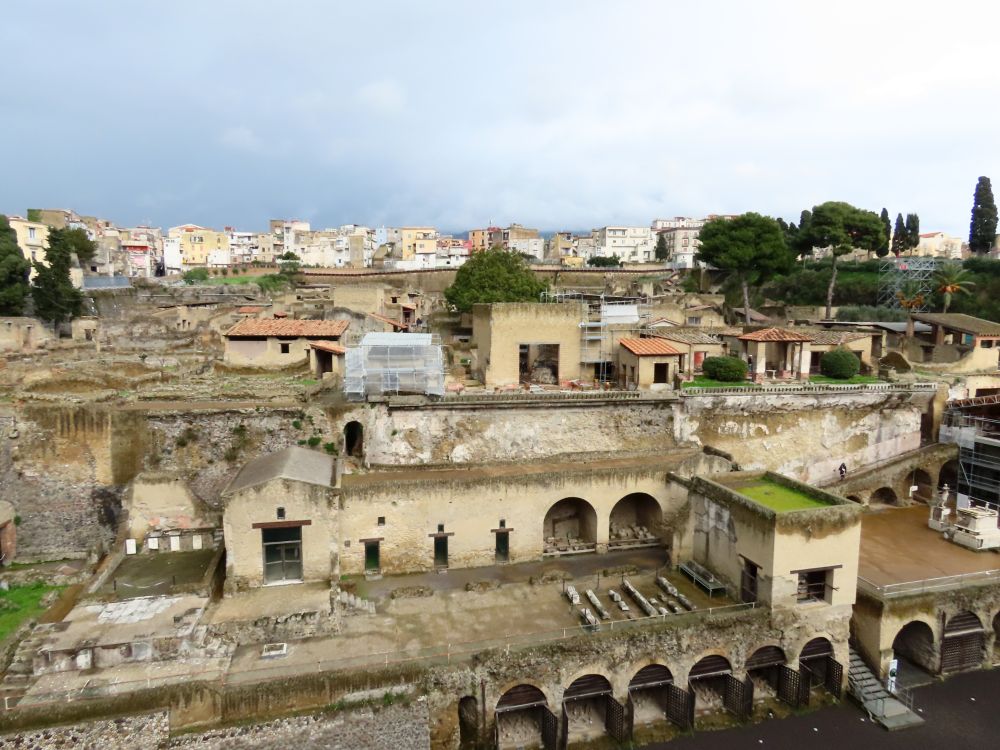
They were right, in a way, to choose these vaulted rooms to await rescue. They were (and are) arches made of stone, and survived the eruption intact. These people couldn’t know that the blast of heat would follow that would kill them instantly. And they couldn’t know that they, the arched vaults, the whole town and the whole coast of the area would then be swallowed up in volcanic matter 20 meters (66 feet) deep.
Today, those vaulted rooms have been cleared of the hardened volcanic material to expose the skeletons, some sitting, leaning against the walls; some lying on the ground. It’s a sad and moving moment to walk along the row of arches and see that the floor of each one is covered in skeletons.
This beach, where these vaulted rooms are, is no longer a beach. Vesuvius released so much volcanic mud that it changed the coastline, adding a 400-meter-wide (1,300 feet) strip of land.
The end result is that Herculaneum is better preserved: archeologists have found wooden objects like furniture and a wooden boat, as well as organic items like plants and food. They’re carbonized, but still intact. The foodstuffs that survived have allowed researchers to learn all sorts of things about life in these towns. The buildings in Herculaneum saw less damage than Pompeii’s, with more intact frescoes, and some of the buildings still have remnants of their upper floors.
Visiting Herculaneum
What is Herculaneum like today?
The vaulted rooms are below the town of Herculaneum itself, which stands above them on the flat top of a cliff. Excavations are still ongoing, though they’re limited by the city that crowds around the site.
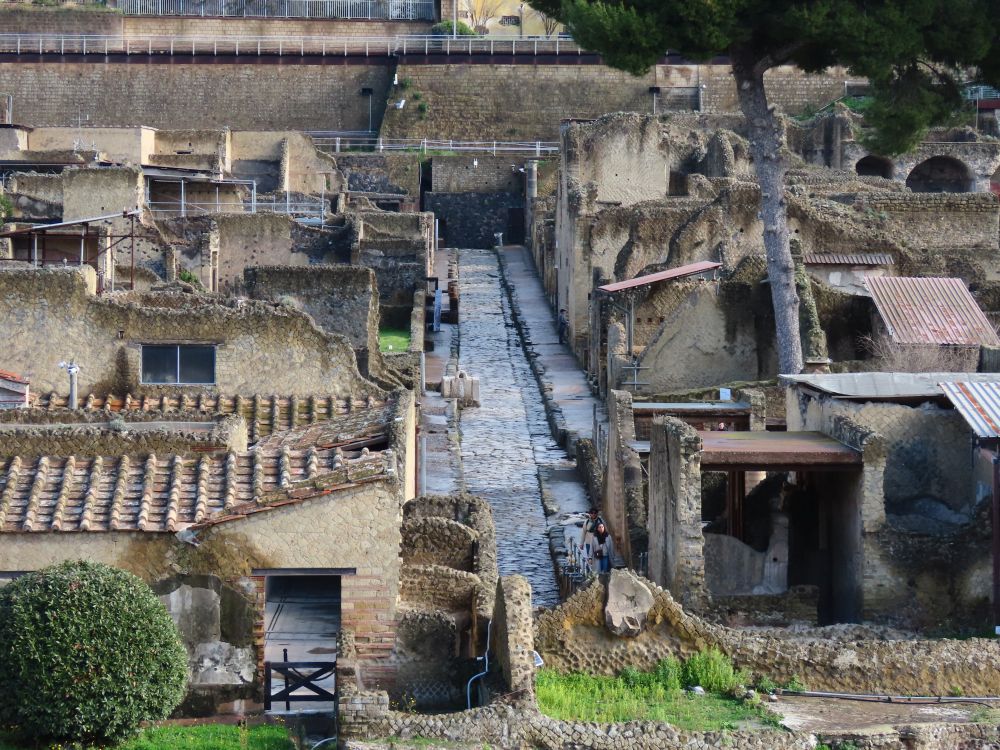
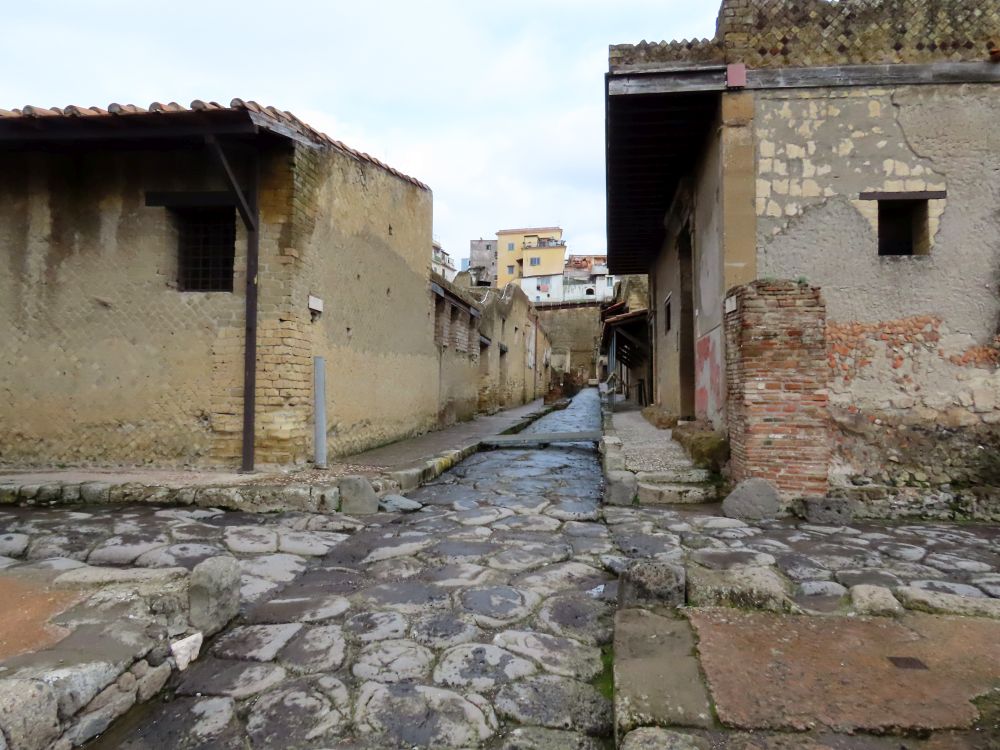
From a distance, Herculaneum looks like a small village of low houses with metal or red-tile roofs. As you approach on foot, you realize that many of the houses are roofless, but the streets are narrow and straight, with sidewalks, neatly paved.
What is there to see in Herculaneum?
This was a prosperous town, perched on a plateau above the sea. Many of the buildings were shops. In one section, the shops were modest and had living quarters above them. In other parts, the houses were larger, with a central open-air courtyard or an atrium with a smaller opening in the roof that allowed water to fall into a central shallow pool. These houses often also had shops or warehouses attached, but clearly the merchant was more prosperous.
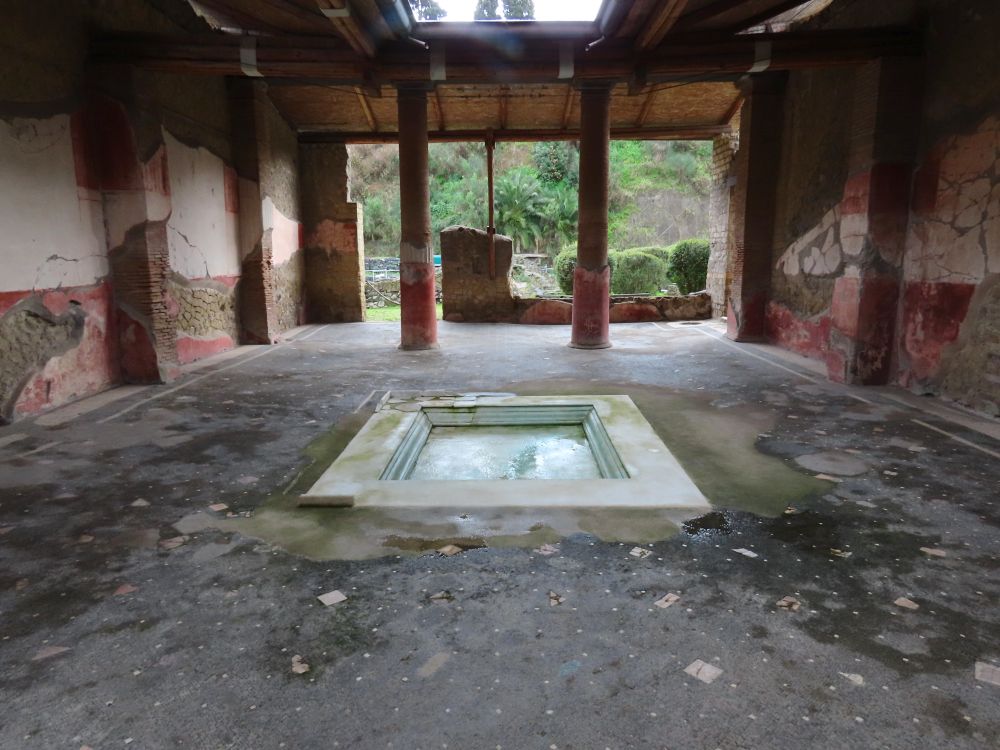
At the same time, Herculaneum may have been a seaside town where wealthy Romans vacationed, judging by the expensive décor in some of the larger houses, and how their houses included terraces and gardens overlooking the sea.
Find accommodations near Herculaneum.
Keep in mind that the original town was, it is estimated, about 20 hectares (50 acres) in size. Only about a quarter of that has been excavated. What you can see today is the residential and shopping area of the town, not the public areas like temples, markets and administrative buildings. These are still mostly still buried. The public baths, however, have been excavated.
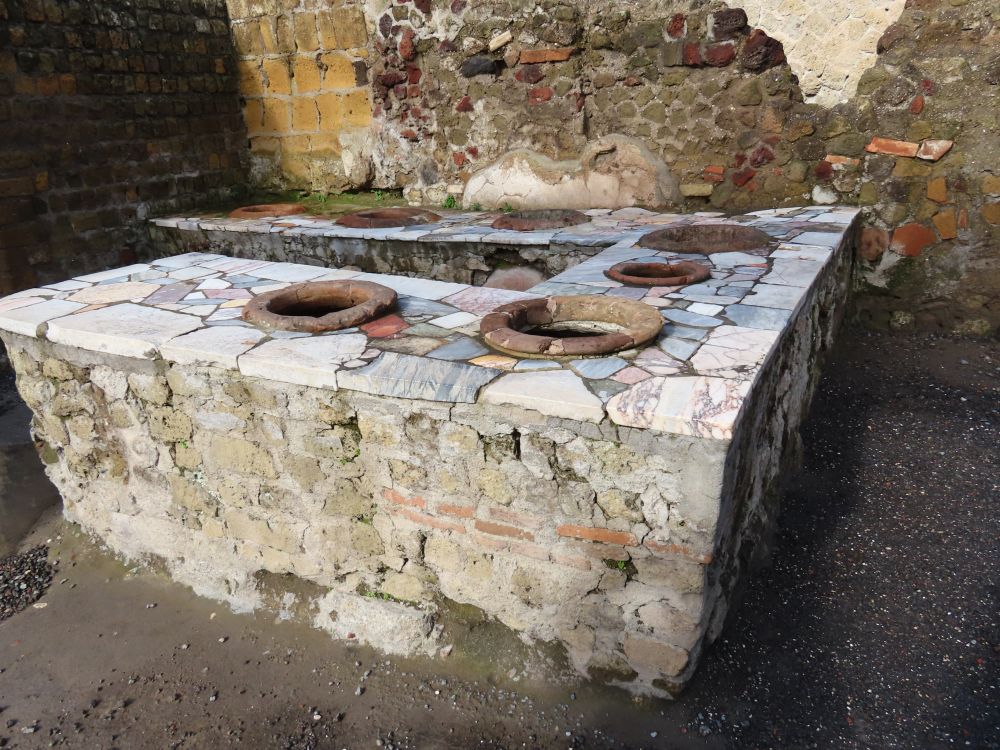
As a modern-day visitor, you can stroll those streets or sidewalks, walking on the original Roman-era stone pavement – in better condition than some of the modern streets nearby. You can enter many of the houses as well.
Most of the interiors had plaster-covered walls, sometimes painted with frescos. Wisely, the caretakers of the site have covered the best of these with new roofs in the style of the originals, protecting the remaining plaster and frescoes from the elements.
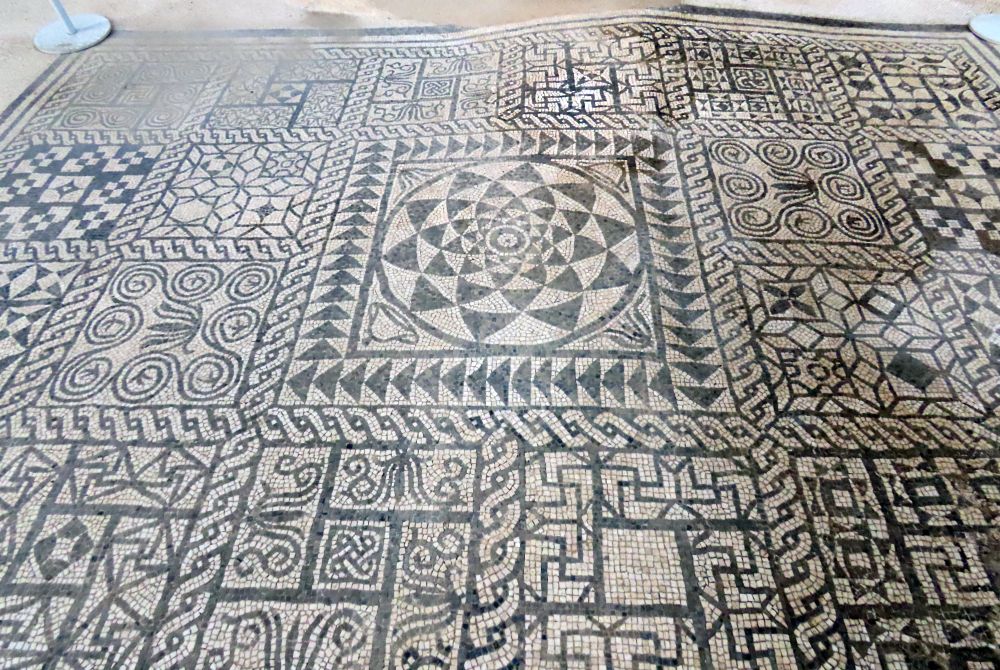
Like the frescoes, the mosaics that covered the floors come in various styles. I don’t know the names of them all, but I’ve never seen such large mosaics in such good shape as some of these. Many are quite plain: white, with perhaps a stripe or two around the edges. Some, though, had simple repeating patterns of black tiles among the white, or vice versa: black with occasional white tiles.
Since there are frescoes and mosaics at both sites, I’ll give more detail below when I compare them.
It surprised me that within many of the houses, visitors are allowed to walk on the mosaic floors. The most ornate, of course, remain roped off for their protection. I suppose if you’re operating a site with so many intact mosaic floors, you don’t worry about protecting the plainer ones.
Other things to see at Herculaneum
The Boat Pavilion: Next to the main entrance to Herculaneum, before you descend to the excavated town, stop into the modern Boat Pavilion, where an excavated boat is on display. It’s a rowboat 9 meters (29.5 ft) long, meant for three rowers. This may have been a rescue boat; alongside it, archeologists found the skeletons of a possible rower and a soldier. They believe he was a soldier because of the belt, swords and coins found with him, working for the Imperial Navy to evacuate people. The rower and soldier died in the heat blast at the same time as the people waiting in the arches.
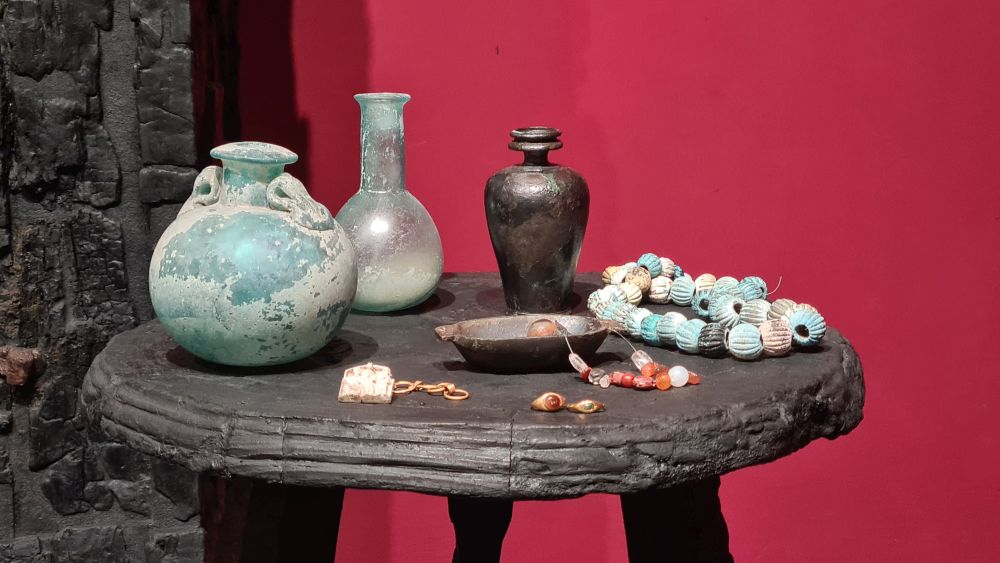
The Antiquarium: This is right next to the Boat Pavilion and holds some artifacts from Herculaneum, though many more are on display at the archeological museum in Naples. It’s worth taking a look, though. Here you can see some of the wooden furniture – charred, but intact. And you’ll see various other items of everyday life: ceramics, glass, metal tools, and so on. Most moving, though, is the collection of possessions – jewelry, small tools, and other valuable objects – found with the 300 town residents who died in the vaulted rooms.
Visiting Pompeii
What is Pompeii like today?
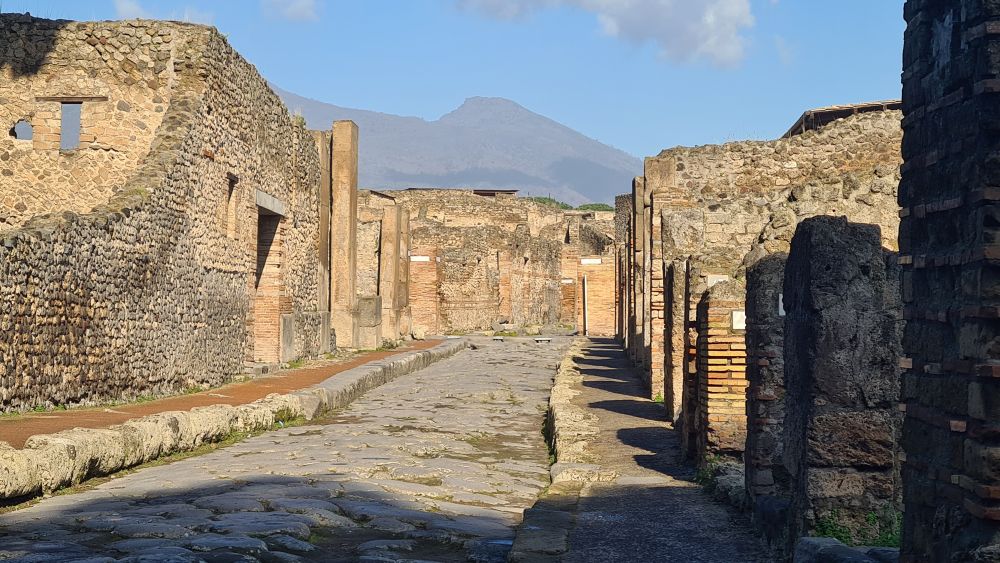
The Pompeii ruins are much larger, with the same neatly-paved streets with sidewalks. In what used to be the residential areas, the streets are, like at Herculaneum, lined with shops and homes, some modest and some luxurious. In other words, it looks pretty similar, but there’s more of it.
There are plenty of places to stay that are very near the Pompeii ruins.
What is there to see at Pompeii?
The ruins have been divided into nine sections (regio). Each has many structures within it, but only some of them are marked on maps and in guides. The unmarked ones are generally nothing but walls and foundations. It’s the marked ones that are worth seeing.
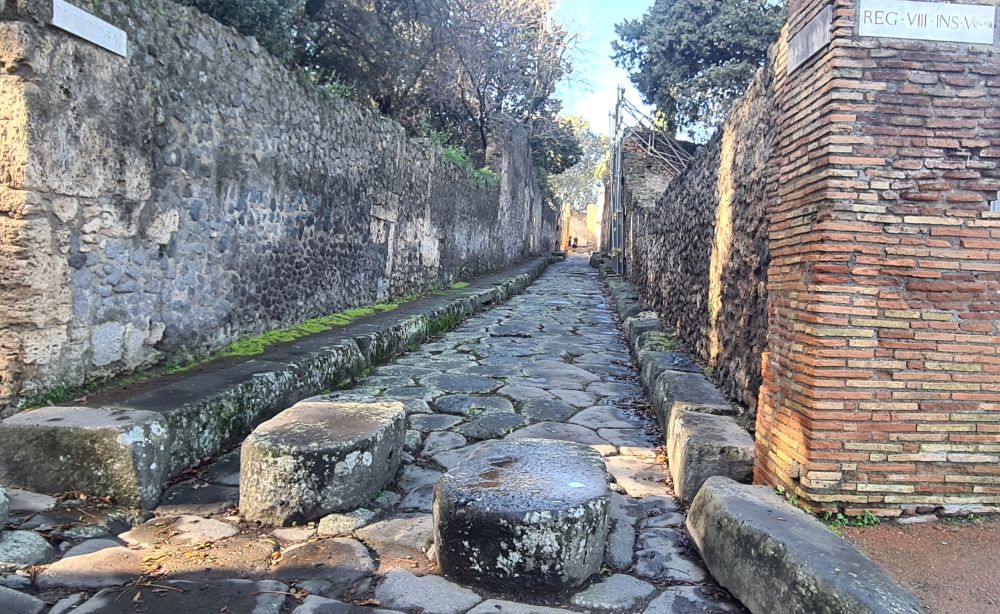
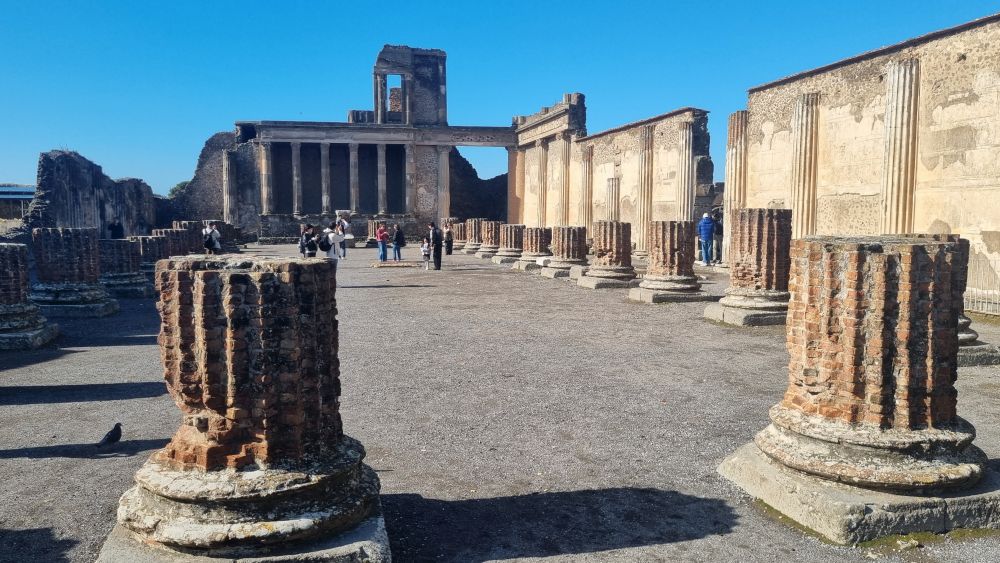
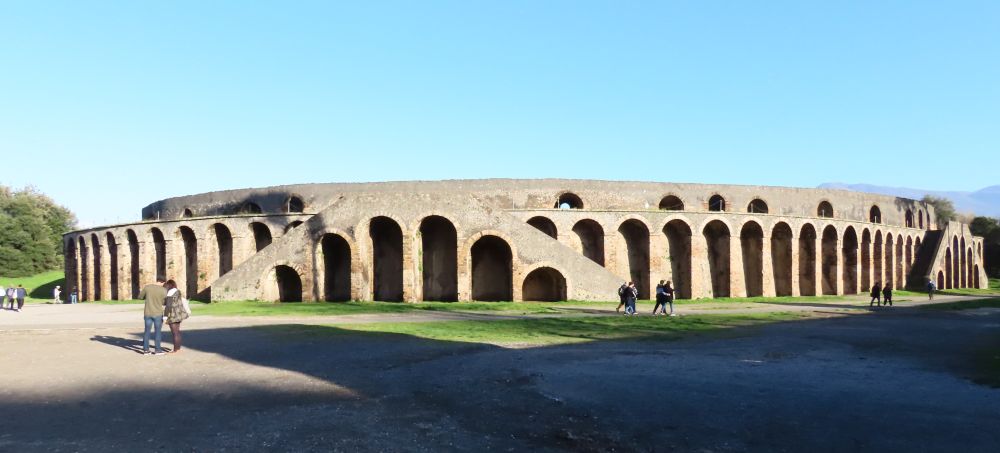
Pompeii has many additional elements that probably also existed at Herculaneum but have not (yet) been uncovered there. At Pompeii, you can see the town’s Forum, for example, in Regio VII. This was a public square used for markets, surrounded by shopfronts, government buildings and temples. The temples remain too, or at least their foundations and partial columns. The big public bath called Terme Sabiane is in Regio VII too. On the edge of the ruins in Regio VIII, you’ll find a large and a small theatre. A large amphitheater is in Regio II.
I particularly liked seeing a section that is still being restored in Regio XI. It consists of several buildings with a large scaffolding and roof covering them. Visitors can go up on the catwalks above the buildings and look down on the rooms under restoration. It’s a great way to get an overview – an idea of how the houses relate to each other, and to see some beautiful mosaic floors and wall frescoes. Unfortunately, you’re not allowed to take photos there.
The “House of the Day” is also worth seeing at Pompeii. These particular houses are only open to the public once a week. I presume this is for their protection, but it made me feel like I was in on a secret of sorts, with the added bonus of fewer people around and a guard who was happy to tell us about the place. Check Pompeii’s website to see which one is open the day(s) you visit.
Suburban villas and other sights to see near Pompeii
The area around Pompeii was a popular place for the movers and shakers of Ancient Rome to build vacation homes. Their villas, buried in the same eruption, give a good impression of the elegant lives of the wealthy who vacationed here.
Many villas are still buried, or are not open to the public, but there are several sites outside of Pompeii that archeologists have excavated and which you can visit for an extra fee (See my section below about tickets.). Two museums outside Pompeii contain finds from the many villa excavations as well as from Pompeii itself.
Villa dei Misteri (House of the Mysteries): This is the nearest of these suburban villas to the bulk of the Pompeii ruins. It is in very good condition, with some remarkable and intact frescoes in the Second style. It is part of Pompeii’s UNESCO designation.
Villa of Diomedes: This must have been a beautiful seaside villa in its day. Excavated, the frescos are in poor shape, but the walls are more or less intact. The main significance of this villa is the 39 skeletons found in the lower level who died in the blast of heat.
Download the official Pompeii guide, which includes the Villa of Diomedes and the Villa of the Mysteries as part of Regio VI.
Villa Regina: About a kilometer away in Boscoreale, Villa Regina was more of a farmhouse than a villa. It contains casts of some wooden items like door and window fixtures, as well as decorative items still on shelves. The frescoes are transitional, with both Third and Fourth-style elements.
Antiquarium: This museum houses some of the best finds from the excavations at Pompeii. Here you can see some excellent frescos, various treasures unearthed there, and some of the plaster casts made of victims of the volcano.
Download the official Antiquarium guide.
Villa Oplontis: This almost completely intact villa in the town of Torre Annunziata is also called Villa A or Villa Poppaea. It has some excellent frescoes and generally gives a good impression of the elegant lifestyle of the wealthy inhabitants. This villa is part of Pompeii’s UNESCO designation. I did visit this one, and if you like frescoes, it’s definitely worth seeing.
Download the official Villa Oplontis map and the guide.
Villa Arianna: Only partially excavated, this elegant villa extended on three levels on the side of a hill. It has some fine frescoes as well as pretty floor mosaics in black and white.
Download the official Villa Arianna guide.
Villa San Marco: This lavish villa had a panoramic view, and contains Fourth-style frescoes as well as thermal baths.
Download the official Villa San Marco guide and map.
The Archaeological Museum of Stabiae: Inside a 13th-century royal palace, this museum displays objects from several Roman villas in Stabiae: frescoes, mosaics, ceramics, etc.
So which one should you see: Herculaneum or Pompeii?
The answer to this question depends on your level of interest in Ancient Rome. I’ll list a few points of comparison between the two in this section. Hopefully it’ll help you decide what you want to see.
The two towns will show you different elements of Roman life at the time. The part of Herculaneum that has been uncovered is almost entirely about the daily life of the residents, as well as their art and livelihood. Pompeii, on the other hand, is better for learning about public life, with its temples, public buildings, forum and amphitheater. Herculaneum had these monuments too, but they have not been excavated. So which you see could just be based on which you’re more interested in: daily life or public monuments.
I’d say that to get a bit of both aspects in a single day, Pompeii would be a better choice; just make sure you see the forum and the temples around it, the theaters, the amphitheater, and a sampling of the houses and shops. The larger, wealthier houses in Pompeii are the ones with the best frescoes and mosaics.
However, Pompeii’s buildings were damaged more severely. Upper floors are gone, and so is most of the plaster on which the frescoes would have been painted. Herculaneum has far more intact artwork, particularly frescoes, many in excellent condition. Pompeii has fewer, but some of the few that remain are beautiful. If the artwork is your main interest, you’ll probably like Herculaneum better, and make sure to see Villa Oplontis too.
Interested in frescoes and mosaics?
The artwork of the frescoes at both sites is quite interesting in that there are four different types that emerged over the two hundred or so years before the eruption, now called First, Second, Third and Fourth styles.
First style: Walls painted in the First style were meant to imitate architectural materials, particularly marble blocks. The idea was to create a trompe-l’oeil effect, so that what was actually stucco would look like marble.
Second style, also known as architectural style: These also imitated architecture, but they’re more complicated and realistic. An example would be if the wall was painted with a series of columns. Usually the bottom meter or so of the wall would be in First style – just the impression of marble blocks. Then above that would be trompe-l’oeil columns dividing the walls into panels. The columns might “support” shelves that were painted with objects sitting on them, again with the idea of appearing three-dimensional. Or the columns framed a painted outdoor scene to create an illusion of looking out on a garden.
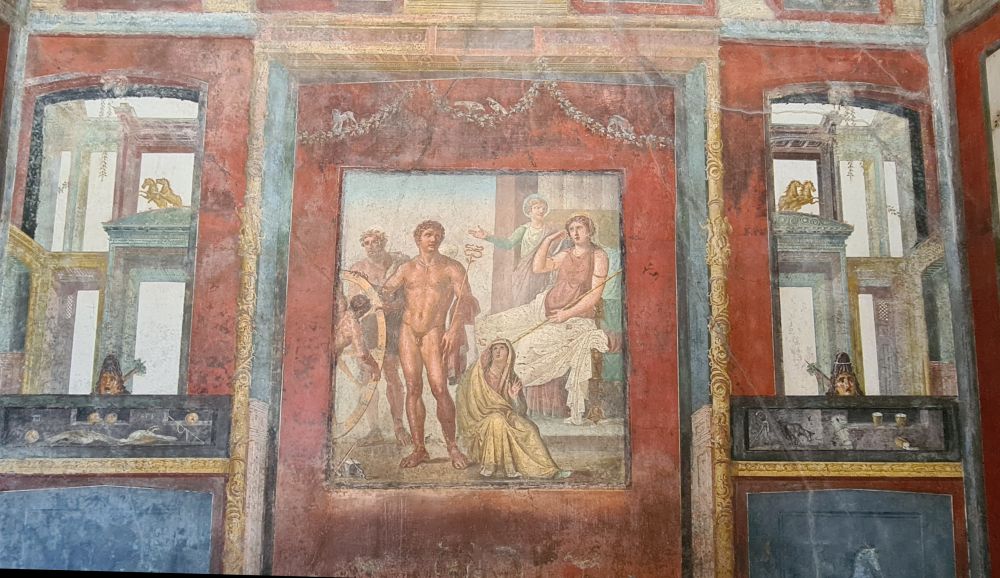
Third style: Here the wall would be divided into symmetrical vertical and horizontal sections with painted elements like columns. The bands and columns separating the sections were often decorated themselves. The panels would have large areas of space painted in a single color – often red or yellow – and in the center there’d be a small painting of a still life or a scene from mythology.
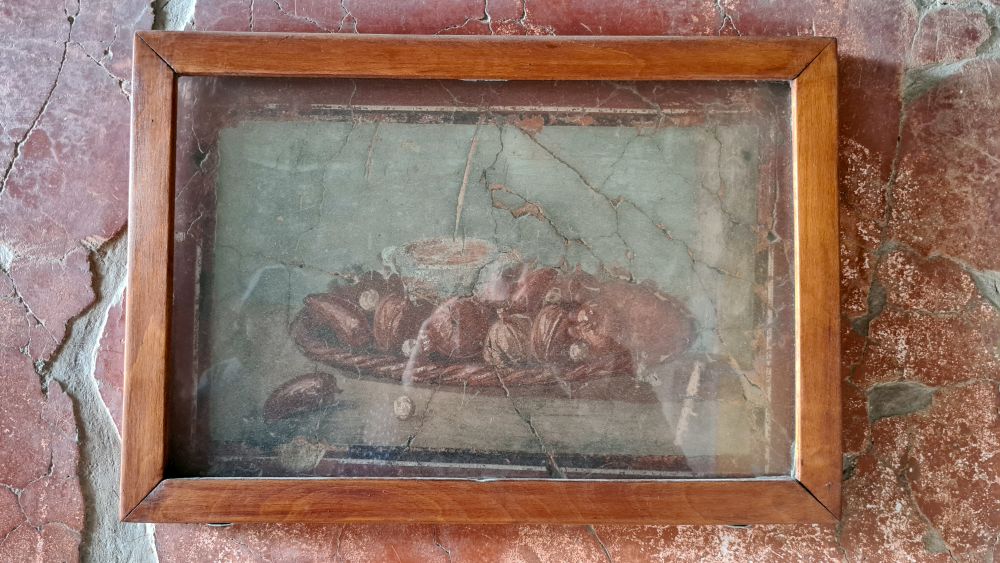
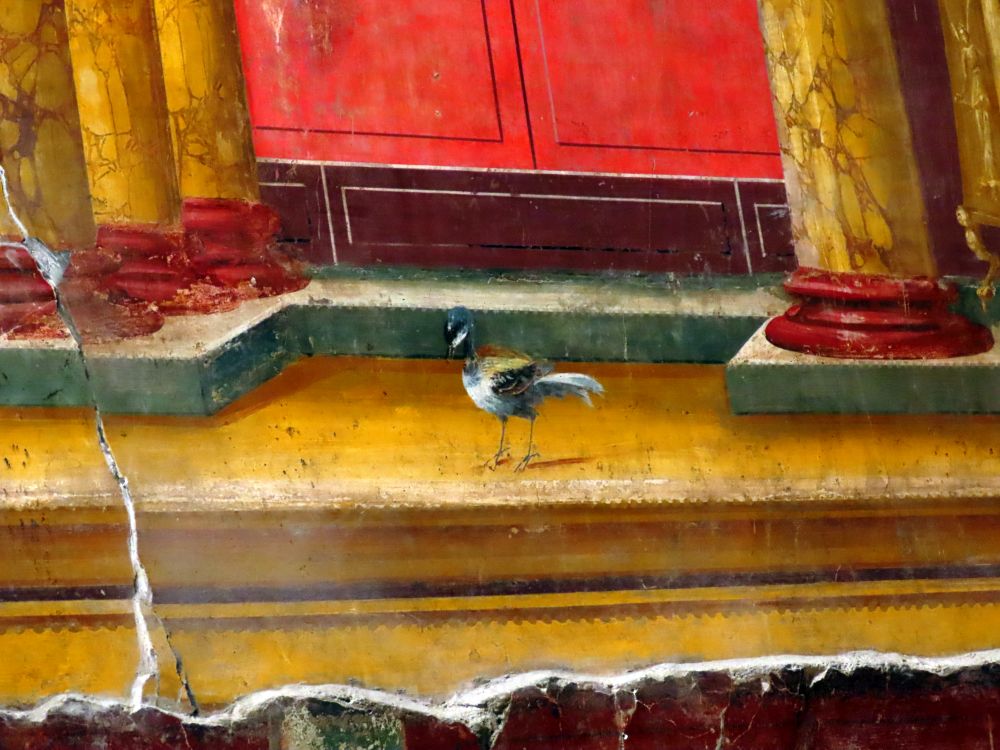
Fourth style: This was my favorite. According to the site guide I downloaded, the Fourth style “expands the architectural imagination of the ‘second style’ and the decorative tone of the ‘third style.’” What that seems to have meant in practice was that the walls had darker horizontal bands of trompe-l’oeil marble-look blocks along the bottom, often in black or red, and sometimes decorated with simple elements like plant images. Above that, the wall is primarily plain white and divided into large panels, with each panel decorated with very fine line paintings of things like vines. These were mostly around the edges, but what I liked about them was that here and there are tiny images near the lines, often of various animals. It’s deceptively plain from far away, but demands your attention as you move closer.
Of course, in many houses in both towns you’ll see transitional frescoes that include elements of two styles.
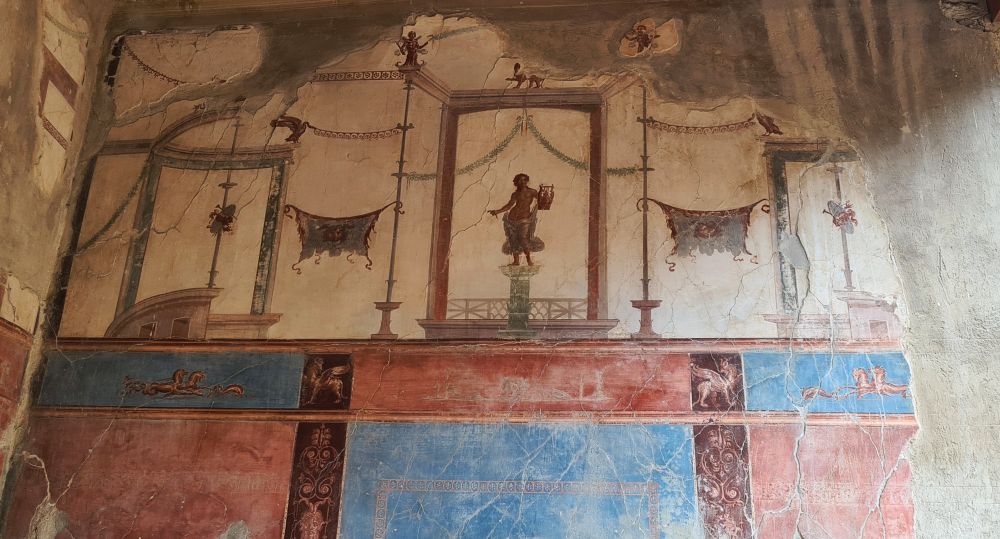
There are more frescoes at Herculaneum, and some of them are beautifully done and well preserved. Pompeii has fewer intact frescoes, but a few of them are quite magnificent.
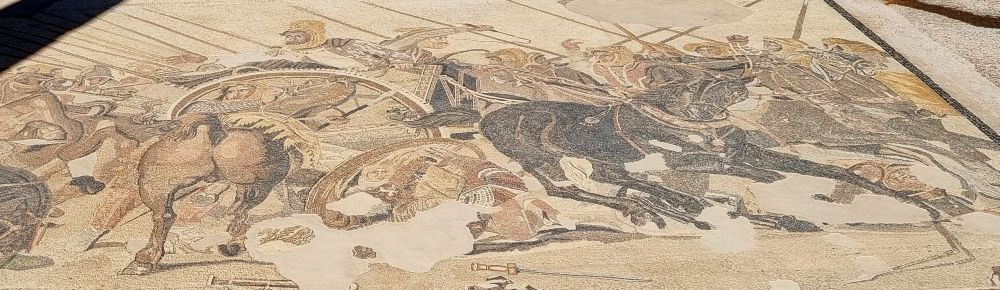
The same goes for the mosaic floors at both sites. At Herculaneum there are many intact mosaics, but they tend to be rather simple: white or black tiles with a simple repeating pattern, or in some places some marble elements. At Pompeii you’ll see the same simple tile floors, but in a few of the villas there are some much more ornate images.
Other things to consider
How much time will it take to see each site?
Pompeii was bigger than Herculaneum, but it wasn’t a big city. Herculaneum’s population was about 4,000, while Pompeii’s was somewhere in the range of 10-20,000. Where Herculaneum covered about 20 hectares (49 acres), Pompeii covered 64-67 hectares (158-166 acres).
Herculaneum is still smaller in size today, with less of it excavated than at Pompeii. We spent about four and a half hours there and didn’t see quite everything, but we felt like it was enough.
Pompeii took us pretty much a whole day: about six hours, I’d guess. And again, we didn’t see everything. It’s just bigger. We only bought the basic “Pompeii Express” ticket, since we knew we wouldn’t have enough time to see the villas or museums as well. (We had already seen Villa Oplontis a couple of days earlier.)
How long you need to spend at either one depends on how interested you are in the architecture, frescos, mosaics and the drama of the story.
Of course, if Roman history isn’t a big interest of yours, you’d get the highlights of either one with a tour guide in two-three hours.
Where can I see the bodies?
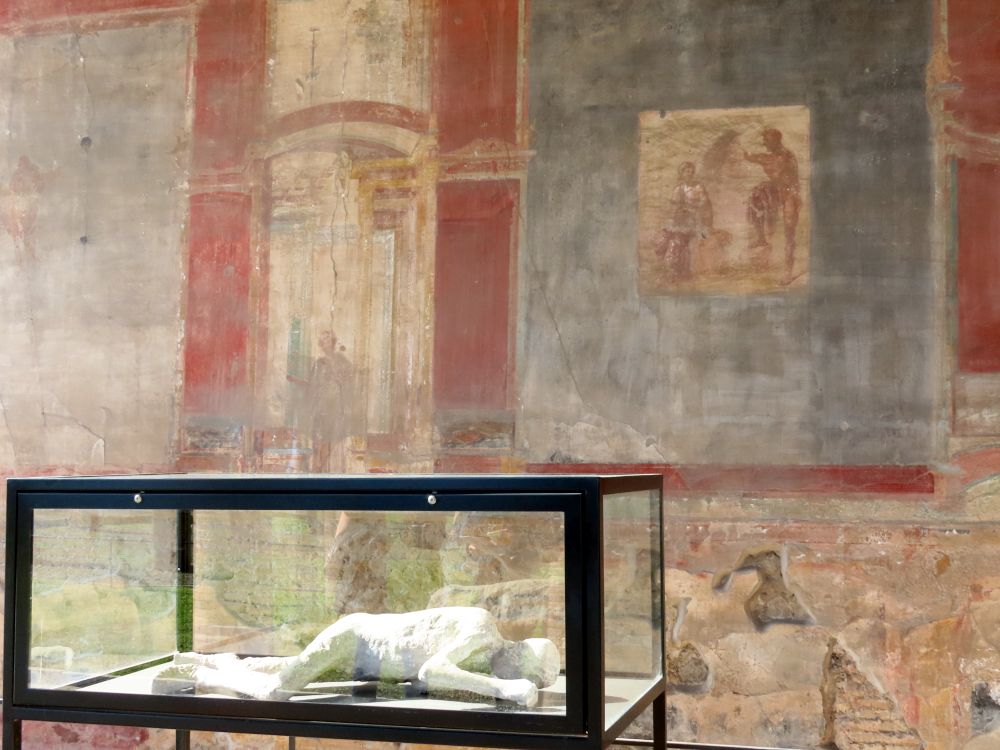
If you’re interested in the darkest part of this dark tourism, you can see “bodies” in both places.
You’ve undoubtedly seen photos of plaster bodies from Pompeii. When these people, who were sheltering or trapped in their homes but hadn’t been killed by the initial rain of stones, died in the pyroclastic flow that followed, their bodies were covered quickly in volcanic material. Over time, the body itself decayed away, leaving very damaged skeletons inside a body-shaped gap. Archeologists, realizing that these gaps in the volcanic rock covering Pompeii were people, filled them with plaster, then removed the rock, leaving plaster casts that capture the shapes of the bodies at the moment that they died. The downloadable map of Pompeii shows the locations of these plaster casts. They’re not all in one place, but rather scattered here and there inside the various parts of the site.
At Herculaneum, the people died of the heat blast while they sheltered inside the stone arches under the town or as they stood on the beach. Their bodies essentially vaporized, but their skeletons remained, enveloped very quickly in the volcanic material that followed. Those skeletons, uncovered by archeologists but left in place, are still in the arches next to where the beach used to be.
Which is better with kids?
Judging by the bored teenagers in the school groups we encountered on our visit, don’t plan more than a couple of hours if you’re traveling with kids. They’ll likely get bored quickly. In either place, they’ll probably enjoy the morbid sights: the skeletons at Herculaneum and the plaster casts at Pompeii. For a while, they might enjoy spotting the tiny images in the Fourth-style frescoes. But beyond that, I’d guess you’d have to just skim and then leave.
At the Pompeii ruins, though, there’s a Children’s Museum. I haven’t seen it, so I can’t vouch for its quality, but it is interactive and aimed at kids in the 6-11 age range.
While it’s intended for people with intellectual disabilities, parts of this simplified guide to Pompeii might be quite useful for children to learn about what they’re seeing. They might enjoy leading their adults on the guide’s suggested routes through the Pompeii ruins. Choose the relevant pages and print them out ahead of time for them.
Are Herculaneum and Pompeii wheelchair accessible?
Parts of both sites are wheelchair accessible. At Herculaneum it’s called the “Herculaneum for Everyone” route. This route has ramps between levels and allows you to move along the sidewalks of some, but not all, of the streets of the town, but many of the interiors will not be easy to access. If you have someone with you to help you over thresholds, you might be able to see more of the interiors. The two small museum spaces – the Boat Pavilion and the Antiquarium – are wheelchair accessible. More information about accessibility – also for autistic children – is on the official Herculaneum website.
Download the accessibility map of Herculaneum.
Likewise, at Pompeii you can follow the “Pompeii for All” route. It leads along the sidewalks of some of the streets, with metal bridges in place wherever you’ll need to cross. Looking at these sidewalks, though, made me think that the route could still present some difficulties. Some are bumpy, and some seem awfully narrow. The ramps to the accessible houses are on the steep side too. Bring someone to help you in case the state of the wheelchair route becomes a problem. More information on the official Pompeii website.
Some of the buildings along the route have ramps that will allow your wheelchair to enter. They’re all marked with a dot on the map. This means that you won’t be able to see every building but you’ll see the highlights.
Download Pompeii’s accessibility map.
How crowded are Pompeii and Herculaneum?
We visited Herculaneum and Pompeii in the cold and rainy off-season – February – so there were few visitors except for some school groups. In the summer, both will be very crowded, but Pompeii will be worse than Herculaneum.
Things have gotten so bad at Pompeii that the management has started imposing limits: no more than 20,000 tickets per day, with 15,000 allowed to enter in the morning, and another 5,000 after 13:00. Those numbers are per day, so it must get terribly crowded, especially during the summer. (And in any case, you shouldn’t visit in the summer. It’s just too hot!)
Tips for visiting Herculaneum and/or Pompeii
Avoid visiting during the summer.
As I wrote above, summer is hot and crowded, not just at these sites but all over Italy. The shoulder seasons (spring and fall) will have the most pleasant temperatures, but Pompeii will still be crowded; I would guess that Herculaneum will be too. The off season, i.e. winter, will be chillier and there’s more chance of rain, but even Pompeii will be distinctly less crowded. You’ll get a sense of the winter numbers in my photos in this article, taken in February.
Hire a guide.
The easiest way to see either site is to hire a guide, either on arrival or ahead of time. Before you hire anyone at the site, though, make sure they’re a licensed guide.
Especially if it’s in the summer, hire a guide or book a tour (and possibly transportation to the site) before your trip.
- For Pompeii, there are plenty of options: group or private tours, without transportation or with transportation from Naples or Rome, or tours that combine Pompeii with Vesuvius or other nearby sights. See lots of choices here.
- You’ll find plenty of options for Herculaneum too: private or group guided tours, with or without transportation from Naples, Rome or Sorrento. Take a look here.
- If you really can’t decide, or you don’t have a lot of time, some tours visit both Herculaneum and Pompeii in a single day, again with various options for transportation. Here’s a list.
Where should we stay?
You basically have three choices, depending on which site(s) you decide to visit.
- Find accommodations near Herculaneum, preferably near enough to walk to the site so you don’t have to contend with finding parking or arranging transportation.
- Find accommodations near Pompeii, again preferably near enough to walk to the site.
- If you’re planning to see both and have a car, you could stay somewhere in between, further away from the more touristy areas: Torre del Greco, which is nearer to Herculaneum, or Torre Annunziata, which is nearer to Pompeii.
Buy your tickets ahead.
Especially if you travel in the summer, you’ll want to avoid a long line to buy a ticket, so buy it ahead of time. If you book a tour, check first to see if the tour includes admission.
At Pompeii you’ll have several choices of tickets:
- Pompeii Express: allows you to see the ancient city and all its structures, but none of the suburban villas. One entry, one day, no re-entry.
- Pompeii Plus: includes the ancient city but also the Villa of the Mysteries, the Villa of Diomedes, Villa Regina in Boscoreale with Antiquarium, and a shuttlebus between these sites. One entry, one day, no re-entry.
- Grande Pompeii: A 3-day ticket that includes everything in the Pompeii Plus, and also Villa Oplontis, Villa Arianna, Villa San Marco, and the Archaeological Museum of Stabiae. Three days, one entry per site, no re-entry.
As I pointed out above, we didn’t get to see all of the ancient city with our Pompeii Express ticket in one day. If you’re particularly fascinated by Ancient Rome, consider the 3-day ticket so you can see everything in a more relaxed way over three days.
Buy your tickets to Pompeii here.
Pompeii has free admission on the first Sunday of every month, to a limit of 20,000 visitors per day.
At Herculaneum, there’s just a single entrance ticket. They also have free days every first Sunday of the month as well as on Liberation Day (April 25), Republic Day (June 2), and National Unity Day a.k.a. Armistice Day (November 4).
Buy your Herculaneum tickets here.
Tickets are available separately for many of the villas as well. If you just want a very short visit, this might be the best option. They have their own ticket offices, so you don’t have to wait in line at Pompeii.
Get prepared.
If you don’t want to hire a guide, there are a few things you need to do ahead of time besides buying tickets.
Preparing for Herculaneum
Download the guide and map of the site ahead of time from Herculaneum’s official website. However, we found the map difficult to use on a phone, so I’d suggest taking a photo of the large map and its key just inside the entrance to the park. Do it on a separate phone so you can look at both the guide and the map at the same time.
- Alternatively, there’s an audio tour you can pay for and download ahead of time from Herculaneum’s official website.
- There’s also a Herculaneum app you can download.
Preparing for Pompeii
For Pompeii it’s a similar story. It’s just a huge place. Download a guide and a site map from Pompeii’s website or rent an audio guide when you get there. Again, you’ll have an easier time juggling the map and the guide if they’re each on a separate phone. Or take a paper map at the entrance.
Download the map of Pompeii and a guide to Pompeii.
Finding your way around Herculaneum and Pompeii
At both sites, all of the building entrances have a number, but that is not the one that corresponds to the official maps.
At Herculaneum, some, but not all, of the houses and shops have a vertically-aligned sign with the name of the building (in Italian) and a small number below it. These are the numbers that appear on the map and in the guide, where you can read a short description and learn about any special features of that particular shop or house.
The same goes for Pompeii: the buildings with interesting things to see inside have signs outside them. These are the ones you should see.
If you only have one day at Pompeii and you’re seeing the ruins without a guide, your best bet is to follow the wheelchair route. I didn’t see everything in the one day we spent there, but the houses and other monuments that had ramps for wheelchair users tended to be the ones with the most to see.
In both places, some of the buildings are closed, with locked metal gates. They’re either under restoration work or they’re just too delicate and only are opened occasionally.
Opening hours
At Herculaneum, the hours in mid-March until mid-October are 8:30-19:30, with the last entry at 18:00. In mid-October to mid-March, Herculaneum is open from 8:30-17:00, with the last entry at 15:30.
The gates to Pompeii open at 9:00 all year, while the individual buildings mostly open at 9:00 or 9:15 and close at 16:00. Get there by 9:00 to see as much as possible if you only have one day, and parking will be easier early in the morning as well.
In mid-October to mid-March, Pompeii closes at 17:00, but the last time to enter is 15:30. In mid-March to mid-October, it closes at 19:00, with the last entrance at 17:30.
Some of the villas associated with Pompeii – Villa Arianna, Villa San Marco, Villa Oplontis, and the Archeological Museum of Stabiae – are closed on Tuesdays.
Parking
At Herculaneum, if you’re taking a road trip, like we did, you can park in an underground parking lot that’s under the bus parking lot. Be careful walking to and from your car if there’s been any rain recently; the floor is very smooth and gets slippery. After your visit, pay for the time you parked by using the machine at the top of the stairs. If that lot is full, you’ll need to find another one further away, or see if you can find street parking.
At Pompeii, you’ll find parking lots all over town outside the site. We paid 10 euros for the day, but I suspect they charge more in the summer.
A couple of side notes about driving in this part of Italy:
- While the highways are good, the local roads are in poor repair. Watch out for potholes! And be cautious in general; things like right-of-way rules and one-way street signs are often ignored.
- Make sure you have a Telepass device for the highways; the toll machines are often broken, so it’s a real hassle and often a long wait to pay with a card or cash. With a Telepass device on your windshield, you just drive through, and it charges your account automatically – though not necessarily right away. After several tries, we found a Telepass device at an Expert store, downloaded the corresponding app, and went through the instructions to set it up and attach it to our windshield. After that it was all much easier! If you are driving a rental car, make sure to ask whether it has a Telepass.
Eating
At Pompeii, since you’ll spend more time there, you’ll need to eat lunch. Only one of the two restaurants was open when we visited, and the food was nothing to write home about. It was also very busy and didn’t have enough seating. I’d suggest instead that you bring sandwiches along so you don’t have to deal with the hassle.
What to bring
Definitely bring water, and if you’re visiting in the summer, wear a hat and sun lotion. If you go in the winter, prepare for rain as well.
Make sure your phone and/or camera is charged up and has enough storage space.
Wear good solid shoes, preferably the kind that support your ankles. The old Roman roads are made of huge blocks of stone, and they’re not very even. It would be easy to twist an ankle if you’re not paying attention.
Let me know what you end up deciding and why! Just add a comment below.
My travel recommendations
Planning travel
- Skyscanner is where I always start my flight searches.
- Booking.com is the company I use most for finding accommodations. If you prefer, Expedia offers more or less the same.
- Discover Cars offers an easy way to compare prices from all of the major car-rental companies in one place.
- Use Viator or GetYourGuide to find walking tours, day tours, airport pickups, city cards, tickets and whatever else you need at your destination.
- Bookmundi is great when you’re looking for a longer tour of a few days to a few weeks, private or with a group, pretty much anywhere in the world. Lots of different tour companies list their tours here, so you can comparison shop.
- GetTransfer is the place to book your airport-to-hotel transfers (and vice-versa). It’s so reassuring to have this all set up and paid for ahead of time, rather than having to make decisions after a long, tiring flight!
- Buy a GoCity Pass when you’re planning to do a lot of sightseeing on a city trip. It can save you a lot on admissions to museums and other attractions in big cities like New York and Amsterdam.
- Ferryhopper is a convenient way to book ferries ahead of time. They cover ferry bookings in 33 different countries at last count.
- I’ve become an affiliate for VisitorsCoverage travel insurance, mostly because you should ALWAYS have travel insurance when you travel! You may be young and healthy and never get sick, but the fact is, sh*t happens, and it’s worse if you don’t have insurance!
Other travel-related items
- It’s really awkward to have to rely on WIFI when you travel overseas. I’ve tried several e-sim cards, and GigSky’s e-sim was the one that was easiest to activate and use. You buy it through their app and activate it when you need it. Use the code RACHEL10 to get a 10% discount!
- Another option I just recently tried for the first time is a portable wifi modem by WifiCandy. It supports up to 8 devices and you just carry it along in your pocket or bag! If you’re traveling with a family or group, it might end up cheaper to use than an e-sim. Use the code RACHELSRUMINATIONS for a 10% discount.
- I’m a fan of SCOTTeVEST’s jackets and vests because when I wear one, I don’t have to carry a handbag. I feel like all my stuff is safer when I travel because it’s in inside pockets close to my body.
- I use ExpressVPN on my phone and laptop when I travel. It keeps me safe from hackers when I use public or hotel wifi.

Rachel Heller is a writer living in Groningen, the Netherlands. She is the owner and primary author of this website, Rachel’s Ruminations, a travel blog focused on independent travel with an emphasis on cultural and historical sites/sights. Read more here about her and about this website. All photos in her articles are her own, unless otherwise specified. Rachel also owns and operates a website about World Heritage travel.