

Havila Voyages cruise review: An eco-friendly coastal Norway journey
Whenever I mention going on a cruise, friends and acquaintances will dismiss it out of hand. “I’ll never take a cruise. They’re so polluting!”
Havila Voyages, the newest company plying the Norwegian coastal “mail boat” route, is working to eliminate that argument. To be fair, so is the original company plying this route: Hurtigruten – read my review of them here. But Havila is definitely ahead in the race to zero-emissions, and Albert (my husband) and I were fortunate enough to tag along on their first proof-of-concept trip powered entirely from biogas and batteries.
Disclosure: Our trip was sponsored by Havila Voyages. However, Havila has no influence over what I choose to write about our experience. I have tried to be as unbiased in my evaluation as possible.
Use the Table of Contents below to jump to the information you’re looking for.
Another disclosure: This article contains affiliate links. Making a purchase through an affiliate link will mean a small commission for this website. This will not affect your price. Privacy policy.
Biogas replacing LNG
All of Havila’s four ships are hybrids. They operate on liquid natural gas (LNG) and carry huge batteries, which are charged while at port, using hydropower as much as possible. LNG emits about 25% less carbon dioxide than fossil fuels and 90% less NOx, so it’s already producing less pollution than pretty much every cruise ship in existence.
Our voyage on the Havila Polaris, though, was the first ever Havila trip to run on biogas and batteries. Biogas is produced from waste, whether that’s garbage, manure, sewage, or biproducts of food production. The waste produces gas naturally – mostly methane – that is often just released into the atmosphere – think of your typical landfill or dump. With industrial biogas production, the gas is captured and processed to a liquid form. The “waste” product from its production is an organic fertilizer that can be used instead of chemical fertilizers in agriculture.
As a liquid, biogas can be used in the same way as LNG, so the ships require no retrofitting. Compared to fossil fuels, though, the emissions are far lower. Biogas is considered carbon neutral because the carbon it prevents from releasing into the atmosphere is taken into account. It also cuts NOx emissions to zero.
This proof-of-concept voyage, then, reduced emissions even further than LNG by running on just biogas – except for a small amount of LNG already in the tanks from its previous voyages – and batteries.
Havila isn’t there yet, though. The supply chain isn’t in place for operating all four ships entirely on biogas. As a matter of fact, for this proof-of-concept trip, they had to import biogas from Sweden: a not-very-environmentally-friendly transportation cost.
For now, they’re still using LNG, but the effort is underway to build a series of biogas facilities along the Norwegian coast. Havila expects to operate a fully biogas-fueled fleet by 2028.
The Norwegian “mail boat” route: Hurtigruten and Havila
Hurtigruten is Havila’s only competitor on this route from Bergen in the south of Norway up to Kirkenes – at the very top of the country, right near the Russian border – and back down again. Hurtigruten ran the route as a monopoly for over a hundred years, delivering mail, cargo and passengers at 34 ports along the way.
Hurtigruten still runs the same route today, but the Norwegian government opened it up for competition several years ago. A Havila ship sailed the route for the first time in 2021. Havila Group is not a new company, though; it is involved in a range of maritime industries related to both transport and tourism.
Both companies have contracts with the Norwegian government to stop at the same ports and deliver cargo in the same way. Both companies use the upper levels of their ships for passengers, some of whom are tourists like us, and some of whom are “port-to-port” passengers, traveling shorter distances from one town to another along the route.
So what is a Havila ship like?
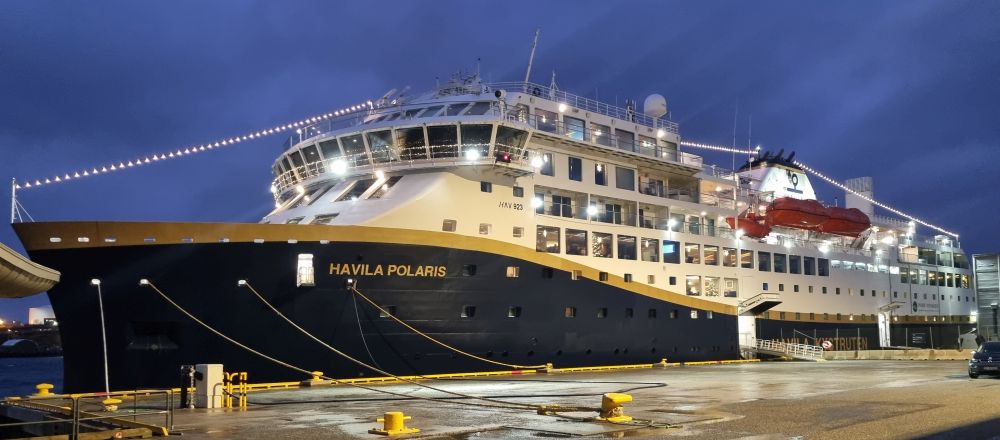
On this trip in December 2025, we traveled on the Polaris, one of Havila’s four identical ships. Each holds a maximum of 640 passengers. Below I’ll describe our experience or you can use the Table of Contents above to jump to your questions.
Boarding the ship in Bergen
Boarding went smoothly and easily. At the start of our northward trip, boarding in Bergen began at 16:00. We checked in our luggage in a modern terminal building and boarded, but could not enter our cabin until 18:00. At that point, we found our cabin, with our bags waiting for us in the corridor. Departure was at about 20:00. It was all very relaxed.
If you board anywhere else along the route, however, it’ll be different. At many ports they only dock for a few minutes. At others, like Trondheim and Tromsø, there’s a window of a few hours.
When we checked in, we were each issued a card the size of a credit card and the receptionist took our photos. When we left or entered the ship at any of the ports, a crew member scanned the pass. The photo attached to the pass showed on their screen, allowing them to check our identities easily and quickly.
If we bought a drink or anything else on board, we could pay with the pass and settle the bill on the last day.
Indoor public spaces on a Havila ship
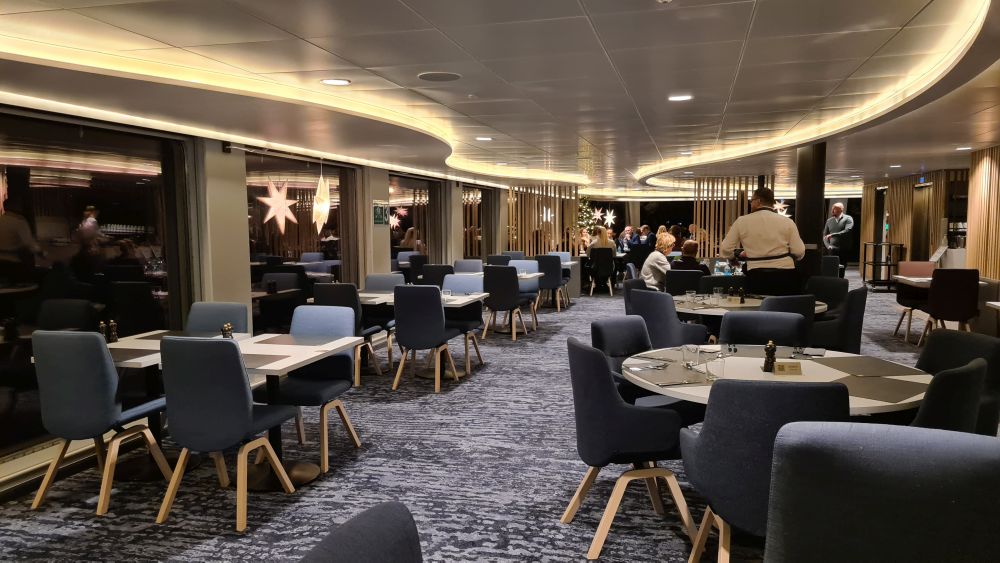
The décor in the public spaces is very understated in natural tones – whites and light wood tones with, for the most part, navy-blue or gray seating. Much of the lighting is indirect and follows curved paths across walls and ceilings. It’s a calm and restful Scandinavian aesthetic.
In the center of the ship is an atrium that extends from Deck 4, where the gangway is, to Deck 9 at the top of the ship. It’s not a huge, loud atrium like in a traditional cruise ship, but some of the public seating areas are next to it on Decks 5, 6, and 7. The furniture is clustered in most places to allow social interactions, with comfortable seating – chairs or sofas – and usually a low table or two. Most of these clusters are near the large windows that line all the public spaces.
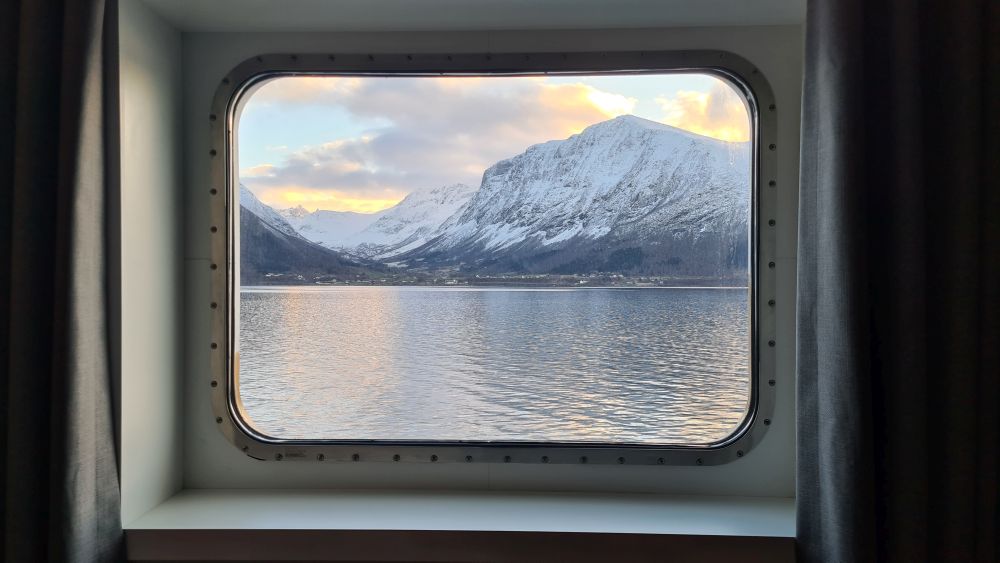
Many of the windows are huge floor-to-ceiling rectangles the size, I’d guess, of three sliding-glass doors. Given how gorgeous the scenery is that passes by throughout the voyage, these huge windows directly contribute to the enjoyment of the experience.
The exception is on Deck 6, at the very front of the ship, where the windows are smaller, the tables are higher and the chairs straighter. Most days I saw port-to-port passengers using this space to work on their laptops.
Outdoor public spaces
The promenade deck – where you can walk the entire perimeter of the ship – is at the very top on Deck 9. This means you don’t walk by anyone’s cabins, but you do walk by people in the main bar who are watching the scenery (and you) through extra-large panoramic windows. It is quite windy up there when the ship is moving.
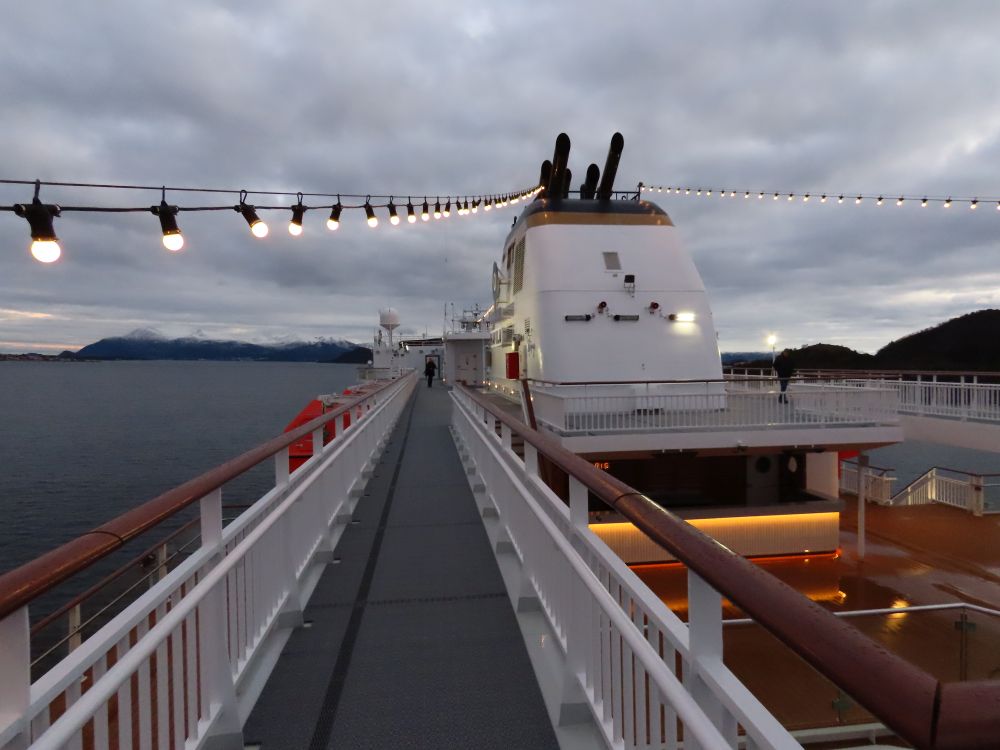
Deck 8 is also partly open to the outside, with two large jacuzzis. It’s at the rear of the ship so it’s not as windy. On the side is a space for passengers who smoke.
Passengers can go out on the open space at the bow (front) of the ship too on Deck 6. It’s an excellent place for photos, but very windy.
Does the ship have a gym?
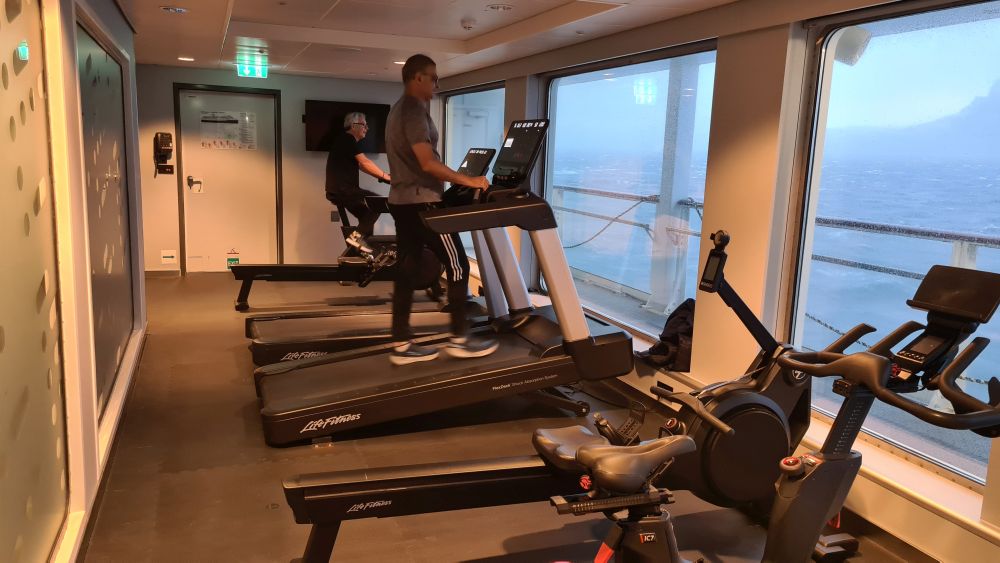
The ship offers two gyms on Deck 7, each with floor-to-ceiling windows so you can keep an eye on the view as you work out. The gym on one side of the ship has free weights and yoga mats, while the other has things like treadmills and exercise bikes.
Quite a few passengers, at least when the weather allowed, got some exercise by doing walking laps around the ship on Deck 9.
Where can you get a drink on a Havila voyage?
The ship has two bars, but only one is open every day. The Havbris bar on Deck 8 is outdoors, and Havila’s website calls it a “pop-up” bar. On our winter trip, it was only used for brief special events.
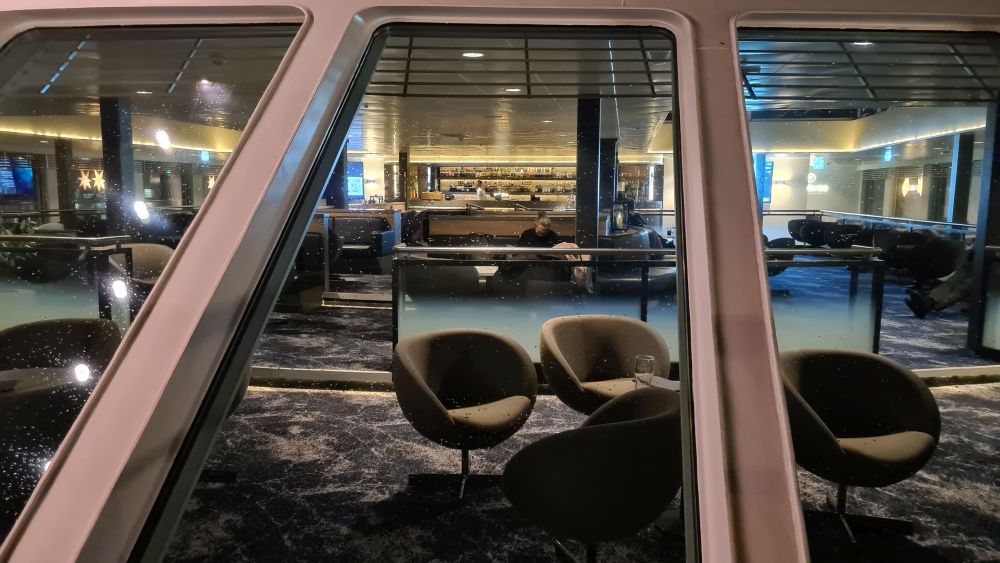
The indoor bar is called the Havblikk. It’s on Deck 9 and fills the very front of the ship. Huge windows allow big views. Even part of the ceiling is glass, so we could keep an eye on the sky in case we spotted any aurora activity. They have an excellent menu of beverages: I enjoyed a few of their signature cocktails, but they have the full list of standard drinks as well.
Alcohol is expensive in Norway, and aboard this ship is no exception. Choose carefully, or just refrain from drinking. Putting drinks on your card makes it all too easy to overspend. On the other hand, the Havblikk bar is a very pleasant place to spend an evening.
Jacuzzis and saunas
At the top of the ship – on Deck 8, but open to the sky – are two quite large jacuzzis, heated with waste heat. In the winter, a jacuzzi visit involves a certain daring: the changing rooms are perhaps 20 meters away, so you’ll have to dash through the cold on the way in and again on the way out. However, the saunas are in the changing rooms – separate for men and women – so you can always warm up again.
What I did not like about these changing rooms is that they had no interior wall. What I mean is that usually changing rooms are designed so that when you open the door, you don’t immediately step into the changing room. Instead, you see a wall straight ahead and have to walk around that to enter the changing area.
This little changing room has two entrances: one from a corridor inside, and one from the walkway outside along the side of the ship. In both cases, there’s no interior wall. You push a button to open the door. It swings open. You have a full view of the changing room. You step in, and the door takes a long time to start its automatic closing.
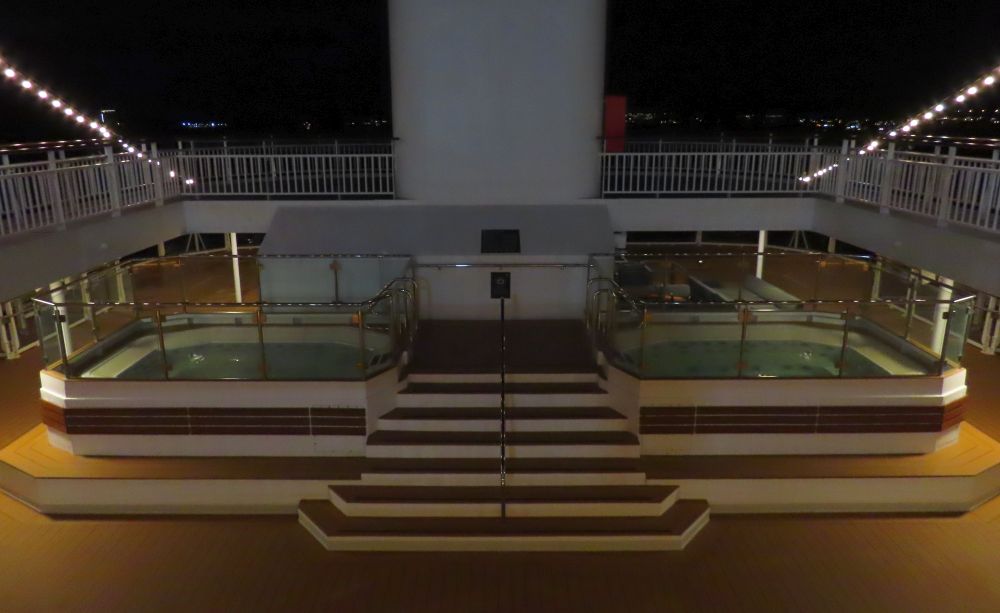
This made me very reluctant to change in that space. The inside door opened to a little-used corridor, so your chances are good that no one will be walking by to get an eyeful of naked people changing clothes. The outside door, though, opening to the walkway, would allow anyone walking by to take a good long look in.
If you’re bothered by this, you can do what I did: change in your cabin into your bathing suit. Cover up with your bathrobe – they’re provided in the Seaview Superior King cabin and all the suite-level cabins, but otherwise you’ll have to bring one along – and just go to the jacuzzis. There are rails around each one that you can drape your bathrobe and towel over. Then when you’re done, just put on the bathrobe again and return to your room for a shower.
Check the weather first, though. I was in the jacuzzi once when it started raining. It was comfortable to be in the hot jacuzzi with a cold light rain coming down, but my bathrobe and towel got soaked!
What are the cabins like?
The cabins are mostly on Decks 4, 5 and 6, with a few of the fanciest suites on Decks 7 and 8.
Seaview Superior cabins
We had a “Seaview Superior” cabin with a king bed. Seaview Superior cabins are also available with double or twin beds, and in an accessible version. All have similar amenities: a wardrobe, a window, a tv, a fridge, a hairdryer, something for making tea and coffee. All have an en-suite bathroom.
Our Seaview Superior King was roomier than I expected, much like your average hotel room. It had two armchairs and a small table under the single window, and a Nespresso coffee machine on a shelf in the corner.
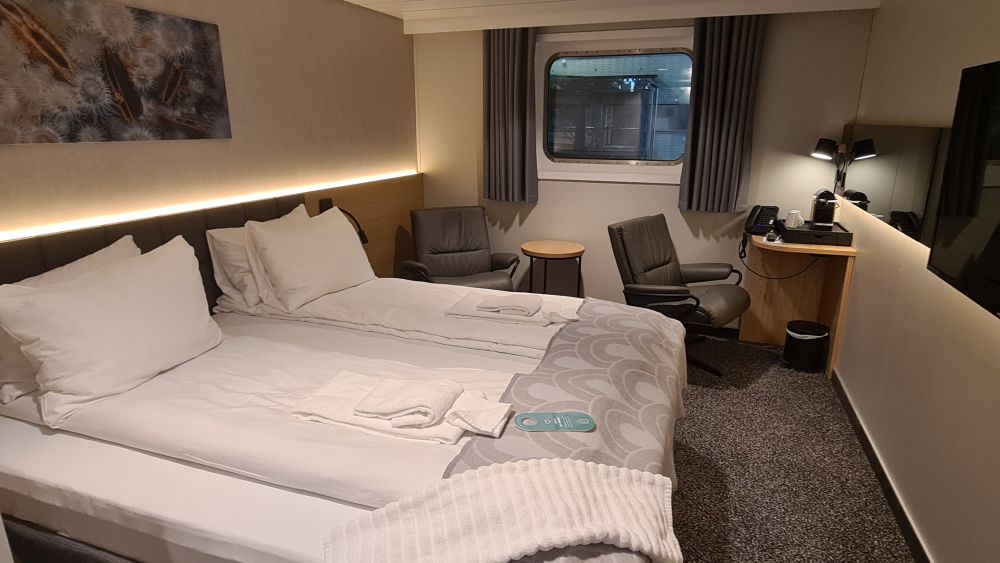
On one side of the bed were two USB outlets; on the other was an electrical outlet. In both the other corners of the room were more outlets, so the room has plenty of places to charge your devices.
The bathroom is small, but wouldn’t feel cramped unless two people were trying to brush their teeth at the same time. It has plenty of counter space and the shower is a pretty standard size, unlike some other ships I’ve traveled in, where the shower is wedged into a corner. The water pressure is sufficient if not very strong, and I loved the Fitjar Islands shampoo provided. I presume that the other seaview cabins have similar bathrooms.
Opposite the bed is a large-screen tv offering several Norwegian channels – which often have American or British programming – and some international news channels. We didn’t use the tv much, except for a couple of informational channels: one that showed a navigational chart of where we were, and another that showed a forward-facing live camera view. On the tv you can also find information about port stops, the itinerary, the ship, and so on.
Inside cabins
Less expensive inside cabins are also available, and seem to me to be much like the cabins you get on ferries, with twin bunks and upper bunks that fold against the wall when they’re not in use. I got the impression that these are generally not used for people taking a “cruise” but rather by locals traveling “port to port.” For them, all they need is a ferry cabin with a place to sleep.
I got to see one of these, though I didn’t get a good picture. It was very ferry-like, with a narrow single bed along one side and a bunk that was folded up against the wall. The bathroom is quite cramped, with a corner shower, again much like what I’ve seen on ferries. Next to each bunk, top and bottom, is an outlet and USB ports, and there’s a tv, though not as big as in a Seaview cabin.
It’s all very small, but would be perfectly suitable if you need to stick to a budget. After all, there are plenty of places on board to spend your time. Even though we had a bigger cabin, we hardly used it except to sleep.
Suites
At the other end of the spectrum are the fancier rooms: the suites.
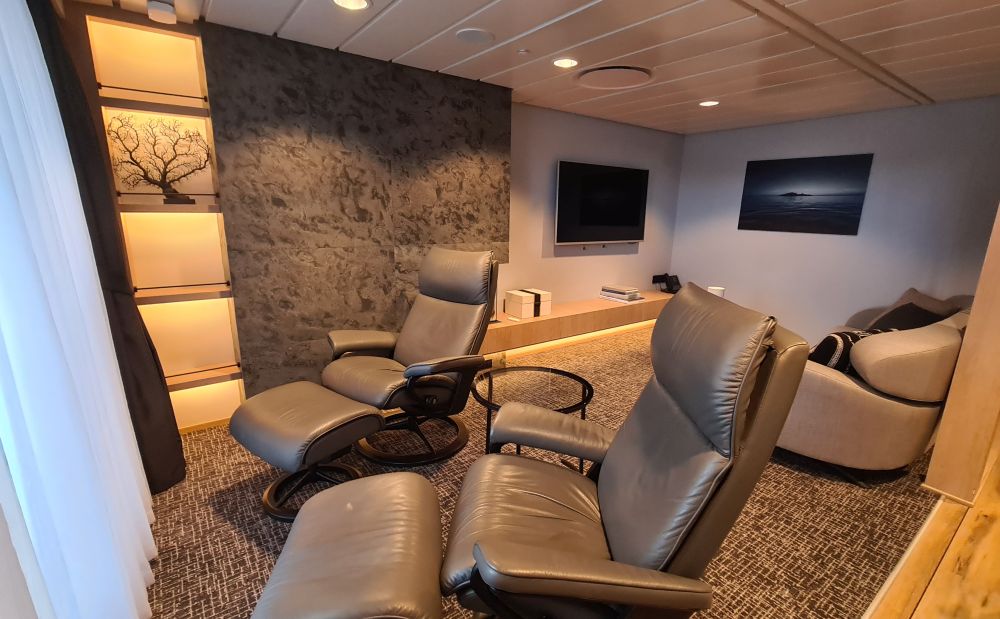
A few mini-suites are one-room cabins with a double bed, a bit bigger than the Seaview Superior cabins, but they face directly forward right under the bridge, with huge floor-to-ceiling windows. Others are further back and don’t have the floor-to-ceiling windows. Instead, they have two separate rooms: a living room and a bedroom.
The Seaview Junior Suite is larger, with two rooms and a roomier bathroom, while the Balcony Junior Suite also has a balcony with a big sliding glass door.
The top of the range is the premium suites. The Balcony Suite is even larger, with an even bigger bathroom, while the fanciest is the Lighthouse Suite, with a large living room, a dining room, a bathroom with a full-size bathtub and shower, and a private jacuzzi on the long balcony.
What’s the food like on a Havila ship?
A fare on a Havila ship in a regular cabin includes three meals a day in the Havrand dining room. Passengers in a suite can opt for the much smaller, quieter and more upscale Hildring restaurant. The Hildring is off-limits to regular passengers for breakfast and lunch – though the menu is the same – but you can pay an additional fee to eat there for dinner.
The other option is a café which offers simple hot dishes, sandwiches and snacks. These are not included in the cabin package, so you pay with your room card and settle up at the end. For suite passengers, some of the café offerings are included.
Breakfast and lunch
At breakfast and lunch, Havila does a very clever thing to reduce food waste. At both meals, guests can order from a menu, but each item is quite small. “Fried eggs and bacon” at breakfast turns out to be a single fried egg and a small portion of bacon. You can order more – as much as you want – but using such small portions reduces waste considerably. Havila aims for an average of only 75 grams of food waste per passenger per day.
At breakfast there’s a buffet with more options, again dosed out in a way that will reduce waste. There’s bread, various cold cuts, smoked salmon, paté and cheeses, yogurt already portioned into small bowls, fruit salad and so on.
Lunch is the same: small portions you can order from a menu, but without a buffet. The recommendation is to order three items to start, then see if you want more and/or dessert. I found, most days, that three items from the menu plus dessert was about right.
Dinner
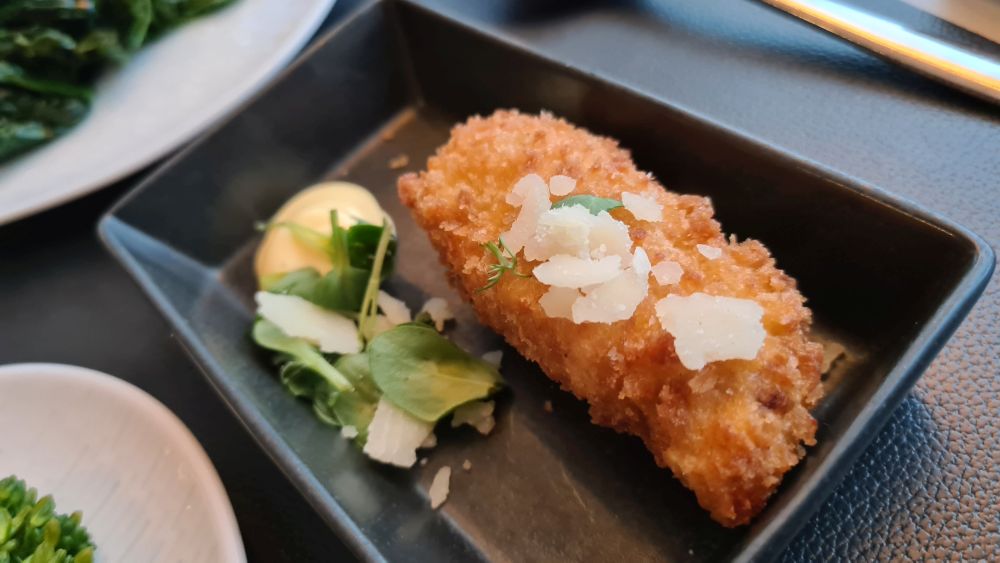
Dinner is more traditional. The menu, changed every couple of days, lists six or seven starters, about the same number of main courses and several desserts. Generally they suggest that you choose a starter, a main and a dessert. It was about right in terms of quantity for me, but I presume you can order more if you want.
Havila says it focuses as much as possible on locally-sourced, fresh food, and that shows in the food choices, though I suspect they succeed more in the summer than the winter. Many options incorporate traditional Scandinavian ingredients: things like “Organic rye bread with roast beef, Danish remoulade, crispy onions and cress” or “Flatbread from Rørøos with whipped pâté and green peppercorns honey.” Given the small serving sizes at lunch, I enjoyed that. I could try, for example, a cured, dried lamb “charcuterie” and a sort of fish paste whose name I forget. If it had been larger, I might not have risked ordering something I wasn’t sure I’d like.
Most dishes are well-presented, well-seasoned and just generally delicious. The seafood is clearly fresh and is certainly a focus. The desserts, at least on our trip, really shine: deeply rich and dark chocolate cake, for example, or a custard of some sort with buckthorn that was divine.
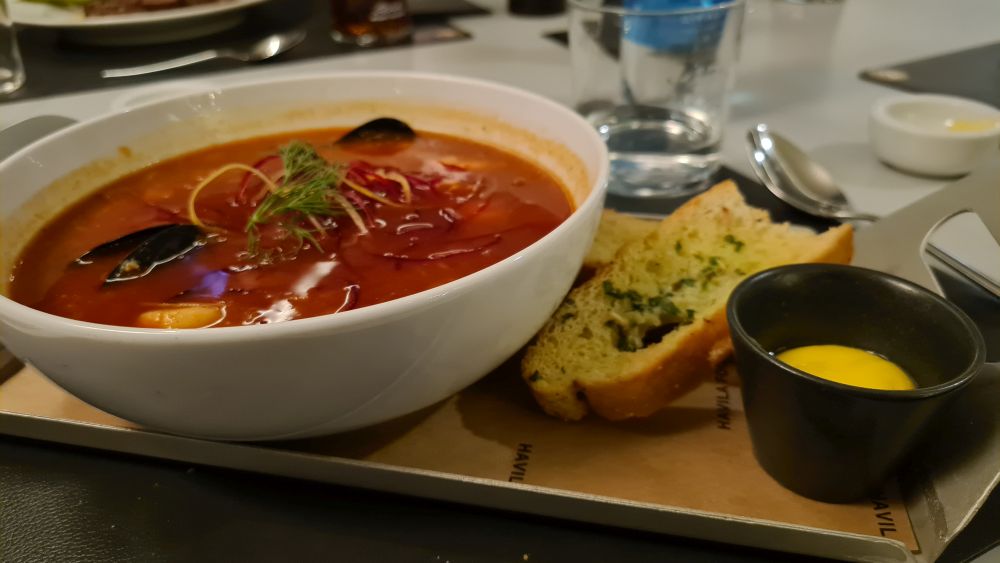
By the way, the menus always include some vegetarian choices, and the servers asked at each meal, at least until they knew us, if any of us had any allergies or dietary restrictions. Let them know if there’s any particular food you need to avoid.
The service in the dining rooms was always friendly and attentive, though not always very efficient, so sometimes we had to remind the waiters of orders we were waiting for. I liked that the servers were not afraid to show a bit of personality in the process.
Hildring restaurant
The tiny Hildring restaurant is much more upscale, with set menus of five courses, different each night and each on a theme. There’s a fish night and a meat night and a king crab night, for example. (Factoid: King crabs are an invasive species in Norway, so you’re doing a good deed by eating them!) Given that you’ve already paid for the meal in the regular restaurant and that the Hildring prices start at an additional US$40 per person, it needs to be extra-specially good. The King Crab menu is far more expensive, at US$188 per person!
We ate in Hildring once, choosing the meat menu night. We started with a tartar of Norwegian beef tenderloin, followed by rack of lamb from Dovrefjell, Norwegian farm duck, reindeer from Finnmark, a chocolate terrin, and a single, elegant chocolate. Each of these courses was small and artfully arranged, accompanied by a small portion of vegetables: things like caramelized carrot puree with the lamb and fancy mushrooms with the tartar. All of them were very tasty and interesting, even the tartar, which I didn’t expect to like.
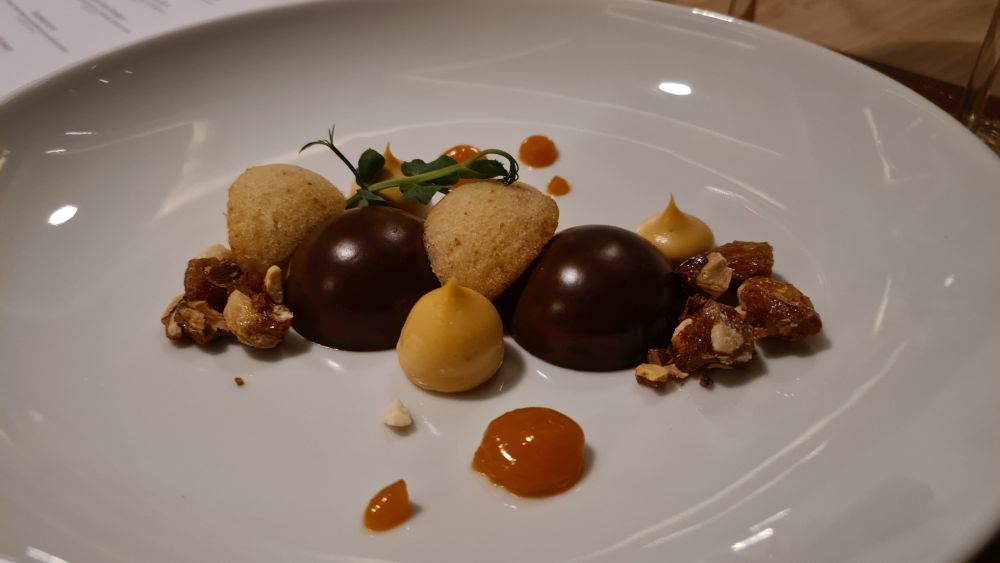
If you’re going to eat dinner in the Hildring and you’re not a suite guest, make sure to make a reservation as soon as you get on the ship. This restaurant only has a few tables and it fills up. It’s not really necessary, though, since the food in the Havrand Restaurant is excellent. I’d suggest only booking the Hildring if you have a special occasion to celebrate.
Meals for port-to-port passengers
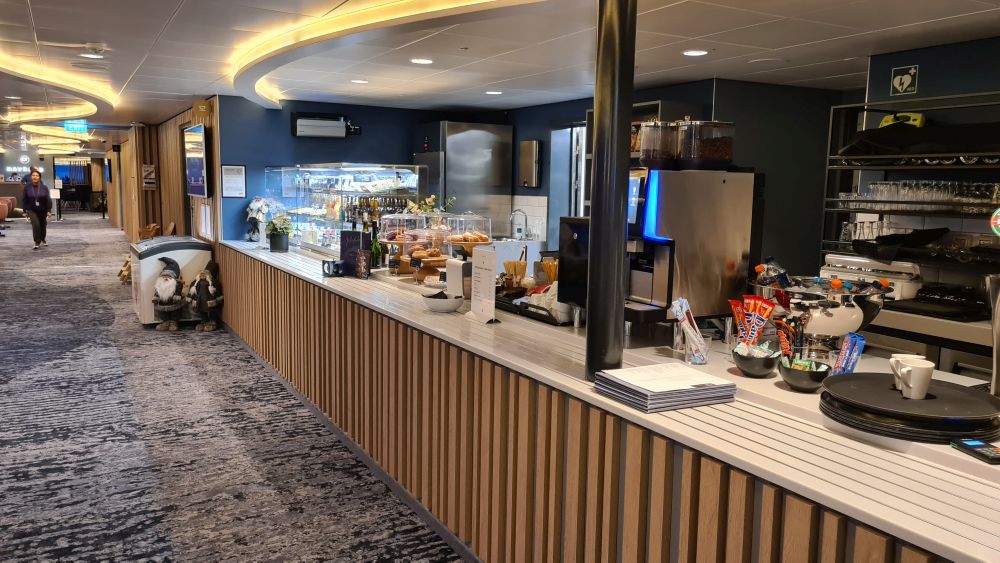
If you’re not doing a full one-way or round-trip between Bergen and Kirkenes, you are a port-to-port passenger. In that case you’ll need to pay for a separate meal package or eat at the café on Deck 6.
Drinks
Make sure to budget for drinks because for the most part they cost extra. At breakfast, tea or coffee and juice (apple or orange) or milk are included. At lunch and dinner, only tap water is free. However, there is a free coffee and tea station outside the gift shop on Deck 6 that you can use all day. Right next to it is a water dispenser that filters the water twice, so if you don’t like the taste of the tap water, fill a bottle here and take it to lunch and dinner with you.
Alcohol is very expensive in Norway, including on the ship. I paid 179 kroners for a Havblikk cocktail: one of their specialties, which I loved. As of this writing, that’s about US$17.70. A glass of pinot noir costs about the same price. It adds up fast!
What other facilities does a Havila ship offer?
Laundry
A few other facilities are worth mentioning, just so you know they’re there. On Deck 4 there’s a laundry room that you can use. If you’re taking the round-trip voyage, you could just pack one week of clothing and wash it. (Read my advice about minimalist packing!) The washers automatically add laundry detergent, so there’s no need to bring any. The room looked clean when I checked, and has three washers and three dryers, as well as an ironing board and iron.
The Northern Lights alarm
Each cabin has a telephone, and if you set it right you can hear the loudspeaker system inside your cabin. It’s audible in all of the public spaces and hallways, but through the cabin door I couldn’t hear the announcements. It’s worth doing because those announcements can be helpful: they tell things like when we are arriving at a town and when we’re expected to leave again or pointing out sights outside.
Most importantly, though, if you travel in winter: you’ll hear the announcement if the Northern Lights have appeared. Don’t worry, they don’t normally use the system at night at all; just for Northern Lights sightings.
Setting the telephone is not very clear, but ask a crew member if you need help. You need to search through the menu to the screen that says Northern Lights. The little screen will shine quite brightly so you might need to throw a piece of clothing over it at night. Also, if you pick up the receiver for any reason, the setting turns off, so you’ll need to reset it.
The on-board shop
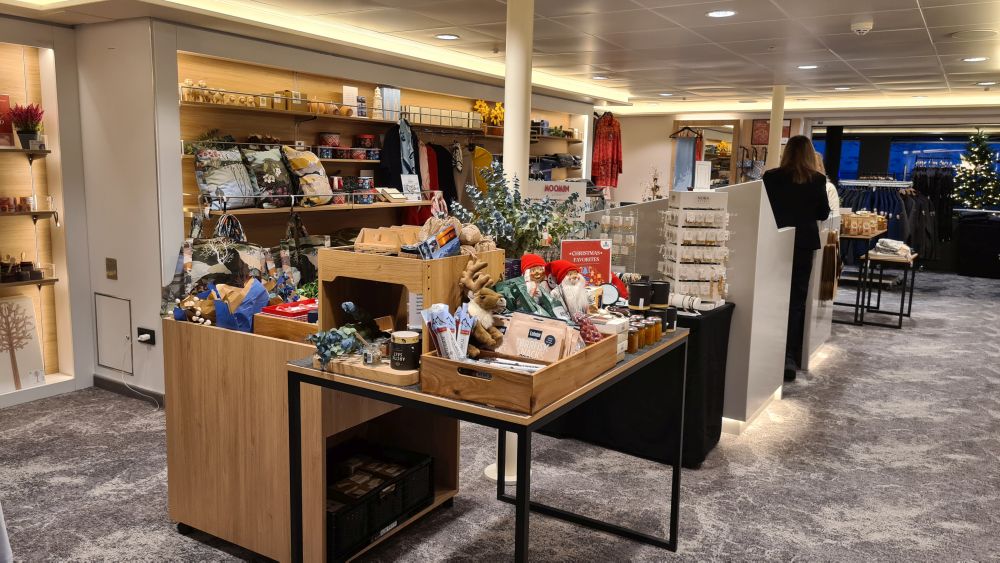
The on-board shop is small and sells a combination of gifts and practical items like crampons and warm jackets. If you need to find gifts, their selection is very good: locally-produced handicrafts rather than junky mass-produced souvenirs.
What about medical care?
A medical facility is on Deck 4. There’s no doctor or nurse, but a few crew members have some emergency response training. If a person is injured or falls ill, they deal with it and the person is either transferred off the ship for medical care at the next port, or, in extreme cases, a helicopter will be called to bring a doctor and/or remove the patient. Reason enough to get travel insurance!
Are there any events or activities on board a Havila ship?
You may have noticed that I haven’t mentioned any of the typical cruise staples: a casino, a theater, live music, or any of the range of activities they offer. That’s because this is not a cruise in the traditional sense. The décor and the cabins resemble a cruise ship, but the primary purpose of these voyages is to deliver mail, cargo and people from port to port. There is very little in the way of onboard entertainment, and that’s intentional.
Information sessions
Each day a member of the crew gives a talk in the conference room. These talks cover a combination of notices about planned excursions and upcoming events and information about the places the ship is passing: historical events, highlights to see in the next town, notes about the local flora and fauna. The talk is illustrated on two screens with photos and short videos. If you miss it, check the screen next to the excursions desk on Deck 6.
The Arctic Circle Crossing ceremony
On the northward route, tradition dictates that anyone crossing into the Arctic Circle for the first time must be “baptized” by the Nordic god, Njord. (This happened on our Hurtigruten cruise as well.) The passengers gather outside – on this December day, it was extremely windy and somewhat rainy – and the “god” appears. It’s a crew member in a fur hat, long grey beard, and a robe. He says a few words, then blows into what looks like a ram’s horn. The ship’s horn is supposed to blare at the same time, but on this occasion it was late, leading to much hilarity when no sound came out.
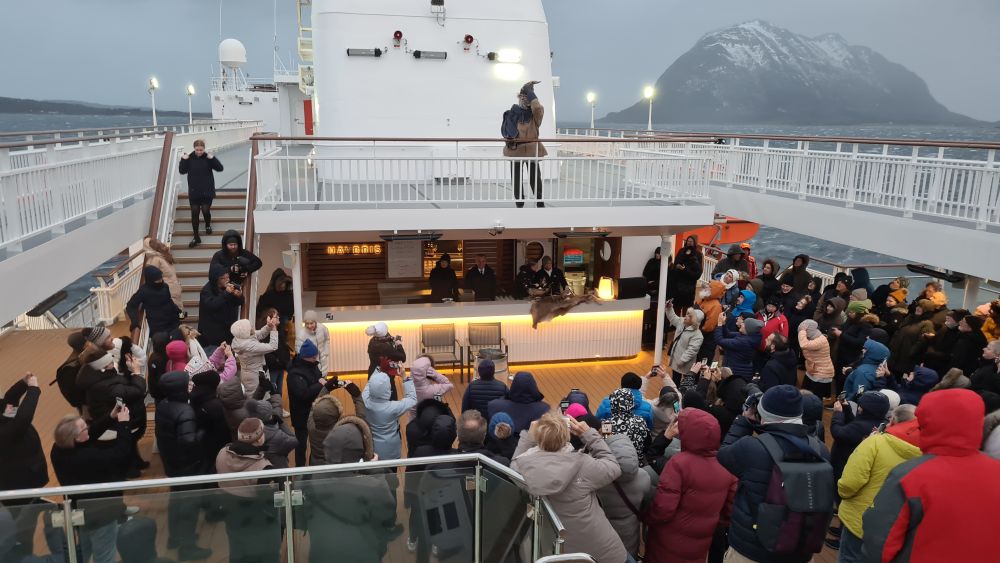
Njord and a crew member set up two chairs and proceeded to “baptize” the passengers. Each guest sat down and received a large ladleful of water and ice on their head and neck. Given the Arctic conditions, it was cold! When Albert’s turn came – he didn’t have to do it because we’ve crossed into the Arctic Circle before – the crew member took his winter hat off him, exposing his bald head, and poured the ice water onto his head. Pulling back on the back of his shirt, she poured more down his back.
As a reward, each passenger gets a shot of liquor to warm themselves up again.
Other events
On the day we entered a narrow section called the Raftsundet, we could join the staff on deck late in the evening for a drink of mulled wine (called Trollbrygg) served in a souvenir mug. We could also have a taste of Rømmegrøt, a porridge with butter, sugar and cinnamon.
I was aware of at least two more pop-up events, but didn’t attend them. I gather they involved tasting some sort of traditional food or local produce and drinking some local alcoholic beverage. Generally there’s an extra charge for these.
What else is there to do on the ship?
That’s about it, as far as events are concerned. As a non-traditional cruise, the onus is on the passengers to fill their days themselves. Some people, including me, kept busy working at their laptops. Others got a lot of reading done, while many just made conversation.
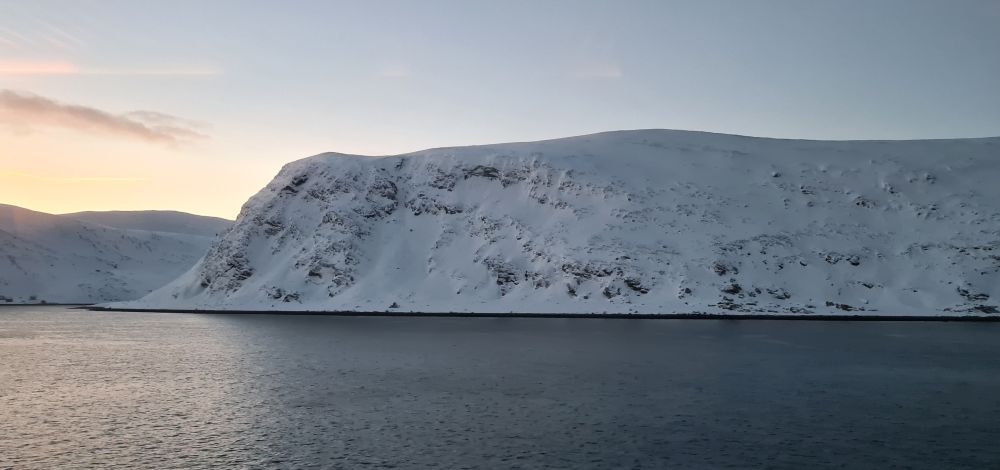
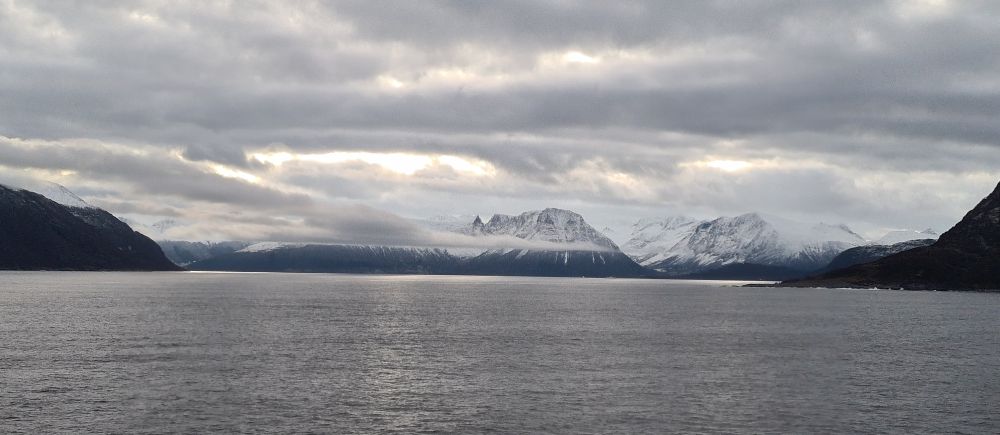
Depending on the time of year, there’s a lot to see outside as well. On this early-December trip, the blue-lit polar day only lasted a couple of hours, but the views are still stunning. Despite the cold, some passengers spent at least short periods out on deck trying to get pictures.
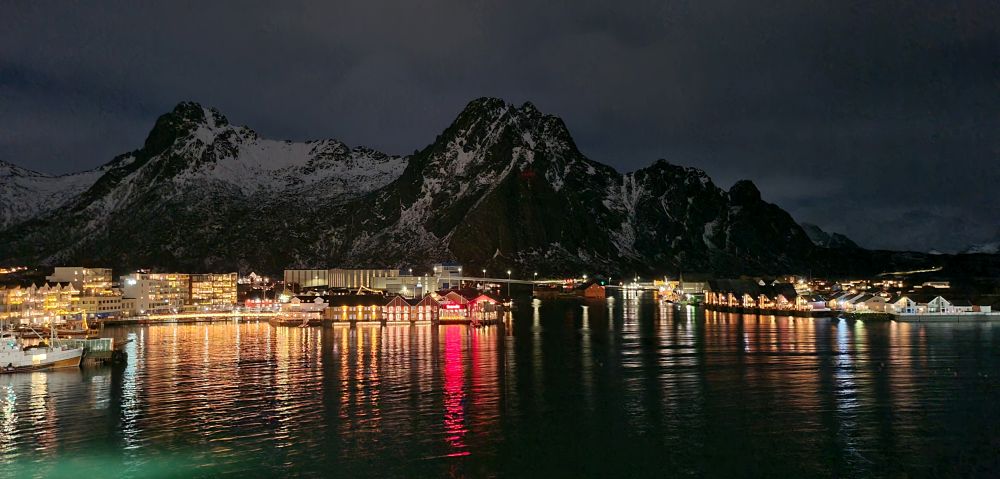
On the two evenings when the Northern Lights appeared, that number grew, but it was very cold and we all retreated inside pretty quickly after snapping some pictures. In the summer, as I experienced when I did the Hurtigruten trip on the same route, the views are constant and almost 24 hours, so you could be well entertained, as I was, just in watching the scenery glide by.
Where does the Norway coastal itinerary stop?
I won’t go into the route in any detail here, since I wrote about it before when I reviewed Hurtigruten. Both companies are required to stop at all the ports, weather permitting. However, in the winter, they don’t travel down Geirangerfjord or Trollfjord.
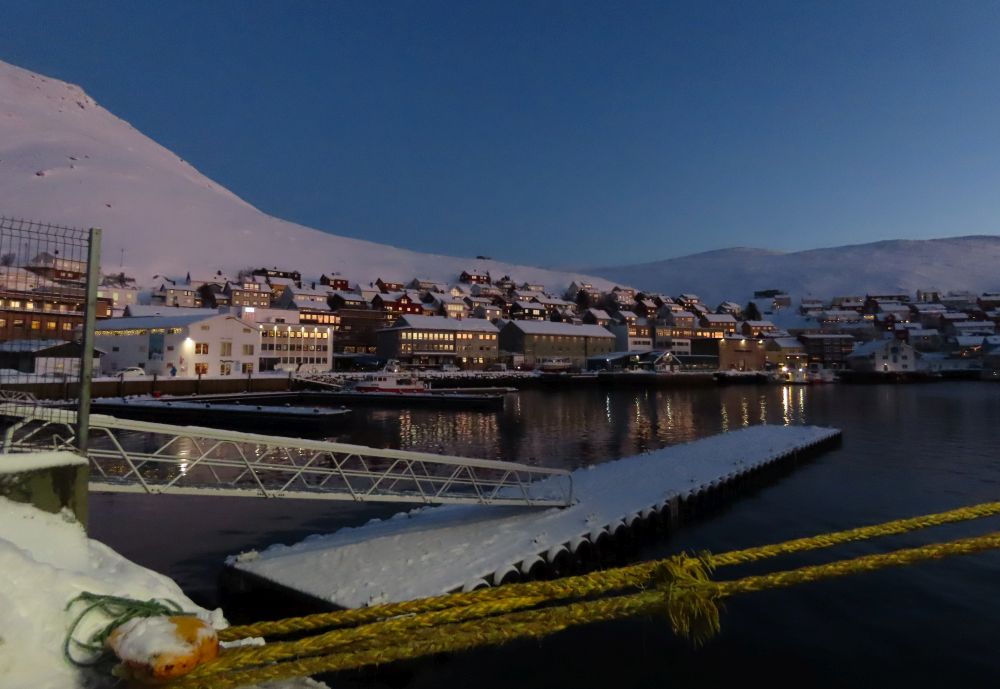
On the northward trip, there are 34 stops. Our longer stops were in Ålesund (twice, so we could get off for the whole day or just about three hours), Trondheim (three hours), Bodø (two hours), Svolvaer (one hour), Tromsø (four hours), and Honningsvåg (three and a half hours). Each of these was during the daytime – even if it was dark out – so if we didn’t have an excursion booked, we had time to visit a museum or just take a walk around the town.
On the southward trip, the ship stops at 33 ports. The longer stops are at Tromsø (almost three hours, but in the middle of the night), Stokmarknes (one hour), Svolvaer (two hours), Brønnøysund (two and a half hours), Trondheim (three hours), and Kristiansund (one hour).
The rest of the stops happen whether it’s night or day. Most of them are very short, taking perhaps 10-20 minutes. At night, depending on how deeply you sleep, you might be aware of stops because of the changes in the engine’s hum or a gentle bumping against a quay.
Can you see the Northern Lights?
This is the main attraction of a winter cruise: the opportunity to see the Northern Lights. We only took the one-way northward route, so we couldn’t count on seeing them. Havila does offer a guarantee: if you take a round-trip voyage – Bergen to Kirkenes and back – during the winter months and you don’t see the Northern Lights, you can take another cruise for free, but with an inside cabin this time. You’d still have to pay your own transportation to the ship, though, so I’m not sure how useful that is.
In any case, your chances are pretty good on a 12-day round-trip voyage in the middle of the winter that at least one night will be clear enough with enough solar storm activity.
We caught a glimpse of the Northern Lights twice. The first time, they were the sort you mostly can’t see with the naked eye. Smartphones are good at picking up the green streaks in the night sky, so we did manage to get a few photos. The second time was better, and there were lots of “oooh”s and “aaah”s as we shivered on the cold deck, watching the green-with-some-pink shapes flicker and twist across the sky.

What are the excursions like?
Many, perhaps most, passengers sign up for excursions, and there are some available every day of the trip, including at the two end-points. Havila has a long list of possibilities, but many are seasonal. Bird-watching, for example, only happens in the warmer months, and sledding only in winter. The excursions are pretty typical, ranging from city walking tours to hikes to more active experiences like ATV rides, dog-sledding, or cross-country skiing.
Anyway, here’s a brief description of the excursions we each took:
Kayaking and sauna in Ålesund
Albert’s Ålesund excursion involved kayaking right through the city, followed by a visit to a floating sauna. Here’s his story:
“From the boat we walked to the kayak center in Ålesund about five minutes away. I had dressed myself warmly but most of that had to be left behind in the changing room as we were handed drysuits. They, it turned out, kept us not only dry but also reasonably warm.
“Boarding the kayak, I took the front seat, leaving the steering to my more experienced Norwegian partner. The group paddled first to the open waters of the sea outside the city, where we were a bit more exposed to the wind and where the waves were a little rougher. Then we headed back into town towards the harbor where our ship was docked.
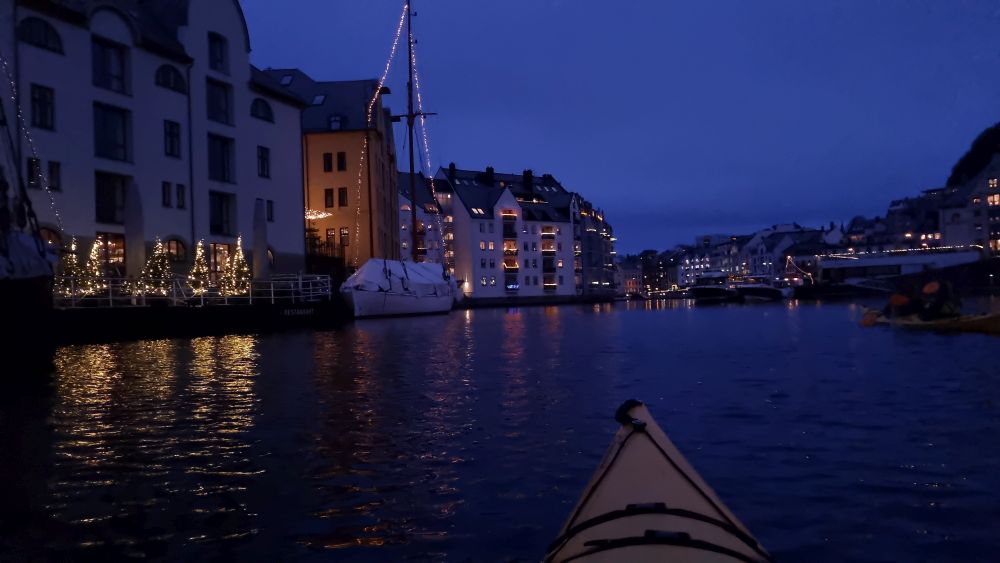
“We spent about 45 minutes paddling, starting off at dusk and coming back when it was already dark. It made for a non-strenuous and very atmospheric trip, with all the lights from the houses and the Christmas lights.
“Having changed back into our regular clothes, our next stop was a floating sauna. After warming up in the sauna while drinking a cold beer – as, we were told, was the Norwegian way – we finished the trip with a dive in the (very) cold water before heading refreshed back to the ship. All in all it was a very enjoyable excursion.”
Art Nouveau Walking Tour of Ålesund
While Albert was busy kayaking, I took a walking tour of Ålesund’s art nouveau architecture. It was a small group: just the guide and two of us guests.
The guide told us the history of the fire in 1904 that burned most of the city’s wooden buildings and related how the art nouveau style came to Ålesund. It’s a very different kind of art nouveau than I’ve seen in other parts of Europe: very understated and simple. Our guide called it “Norwegian art nouveau,” and, given the very understated style of, for example, Scandinavian furniture design, it seemed to fit the Norwegian aesthetic.

The guide seized the opportunity of the small group to show us places she could not have taken a larger group. Instead of just seeing the outside of the buildings, she showed us several interiors, all of them in this wood-toned Scandinavian vibe. She was knowledgeable and pleasant and showed real enthusiasm for her hometown.
Historic City Walk in Trondheim
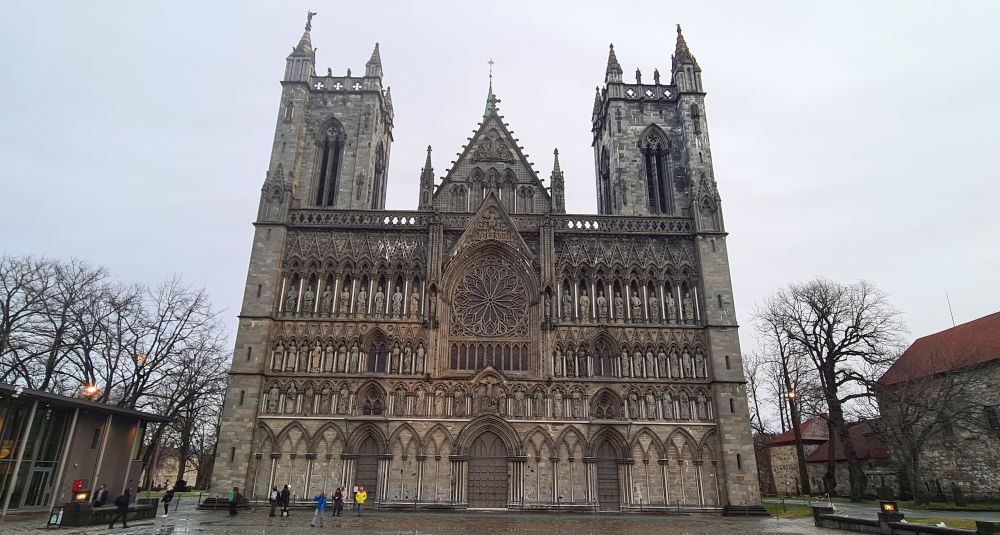
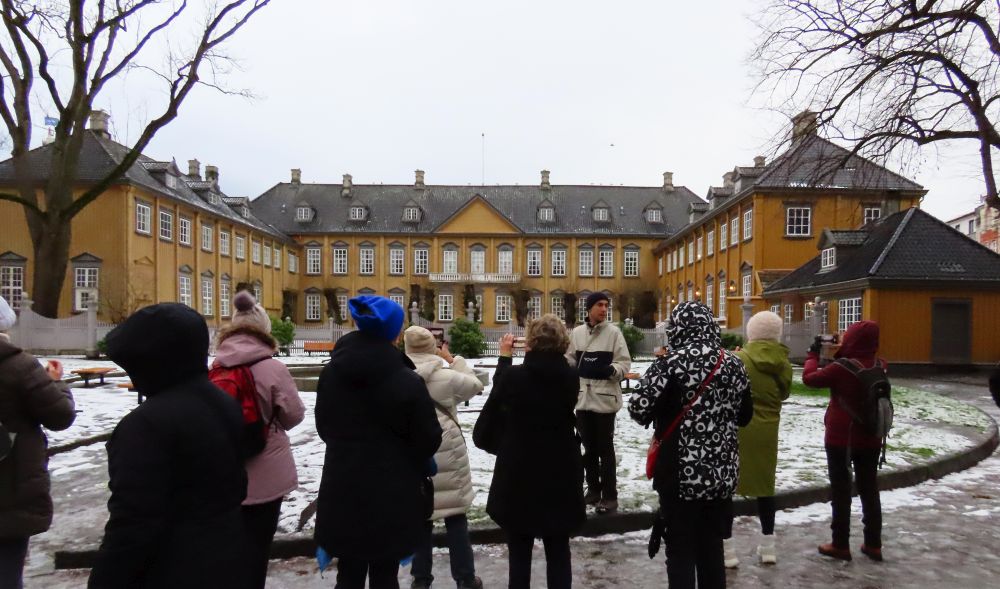
I had walked rather aimlessly in Trondheim on my Hurtigruten trip, but didn’t know anything about its history, and this tour was perfect to fill in the gaps. While I had seen much of the route already, the Trondheim guide was enthusiastic and knowledgeable about the town’s history and architecture. I was pleased to be able to spend some time inside Nidaros Cathedral, a remarkably well-preserved gothic confection about a thousand years old.
Arctic Coastal Walk from Bodø
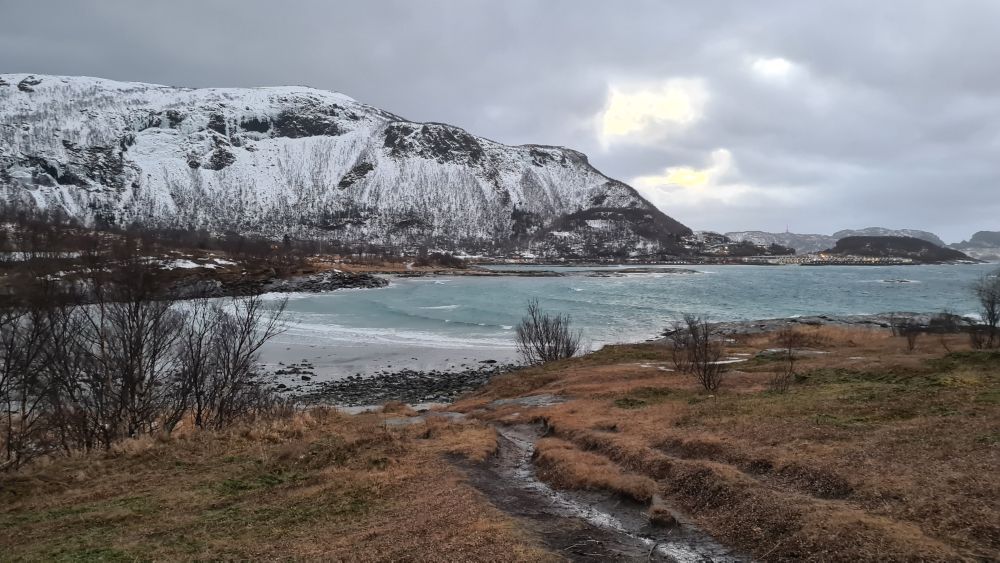
My last excursion was an “Arctic Coastal Walk” near Bodø. The sky was cloudy and a storm was threatening. It wasn’t that cold – about at the freezing point, but it was that damp kind of cold that enters your bones. I wasn’t all that enthusiastic about going, but I figured it couldn’t be a very long walk, since our stop in Bodø was only about two hours.
Another excellent guide led the walk, weaving commentary on the geology of the place with a dash of history – a Viking grave – and a large dose of local traditions around walking in the outdoors, fishing and lots of other topics. A second guide followed behind the group to deal with stragglers and also answered questions about life that far north.
We had all been issued metal crampons to put over our shoes. That was a good thing because, when we weren’t walking on a sandy beach, most of the path we trudged along was wet ice. It was a rather dismal landscape: rocky islands off the coast, barren snow-dusted hills rising above the beaches, bare and stunted white birch trees. It wasn’t a hard walk, though, and I’d dressed warmly enough. I enjoyed it mostly because of the guide’s stories, not the walk.
Reindeer & Sami
When his cross-country skiing excursion in Tromsø was cancelled, Albert instead signed up for the Reindeer & Sami excursion. Here’s his account of it:
“Prepared for cold weather, we took a bus that brought us to a Sami camp outside of Tromsø. There, in a tent with a fire in its center, a young Sami woman welcomed us and told us the program for the afternoon. We were divided into two groups: one group would ride the reindeer sleigh while the other would feed the reindeer, after which we’d switch.
“The sleigh ride was not very long (basically a large circle) but it was very atmospheric: it was dark with only sparse lights from houses in the distance. The moon was full and we saw some streaks of Northern Light.

“Feeding the reindeer was a bit of a challenge as some of them were very eager and tried to chase away other reindeer (usually the ones with smaller horns). It meant we had to pay close attention not to get hurt by those horns. Fortunately, we were instructed on how to go about the feeding and to lift the feeding bucket if they got too aggressive.
“Afterwards, we went inside to have a warm cup of tea and some reindeer soup. In the main tent, the woman told us about the Sami nomadic way of life and the challenges they encounter in light of climate change: a very interesting and insightful presentation.”
My Havila Voyages cruise review
In short, I’d give it five stars out of five.
- The ship is new and well-appointed, as are the cabins. It’s all kept very clean too. Except for during a storm one day, the ride was very smooth and quiet. In our cabin on Deck 5, I rarely noticed our nighttime port stops.
- The food is consistently excellent, interesting, and it’s locally-sourced as much as possible. I wish more cruise lines (and restaurants!) would adopt their small-portions concept to reduce food waste.
- I love their focus on improving their environmental impact levels. It means I can enjoy the luxury of a cruise without the feeling of guilt that a traditional cruise can mean.
- As a person with ADHD, the generally quiet vibe of the public spaces suited me perfectly. I don’t like noise or flashing lights or crowds or frenetic activity around me, and I had none of these on this trip.
- The staff was friendly and helpful at all times. Occasionally there were communication issues, though, so we had to repeat requests – reservations and food orders – that didn’t go through the first time.
- The excursions were very worthwhile, and I appreciated that most of them are locally-run: the guides live in the places they talk about. The local Sami community takes the lead on some of them, teaching guests about their traditions and culture.
- I wanted for nothing and the only thing I didn’t like was the changing room near the jacuzzis and its slow-closing doors.
- It’s an all-around elegant experience compared to many cruises: sophisticated food, understated decor, comfortable cabins, and none of the bells and whistles or constant upselling you experience on traditional cruises. Yet, at the same time, there is absolutely no pressure to dress up for meals. You can enjoy the elegant food in jeans and a t-shirt, if you want.
FAQs and advice
All of Havila’s ships are the same, so you don’t need to choose between them. Here’s some advice about choosing a Havila cruise.
Should you take a Havila Voyages cruise?
If you like constant entertainment, don’t take this cruise. If you can entertain yourself and are happy with a laid-back, quiet atmosphere, combined with great food and beautiful scenery, you’ll love this cruise.
Is this a good cruise to take with kids?
If you’re traveling with children, think carefully about whether this is something your kids can handle. There are no child-centered activities on board the ship. I only spotted one small corner on Deck 6 with a table, a few chairs and some boxes that probably contain some toys. Can your kids entertain themselves well enough that they won’t affect your enjoyment or that of your fellow passengers? If not, try a more traditional cruise instead.
On the other hand, if your kids are good at keeping themselves entertained, they’d likely enjoy some of the excursions. In the winter, they could take the Reindeer & Sami excursion, for example, or the dogsledding in Kirkenes. The “Feast with the Vikings” would be a hit too, I’d guess. Think about whether a single excursion each day – each costing extra – would be enough for your child.
Is Havila better than Hurtigruten?
I’m glad you asked! I wrote a separate article comparing the two. Read that to get the side-by-side comparison of all aspects of both companies, and to see which I preferred.
Which route is right for you?
The “coastal express routes” go either Bergen to Kirkenes or vice-versa in 6 or 7 days (5 or 6 nights), or you can do the round-trip in 12 days (11 nights). If you want a shorter experience, you can choose a shorter trip between any two port stops.
When I asked the CEO of Havila what he’d recommend, he suggested that the southbound route is better than the northward one. It’s cheaper and tends to be less crowded. He also likes the timing of the stops better. Of course, the round-trip would ensure you don’t miss anything.
When should you travel?
When you book a Havila Voyage, your first step will be to decide which season you’re looking for. I’ve taken a mid-summer northward journey on the Hurtigruten – read about it here – and this recent trip was the same northward journey, but on Havila in mid-winter.
They are very different. In summer, it’s light most of the time, and the views are enthralling. I had such a fear of missing anything that, except for meals, I spent pretty much the whole trip out on deck taking pictures. It meant I didn’t sleep much. I didn’t bother with any excursions either. It was gorgeous.
On this winter cruise, it was dark a lot of the time. At our first long stop in Ålesund, the sun rose at 9:30 and set just before 15:00. The next day, at the next long stop, Trondheim, it set by 14:45. By the next day, about the halfway mark of the itinerary, it was polar night, so the sun never rose above the horizon. That made for a peculiar bluish twilight for just a couple of hours in the middle of the day, with the colors of a sunrise on the horizon if the sky was clear.
The lack of bright daylight cuts into photography time. Even when you’re aware of dramatic snow-covered scenery passing by outside, you’re less likely to brave the cold to try to capture it on camera. On the other hand, it makes for a more relaxed journey: just watching what you can out the windows, and otherwise keeping yourself busy with other things inside.
The exception is when the Northern Lights make an appearance. That’s when most passengers throw on their warm layers and dash outside to see what they can. It was my first time seeing the Northern Lights, and it is a truly magical experience.
When I asked several Norwegians what they’d recommend, their answers were all the same: the best time is spring or fall, particularly in about May. It’s less crowded in these shoulder seasons than in the summertime. It’s still chilly, but the daylight hours are long. In May, you’ll see a very green landscape, like in the summer, but with plentiful snow on the mountains. And the spring is when the waterfalls will be at their fullest. In September or October, you’ll see the autumn colors and the early snows in the higher elevations.
Which cabin on a Havila ship should you book?
This depends on your budget, of course. If you have to watch it carefully, book an inside cabin and just spend most of your time in communal areas.
Generally, the standard Seaview Superior cabin is fine. If you’re traveling in the summer and you can afford the higher price, a balcony would be great. I’d suggest asking for a right-side view on a northward trip and a left-side view on a southward trip, so you’ll get the mainland views. Or take the roundtrip so you end up seeing both the mainland and the islands.
In the winter, a balcony probably isn’t necessary. A suite is a luxurious splurge, though I’d guess that the difference is mostly in the size of the room rather than in the furnishings, since the Seaview Superior cabins are well appointed too. If you can afford it, a lighthouse suite with the balcony jacuzzi would be really special.
When should you book?
Generally booking far ahead is best, especially if you prefer a suite or need an accessible room. Apparently, the two mini-suites that face forward right at the front of the ship book up the fastest.
If the cabin doesn’t matter too much to you, you can book within a few weeks of the trip, but you’ll have fewer cabin options. Interior cabins probably won’t be available anymore, so you might end up spending more than you mean to. Of course, for popular times – in the summer, mainly – that strategy is risky. You might not find any free cabins.
And speaking of booking, make sure to arrive at your starting point at least a day before your embarkation. Flights get delayed, connections get missed, and you don’t want that to spoil your Norwegian voyage.
How much does a Havila cruise cost?
I can’t quote exact prices because they vary depending on dates and how far in advance you book. What I can say is:
- The southward journey is cheaper than northward, but it’s also one night shorter.
- Winter is the cheapest time to travel.
- Traveling in spring or fall is cheaper than in the summer, but more expensive than winter trips.
- If you look at it on a per-night basis, the round-trip costs a bit less than one-way.
Keep in mind that drinks and excursions are additional costs. If you’re going to take a one-way trip, you also need to figure in the cost of transportation in the other direction. In our case, we flew home from Kirkenes.
What about tipping?
The price includes a service charge, so there’s no need to tip and no hidden gratuities charge. You can tip if you want to, though. Prices are in Norwegian kroners, but you can pay your bill at the end of the journey with a credit card. When you check in, they’ll scan your credit card, and the invoice will be sent automatically. Check it, because the total gets charged to your card automatically at midnight on the last night on board.
What kinds of outlets does the ship have?
Just like all over Europe, the voltage is 220V. Electronics like phones and laptops can use 220V outlets with no problem, but don’t bring anything from the US like a hairdryer or curling iron. If you really must, then you’ll have to bring a voltage converter as well.
The outlets are the European kind with two round prongs, so get an adapter if yours are different. Our cabin had USB outlets too, so you could use that instead.
What should you bring on a Havila Voyages cruise?
For a winter cruise, bring plenty of warm layers and warm, solid shoes for excursions. Make sure the shoes have a good deep tread for walking on icy sidewalks or snow. Alternatively, bring crampons to attach to them, or buy them in the ship’s shop.
For a summer cruise, bring layers as well, but thinner ones will be enough: a light jacket, a waterproof jacket or windbreaker, and a sweatshirt. But also have some short-sleeved or sleeveless shirts since it can get quite warm. Bring light shoes, but solid enough for excursions. For spring or fall, choose layers that are somewhere in between.
Don’t worry about style – the ship is very casual and there’s never a need to dress up.
No matter what time of year, don’t forget a swimsuit. You can use it in the jacuzzi, but you also might want to take a cold-water dive at one of the stops, like Albert did on his excursion. Even in summer the sea up north is cold. On the ship, a bathing suit is mandatory for the sauna as well.
Binoculars would come in handy, especially if you like bird-watching. And bring a camera!
Also pack whatever will keep you entertained between excursions and longer stops, especially if you’re taking a winter cruise. That could be a book, knitting, a pack of cards or some other game to pass the time.
Don’t forget any medications you might need. For certain highly-regulated medications, you might need a medical certificate or other paperwork. It’s all detailed on this website. Follow the rules carefully. Customs officials are unlikely to check, but it could ruin your trip if they raise questions.
Unless you’re very particular, there’s no need to pack shampoo or conditioner; they’re provided, and it’s an excellent locally-produced brand.
How wheelchair-accessible is a Havila ship?
Each ship has, according to Havila’s website, 18 wheelchair-accessible cabins (ten inside with no window, six Seaview Superiors, and two with balconies). There are elevators and no stairs within the ship, and plenty of room for wheelchairs to move around.
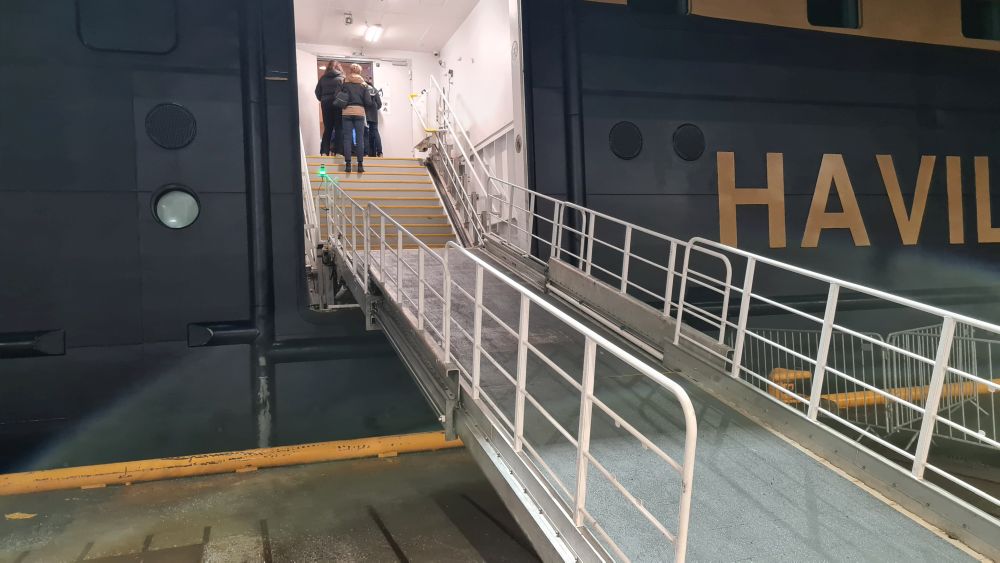
The gangway, however, might be a bit problematic. It’s a flight of stairs plus a ramp. A wheelchair lift will take you down or up the stairs, but the ramp, I noticed, is quite steep at times. I guess it depends on the height of the wharf at each port. Or maybe it has to do with the tide. I think, depending on the wheelchair you’re using, you might need someone to help slow your descent and, when you board again, to push you back up the ramp.
The jacuzzis only seem to be reachable via a half-flight of stairs, unless the ship provides some sort of lift that is stored somewhere else.
Other tips
The ship can roll a little or a lot, depending on the weather and where it’s sailing – open sea or between islands and mainland. If you have a tendency to seasickness, definitely bring your medicine along. We had several hours one day when the waves were as high as 8-10 meters as we crossed an area of open water. The ship rolled rather dramatically. We were fine, but many other people retreated to their cabins to lie down, not emerging until we entered a calm port. The whole rest of the week was very smooth.
Make sure that, if you have any dietary restrictions, you say so both when you reserve and when you are on board. Tell your server at every meal.
Don’t worry about the language. Norwegians generally speak English well, and most important communications on board the ship are in English, German and Norwegian. Even the staff members who aren’t originally from Norway speak at least Norwegian and English. And, at least on our voyage, they have plenty of English-speaking passengers.
The ship has pretty good Wi-Fi. It’s probably not good enough for streaming, but I was able to use it for e-mail and website work with no problem. I also made voice calls using Whatsapp. Use the Wi-Fi rather than data from your SIM or eSIM while you’re on the ship. Turn off your data roaming so you don’t end up getting charged for maritime data use. Maritime use isn’t covered on your SIM or eSIM and can cost a fortune.
And speaking of money, watch your spending. As on any cruise, it’s easy to overspend when it’s so easy to just put everything on your card. Drinks add up fast.
The tap water is drinkable, but tastes a bit of chlorine. Bring a water bottle and fill it at the filtered-water dispenser outside the shop on Deck 6.
Go to the daily meeting in the conference room so you’ll know what’s going on. I missed, for example, some sights we passed because I skipped some of the meetings and didn’t know they were coming up.
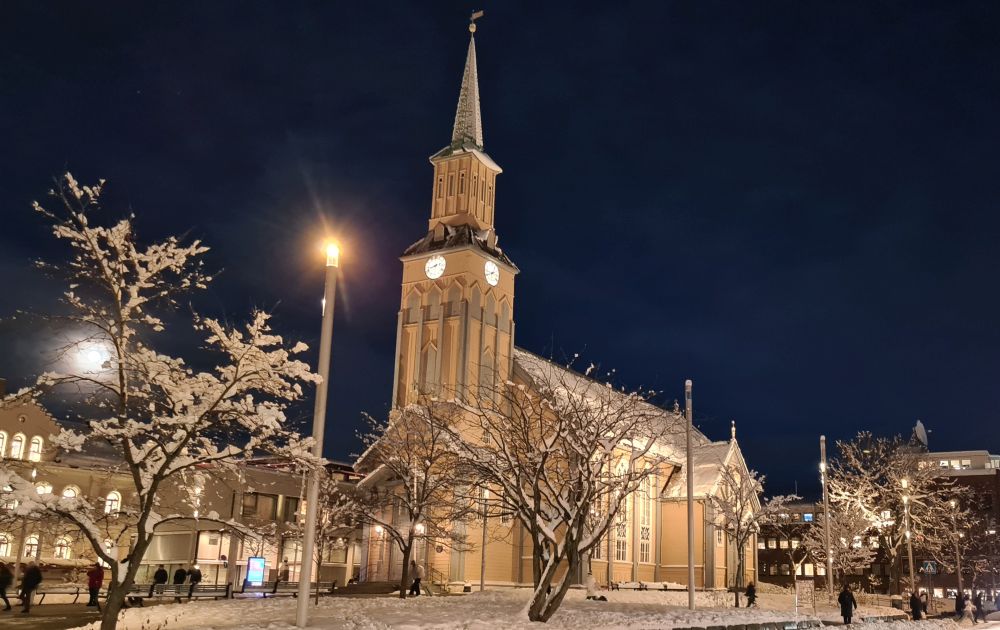
You don’t have to take the excursions. At the longer stops – generally one each day on the northward route – you can just get off the boat and wander. When I didn’t have an excursion booked, I looked up the local museums and chose one to visit. Tromsø and Trondheim in particular are both very pretty towns with attractive shops and interesting museums.
If you’ve made it through this very long review, congratulations! Are you considering a Havila cruise? Please add a comment below if you still have any questions I didn’t answer.
My travel recommendations
Planning travel
- Skyscanner is where I always start my flight searches.
- Booking.com is the company I use most for finding accommodations. If you prefer, Expedia offers more or less the same.
- Discover Cars offers an easy way to compare prices from all of the major car-rental companies in one place.
- Use Viator or GetYourGuide to find walking tours, day tours, airport pickups, city cards, tickets and whatever else you need at your destination.
- Bookmundi is great when you’re looking for a longer tour of a few days to a few weeks, private or with a group, pretty much anywhere in the world. Lots of different tour companies list their tours here, so you can comparison shop.
- GetTransfer is the place to book your airport-to-hotel transfers (and vice-versa). It’s so reassuring to have this all set up and paid for ahead of time, rather than having to make decisions after a long, tiring flight!
- Buy a GoCity Pass when you’re planning to do a lot of sightseeing on a city trip. It can save you a lot on admissions to museums and other attractions in big cities like New York and Amsterdam.
- Ferryhopper is a convenient way to book ferries ahead of time. They cover ferry bookings in 33 different countries at last count.
Other travel-related items
- It’s really awkward to have to rely on WIFI when you travel overseas. I’ve tried several e-sim cards, and GigSky’s e-sim was the one that was easiest to activate and use. You buy it through their app and activate it when you need it. Use the code RACHEL10 to get a 10% discount!
- Another option I just recently tried for the first time is a portable wifi modem by WifiCandy. It supports up to 8 devices and you just carry it along in your pocket or bag! If you’re traveling with a family or group, it might end up cheaper to use than an e-sim. Use the code RACHELSRUMINATIONS for a 10% discount.
- I’m a fan of SCOTTeVEST’s jackets and vests because when I wear one, I don’t have to carry a handbag. I feel like all my stuff is safer when I travel because it’s in inside pockets close to my body.
- I use ExpressVPN on my phone and laptop when I travel. It keeps me safe from hackers when I use public or hotel wifi.

Rachel Heller is a writer living in Groningen, the Netherlands. She is the owner and primary author of this website, Rachel’s Ruminations, a travel blog focused on independent travel with an emphasis on cultural and historical sites/sights. Read more here about her and about this website. All photos in her articles are her own, unless otherwise specified. Rachel also owns and operates a website about World Heritage travel.
What a brilliantly informative article! I’m just in the process of planning a cruise / trip in February next year. It’s very early but I’m a planner… your tips and tricks have answered a lot of my questions. My main conundrum is whether to do port-to-port or a round trip or a mix of both! Reason being is that Tromso, Lofoten and Alesund in particular look so interesting that I’m wondering if I should spend at a bit more time in each. The idea of packing and unpacking is a bit off putting though…. So it’s interesting to read about how much time you had at those places, especially Alesund and Tromso. I guess if I love them that much, I’ll have to come back, perhaps in spring. Anyway, thanks for the insight 🙂
I’m glad it was helpful! We had a few hours each in Alesund and Tromso, and then we flew back from Kirkenes to Tromso, so we had more time in Tromso. As for Lofoten, there are several short stops, but you pretty much have to take an excursion, I’d say, to see much. With either Havila or Hurtigruten, you can book it so that you get off at any port, stay a couple of nights and get back on to continue the journey. But that means packing up more often, of course.