

Turkestan, Sauran & Otrar: 3 Silk Road ruins in Kazakhstan, compared
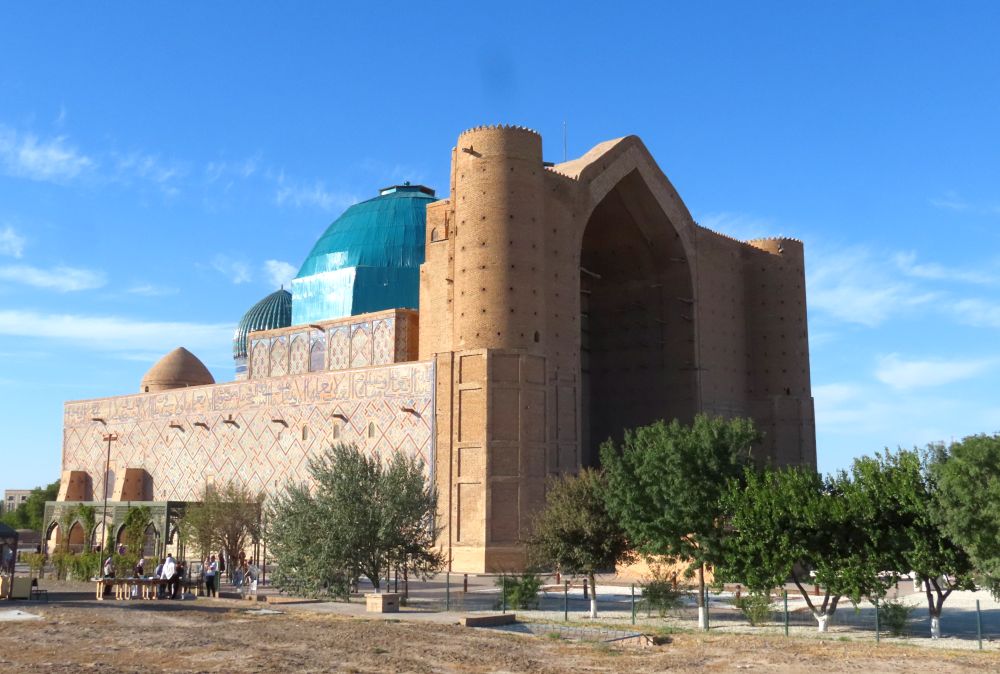
Turkestan’s modest tourism industry is mostly based around a UNESCO site: the Mausoleum of Khoja Ahmed Yasawi. But Turkestan – sometimes spelled as Turkistan – was a stop on the so-called Silk Road, and the ruins of its Silk Road city are right near the mausoleum. We visited the ruins and the mausoleum, but also, on our quest to see lots of Silk Road sites, we visited two other medieval-period Silk Road cities near Turkestan as day trips: Sauran and Otrar. Both of these are also in ruins, and both are about an hour’s drive away.
Disclosure: This article contains affiliate links. Making a purchase through an affiliate link will mean a small commission for this website. This will not affect your price. Privacy policy.
What was the Silk Road?
The Silk Road is often portrayed as just that: a road. In reality, it was a number of different routes. Not only that, but the routes shifted and changed over the centuries because of political developments or shifts in goods that were transported.
What products moved along the Silk Road?
It is common knowledge that this trade route was the way that silk from China – for centuries the only place it was produced – made its way to the Mediterranean and Europe. That is true, and this movement between China and Ancient Rome, Egypt and Greece started as early as the 1st century BC. It lasted, with many shifts and changes, until about the 15th or 16th century, when the Western powers explored ways to move goods by sea instead, allowing them to avoid the territory of the Ottoman Empire.
But it wasn’t just about silk. Lots of other goods moved along the routes: tea, spices, lacquerware and porcelain moved west while things like wine, gold and horses moved east. It also wasn’t just between Europe and China. Lots of goods went shorter distances. For instance, dates and nuts from what is now called the Middle East went to China.
Intangible things also traveled along the routes: the plague, for example, likely arrived in Europe from Central Asia. Knowledge too: scientific and philosophical ideas and, of course, knowledge about the cultures along the routes. Religions spread as well: Zoroastrianism, Buddhism, early Christianity and early Islam.
What was it like to travel on the Silk Road?
The other myth is that merchants traveled the whole route. Mostly they just did a section of the route and the goods were sold on from there, which meant many of the cities along the route were not just rest stops; they were trading centers.
It wasn’t an easy or safe way to make a living. The routes weren’t organized or secured in any way; they developed organically and trading posts and waystations (caravanserais) appeared along them. Caravans, with wagons and animals loaded up with valuable cargo, could be attacked by bandits or get caught up in local wars. The weather could be harsh: desert heat, sand storms, or lack of water could wipe out a caravan. And so on.
Where is the Silk Road?
There were many, and they changed depending on wars and other events. At the moment two have been designated by UNESCO as World Heritage sites, but more are on UNESCO’s tentative list. The routes extended from China to Europe by way of India, Afghanistan and Iran, or by way of Mongolia, Kazakhstan, Kyrgyzstan, Tajikistan, Turkmenistan and Uzbekistan into Iraq and Syria and then on to Greece, Turkey and Italy.
Whatever route the caravans traveled, they had to stop often to rest, feed and water their camels, horses or donkeys, and also to buy and sell goods. Cities rose and fell along these routes, especially where routes crossed, and especially at oases because of their secure water supply. Turkestan, Sauran and Otrar were three such cities.
Kultobe in Turkestan, Kazakhstan
The Turkestan ruins have a single explanatory sign at the entrance. The site is called Kultobe, and it dates to between the 2nd century BCE and the 14th century CE. It includes the remains of a citadel, a temple, residential areas and streets. It also has fire altars, used by Zoroastrians.
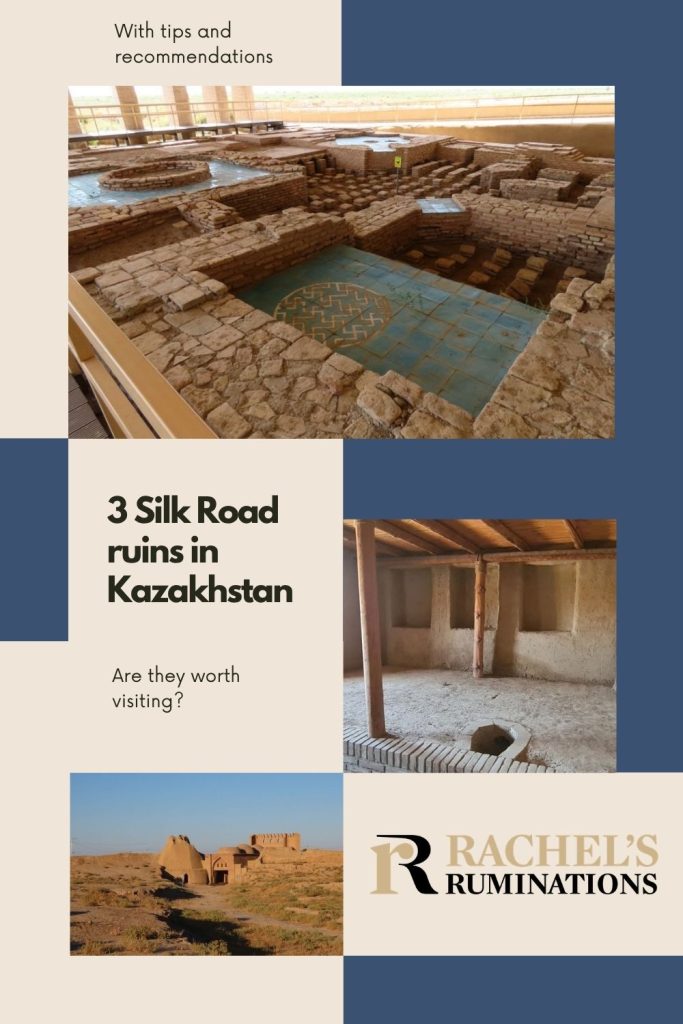
The ruins – in two sections – have been stabilized and it looks like they’ve been rebuilt to some extent. An open-air section is mostly a warren of low foundation walls outlining buildings and streets. What I appreciate about it is that visitors cannot go walking among them. Instead, they walk wooden walkways above them and look down at the remains.
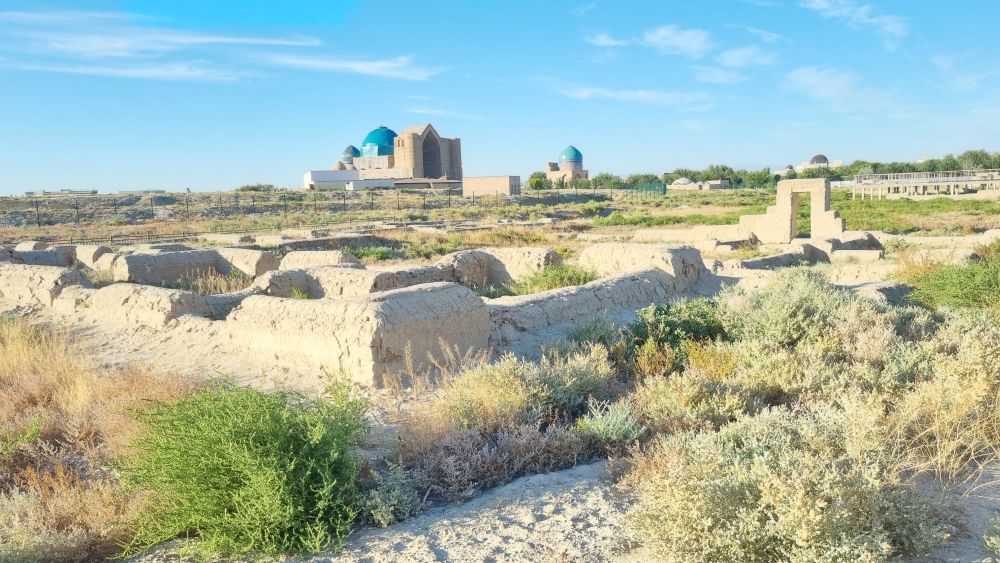
On the other hand, it also means that the ruins are exposed to the weather. They look, for the most part, like they’ve been sealed off with plaster or concrete, which would certainly protect them, but also makes it hard to know what you’re seeing. There’s no signage anyway, so you can only guess as to what each structure might have been.
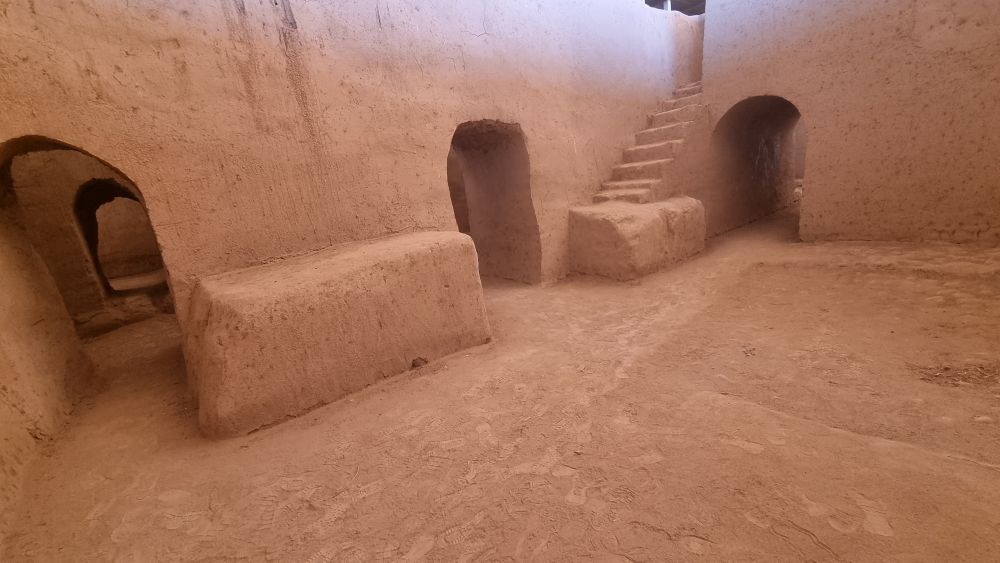
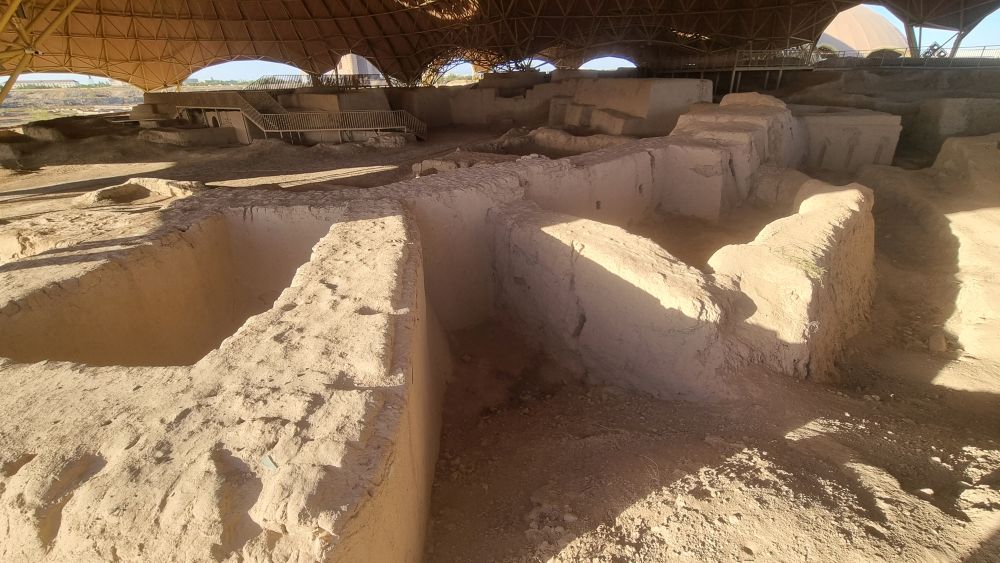
The other section has huge domes protecting it, open to the outside air around the bottoms, but preventing rain from hitting them. This section also has no signage, which is frustrating because the ruins are extensive. As a non-expert, I found it hard to tell what anything was.
Walkways in this section allow visitors to both climb above the walls and look down and to descend to the floor of the buildings. Some walls look like they might be their original height, and you can walk from room to room, along halls (or streets?) and through archways. When I walked around the maze of rooms under one of the domes, it seemed very likely to me that it has been completely refurbished. The mud daub that covers the walls is just too neat, and so are the arches. The lack of any explanatory signs meant, while it was fun to get lost in the maze of rooms, I learned very little about the ancient city that was here.
Is Turkestan worth visiting?
Turkestan as a whole has quite a few things to see and do. It might be worth visiting, but not especially to see the Kultobe ruins. Besides the Mausoleum of Khoja Ahmed Yasawi and the Kultobe ruins, you can see:
- A few other Silk Road period sites including a bathhouse, the Hilvat Underground Mosque – which didn’t seem to be open when we visited – and the smaller Mausoleum of Rabia Sultan Begum nearby.
- The Karavan Saray, also nearby, is a huge shopping center, essentially, but it is very pleasant for a walk in the cool of the evening. There’s a free light show on the canal next to it every night.
- You can also spend some money and see the Flying Theater show in the giant gold egg-shaped building next to Karavan Saray. It’s a 4D production that’s very light on information, though they do rush you through a token history ahead of taking your seat for the “flight.” It’s fun, though, and shows some of Kazakhstan’s stunning scenery.
In other words, I think the ruins on their own are not worth a special trip, but if you’re in the area anyway, you can visit it and several more sights within an afternoon. Or if you’re in Shymkent, sign up for a day tour to Turkistan.
What should you know before visiting Turkestan?
You’ll have to pay admission to the National Historical and Cultural Museum-Reserve Aziret Sultan, which includes the Mausoleum and the ruins of Kultobe. Hang on to the receipt because you’ll need to show it at the mausoleum and other parts of the park.
You’ll be doing some walking between the sights within the park, so wear comfortable shoes and a hat and put on sun lotion. Parts of the park are prettily manicured and offer shade, but around the ruins there’s no shade outside of the dome-covered part.
If you are wearing shorts, whether male or female, you’ll have to put on one of the robes you’ll find inside the mausoleum. Women should have their shoulders and knees covered, and wear a scarf to enter the mausoleum. Be quiet and respectful inside; many people come here for worship, not as a sightseeing trip. On the other hand, you can wear what you want in the rest of the park, as far as I could tell.
Book your Flying Theater tickets ahead or stop by when you first arrive at the park. It’s not cheap. The light show on the canal, on the other hand, is free.
For a splurge, book a night in the Karavansaray Hotel, right in the shopping center. It includes free admission to the Flying Theater. If you’re looking for something less expensive, there are plenty of other accommodation options.
The paths in the park appear to be wheelchair accessible for the most part, but not everywhere, and you won’t be able to go into many of the buildings.
The ruins themselves will only take about an hour to see, but if you want to see the other elements of the park and stay for the evening light show and/or the Flying Theater, you could spend the whole day. You’ll find plenty of things to eat at the Karavan Saray.
Find accommodations in Turkestan.
Sauran, Kazakhstan
Sauran (sometimes spelled as Sawran), about an hour and a quarter northwest of Turkestan, was a thriving Silk Road city of 15,000 people from the 13th-18th centuries. It had huge defensive walls and two gates. In its center was a square, with a mosque and a madrassah along with living quarters and ritual spaces for Sufis.
What is Sauran like today?
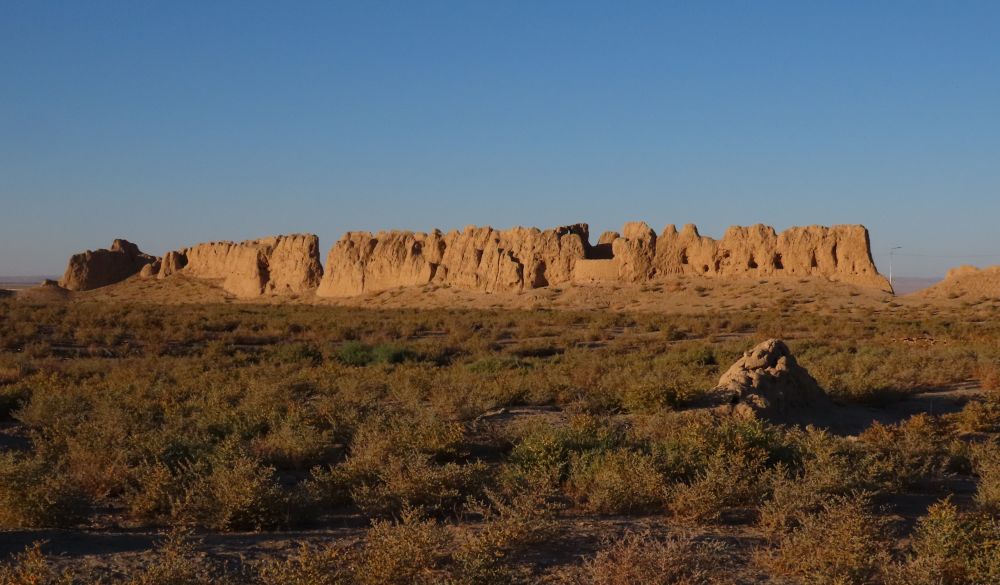
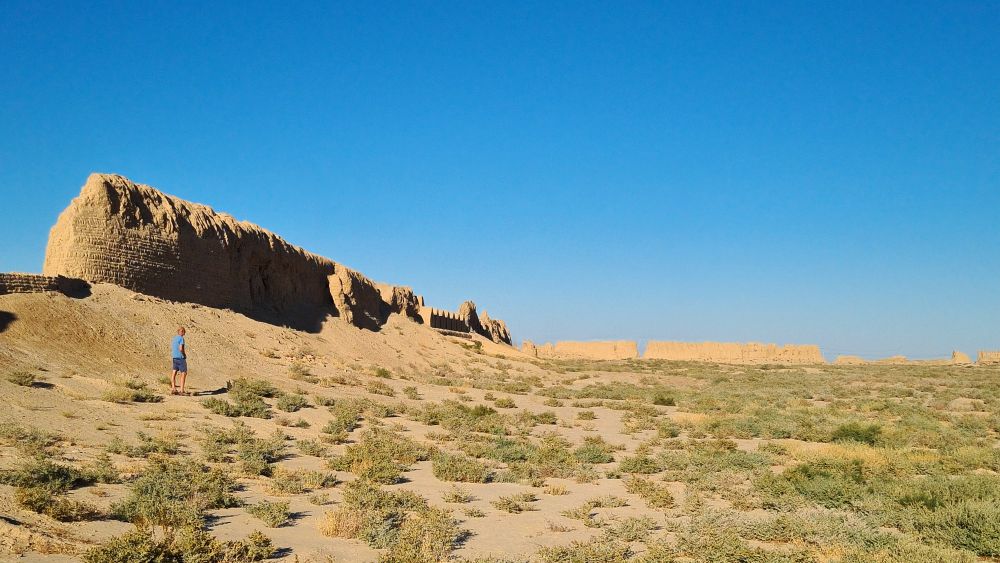
Today, not much remains. Some of the defensive walls still stand, very eroded, poking from hills of dust. One of the entrance gates has been rebuilt, illustrating how imposing the city must have seemed for the travelers as they arrived with their caravans. From the looks of it, the madrassah and the Sufi area are being rebuilt, or at least enough to suggest what they might have looked like.
As for the rest of the city, it appears that none of it has been excavated. The huge area inside the walls is a series of dusty hummocks covered with thorny shrubs. Beyond the new paved walkway from the entry gate to the central square, there are no informational signs and no paths.
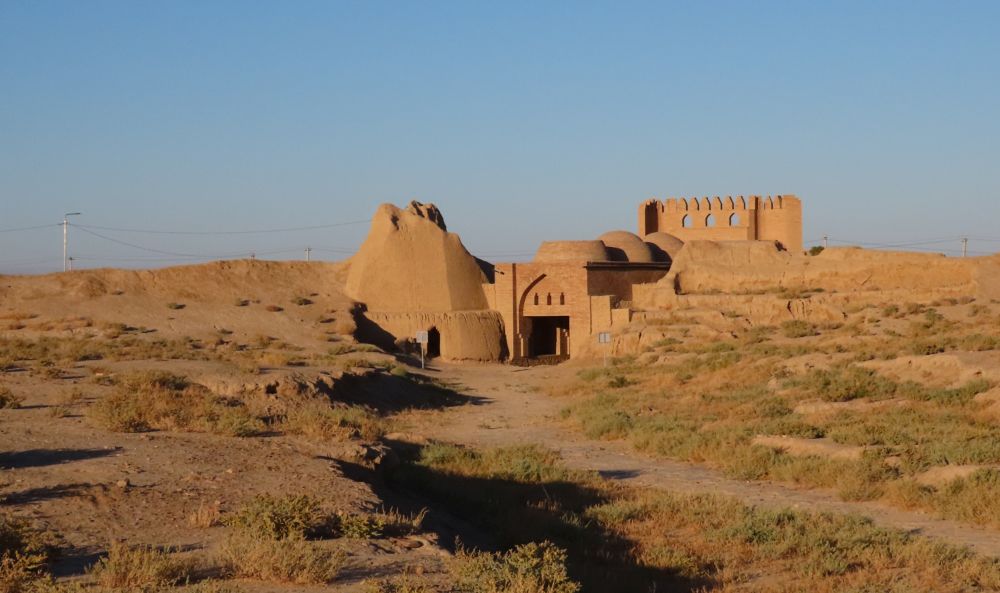
Our observations at Sauran
We had the place to ourselves, other than a few men working on the madrassah restoration. Wandering along the inside of the wall, we picked our way between the thorny shrubs. The wall, in places, towered above us, and slopes of eroded dust separated us from it.
As we trudged along, stopping for pictures of the walls, we began to notice what was under our feet. The ground was littered with shards of pottery. Some had striations like they’d been made on a potter’s wheel. Some had traces of paint or glaze. We noticed quite a few bottoms of pots and one handle.
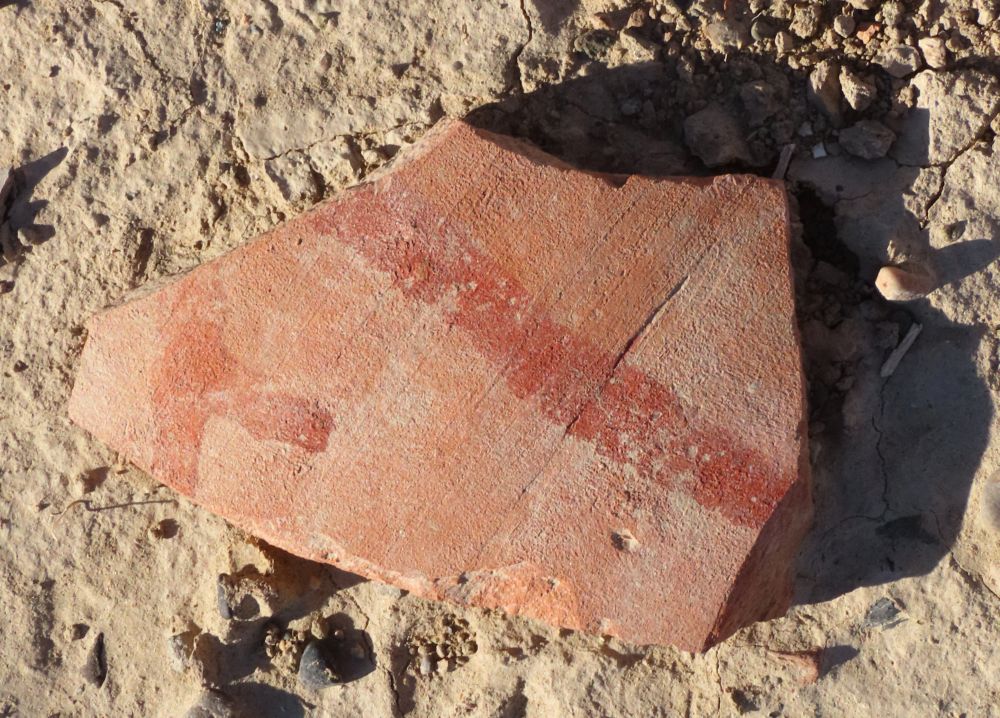
I read after our visit that when the Mausoleum of Khoja Ahmed Yasawi was built in Turkestan in the late 14th century, the tiles and brick came from Sauran. That explains the pottery shards we saw all over the site: it was a pottery production center.
It had been dry for weeks when we visited, and as we walked we raised puffs of dust with every step. I imagine that if it has rained recently, visiting Sauran would mean some slogging through mud.
Is Sauran worth visiting?
Having the place to ourselves during the “golden hour” when the sun is low was pretty magical for us. It wasn’t completely quiet; the wind was blowing and from time to time noisy cargo trains passed nearby. But we felt like explorers of a sort; finding pieces of pottery, figuring out what they might have been part of, dropping them again and looking for more. It made me regret I didn’t study archeology.
On the other hand, I had lots of questions about the place, and because it is still unexcavated and there was almost no signage anyway, I left with just as many questions.
What do you need to know before visiting Sauran?
You’ll likely need to either rent a car or take a taxi. We rented a car from this company. The problem with taking a taxi is that most people use Yandex in this part of the world. However, Yandex just does point to point, and since Sauran is in the middle of nowhere, you can’t just call a Yandex to take you back to Turkestan again or, if you do, you’ll have to wait a long time for them to arrive. You’ll need, instead, to hire a taxi driver without using the app and negotiate so that the driver waits for you. Ask at your hotel if they know someone and what a fair price would be.
I looked Sauran up before we went and read several blog posts about it. Things have changed since any of the ones I read were written. They tell you to go past where the signs point to Sauran because that’s the modern village. They say to go another 10 kilometers past those signs to find the ancient city.
Not true. There’s a new road now, and the signs that say “Sauran City” are the ones to follow.
Will you also be visiting Almaty? Read this: Arasan Spa: A naked, awkward and surprisingly great cultural experience.
Wear closed shoes. We had sandals on and ended up covered in dust and a bit scratched up from the thorny shrubs. If it’s rained recently, make sure you wear closed shoes that you don’t mind getting dirty.
I’d also recommend long pants. I had longish shorts on, but I wouldn’t have gotten so scratched around my ankles if I’d worn long pants.
Do not take any of the pottery shards. They should stay until the place is excavated!
There is a parking lot in front of the entrance. As far as we could see, there is no fee to go in and no ticket booth. This could change in future if they restore any more of it.
Apply sun lotion and wear a hat and sunglasses if you visit in sunny weather. Bring water as well. The walking isn’t easy once you get past the entrance. There are no toilet facilities.
The entrance seems wheelchair accessible, but you won’t be able to get further than however far the single paved path goes: probably just to the central square. With flat stones as pavement, it’s still bumpy, but a wheelchair should be able to manage it.
The rest of the site is a series of bumpy hillocks with no paths to speak of other than a very rutted driving path used for the restorations at the central square.
It took us about an hour to walk along the wall to the side directly opposite the entrance gate, then cut straight back through the center.
Otrar, Kazakhstan
Otrar (or Otyrar) has a similar story. About an hour south of Turkestan city, it is older, dating to somewhere in the first few centuries CE, but, like Sauran, its heyday was in the Middle Ages. The city of about 5,000 people stood on a hill – all around it is very flat agricultural land – and a high wall with three gates protected it. The area was an oasis because of the Syr Darya river, which allowed the construction of irrigation systems. It was, like Sauran, a center of pottery production.
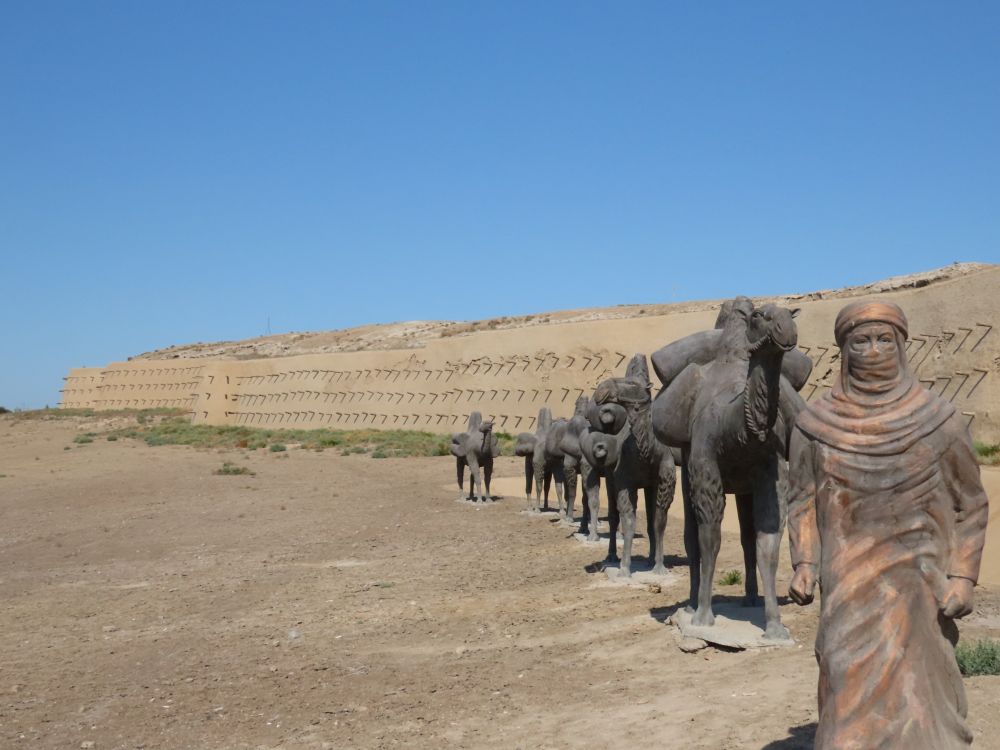
Destroyed by Ghengis Khan in 1219 – including all of its inhabitants – Otrar gained importance again after his death. By the 15th century the city was part of Tamerlane’s (Timur’s) empire. In fact, Timur himself fell ill and died here in 1405. By the 17th and 18th century, the Silk Road had become less important. Once the Dzungars destroyed Otrar’s irrigation system in the 17th century, the city slowly died.
What is Otrar like today?
Unlike Sauran, Otrar has been partially excavated and partly redeveloped. The three gates are modern rebuilds or replicas. A paved walkway extends across the center of the city, and as you walk it you pass several interesting sights. Most of the city, though, is just like Sauran: bumpy scrub-covered land, complete with pottery shards.
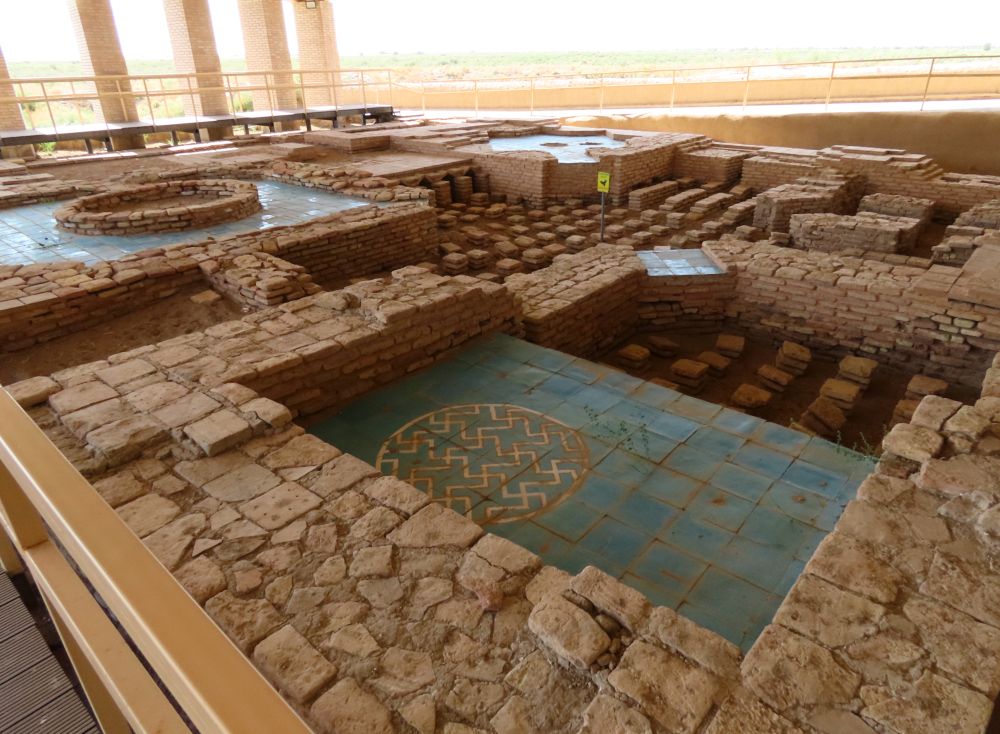
Some places are excavated and only restored to the extent of stabilizing the ruins or replacing stones to help visitors understand what was there. For example, a new roof protects what was once a bathhouse. Some tiled areas have survived, and you can see the small piles of bricks that once held up the floor, allowing heated air to circulate to heat the rooms.
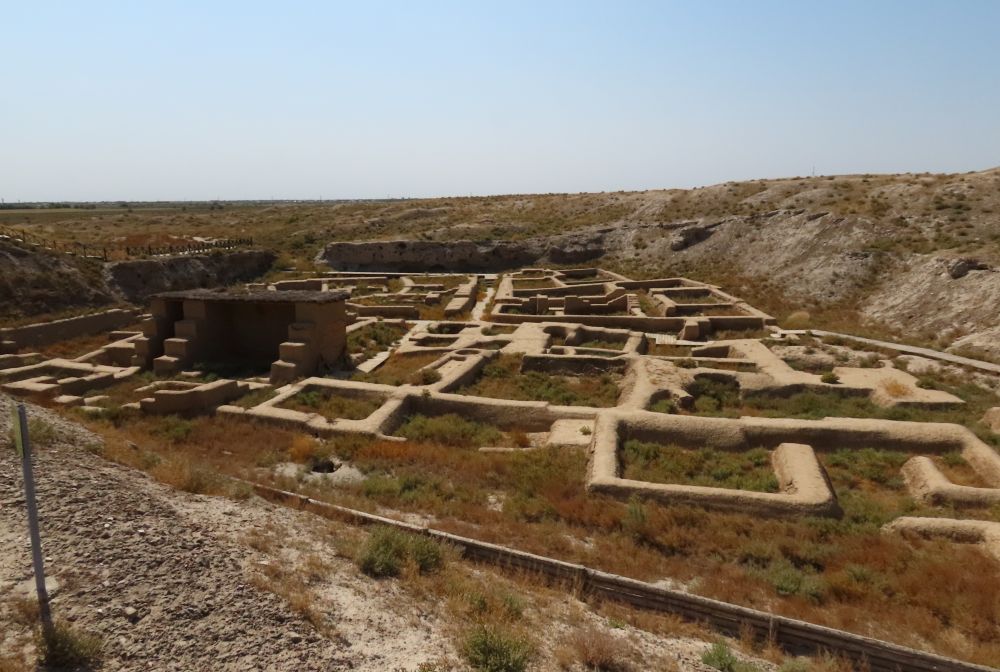
At another spot, a few residential buildings, excavated only to their top stories, make it clear why so little has been researched. Centuries of wind and dust have buried the houses six meters deep.
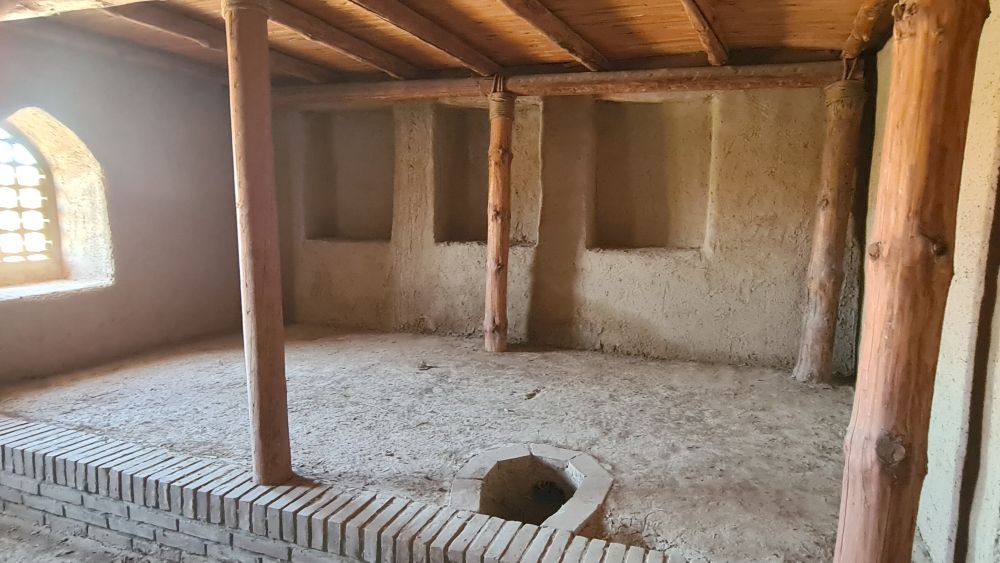
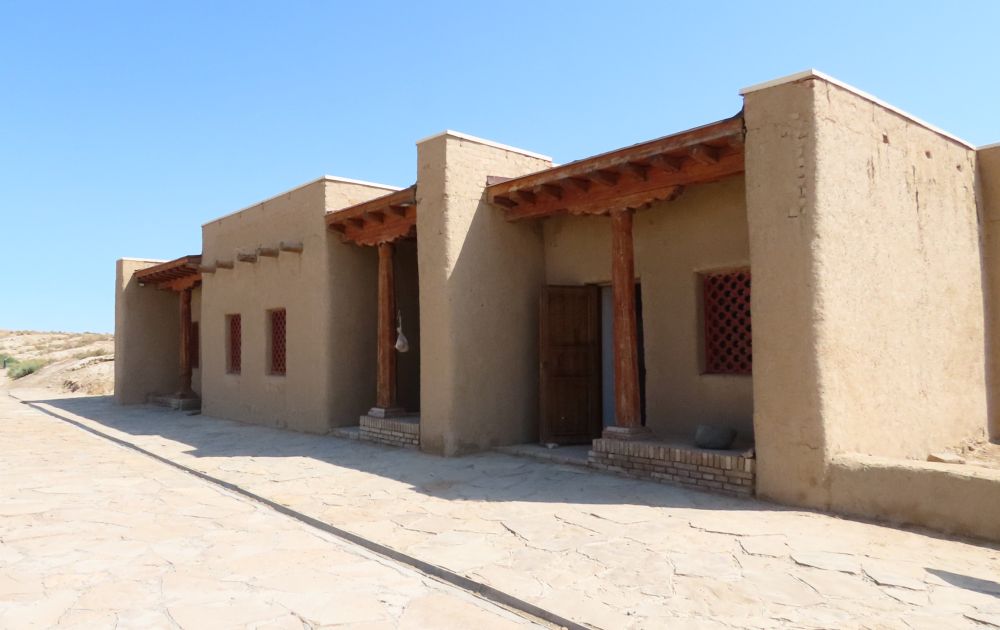
In other places, new buildings illustrate what the original structures might have looked like. Visitors can enter what was once a potter’s studio, for example, or various residential buildings from several different centuries. These buildings of wood frames and mud bricks are covered in a plaster that appears to be a mix of mud and straw. It’s not surprising that so few such buildings have survived the centuries. They’d gradually erode to nothing.
Is Otrar worth visiting?
I had mixed feelings about how this archeological site has been readied for tourism. While it certainly gave me a much clearer idea of how people in these cities might have lived, I hope they don’t rebuild too much. The stabilized and protected ruins seemed more interesting and worthwhile to me. Building too many reproductions could turn it into a sort of Disneyland version of a Silk Road city. In any case, huge areas of the ruined city remain unexcavated.
I do think it’s worth visiting if you’re in the area, and I’d recommend it over Sauran or the ruins in Turkestan. The signage is distinctly better, and the replica buildings do help you to understand what these Silk Road stops might have been like.
What do you need to know before visiting Otrar?
Again, the best way to get there is by rental car or taxi. It’ll take about an hour from Turkestan. When you turn off the highway, the side road will split. Even if your GPS says to go left, don’t. Follow the sign to the right that says something like Otrartobe. That’s the ruined city, not the modern-day village. You’ll find a parking lot in front of the entrance.
There is an entrance fee to this one: 2000 tenge, as of this writing. That’s the equivalent of about 4 euros. They accept card payments.
You can stay on the modern paved path for pretty much all of your visit, though you might want to step off it onto the dirt paths to see some of the excavated parts more closely. It was very dusty when we visited, so closed shoes made sense. If it has rained recently, stepping off the path will mean mud.
The paved path, like at Sauran, is bumpy but wheelchair accessible, and it covers more territory. However, the replica buildings often involve steps up or down, as do the side dirt paths. One of the gateways – on the far right path as you first enter after the ticket booth – is wheelchair accessible, but I don’t think either of the other two is, so enter and exit that way. We saw a group getting a tour using a golf cart; I don’t know what the rules are for using that, but it might be worth asking.
As with visiting Sauran, apply sun lotion and wear a hat and sunglasses. Carry water with you. A toilet building stands outside the gate, next to the parking lot. Its women’s section has both sit and squat toilets.
We spent about an hour and a half at Otrar.
Will you be visiting other Silk Road cities? My recommendation
While we enjoyed visiting Turkestan, Sauran and Otrar, there are other more intact Silk Road cities. Samarkand, Bukhara and Khiva (Itchan Kala) are all in Uzbekistan. Not only are more of the medieval buildings intact and in good repair in these places, but these cities are much more tourism-ready than Turkestan, Sauran or Otrar.
Find accommodations in Turkestan.
So my recommendation is, if you’re planning to travel in Uzbekistan as well, to skip these Silk Road ruins in Kazakhstan. On the other hand, if you won’t be crossing into Uzbekistan, then by all means at least go see Otrar to get a small taste of Silk Road history.
My travel recommendations
Planning travel
- Skyscanner is where I always start my flight searches.
- Booking.com is the company I use most for finding accommodations. If you prefer, Expedia offers more or less the same.
- Discover Cars offers an easy way to compare prices from all of the major car-rental companies in one place.
- Use Viator or GetYourGuide to find walking tours, day tours, airport pickups, city cards, tickets and whatever else you need at your destination.
- GetTransfer is the place to book your airport-to-hotel transfers (and vice-versa). It’s so reassuring to have this all set up and paid for ahead of time, rather than having to make decisions after a long, tiring flight!
- Buy a GoCity Pass when you’re planning to do a lot of sightseeing on a city trip. It can save you a lot on admissions to museums and other attractions in big cities like New York and Amsterdam.
- Ferryhopper is a convenient way to book ferries ahead of time. They cover ferry bookings in 33 different countries at last count.
- I’ve become an affiliate for VisitorsCoverage travel insurance, mostly because you should ALWAYS have travel insurance when you travel! You may be young and healthy and never get sick, but the fact is, sh*t happens, and it’s worse if you don’t have insurance!
Other travel-related items
- Get an e-sim! It’s really awkward to have to rely on WIFI when you travel overseas. An e-sim is a great alternative to paying high roaming fees for your home provider. Both GigSky and Holafly have worked well for me, so it’s worth comparing them. Holafly offers unlimited data, but if you won’t use that much, GigSky might be more cost-effective. For both companies, I’ve sometimes needed help from their customer service to get the e-sim working, but both companies have great customer service, so it wasn’t a big deal. Download either of their apps and activate it when you need it.
- Another option is a portable wifi modem by WifiCandy. It supports up to 8 devices and you just carry it along in your pocket or bag! If you’re traveling with a family or group, it might end up cheaper to use than an e-sim. Use the code RACHELSRUMINATIONS for a 10% discount.
- I’m a fan of SCOTTeVEST’s jackets and vests because when I wear one, I don’t have to carry a handbag. I feel like all my stuff is safer when I travel because it’s in inside pockets close to my body.

Rachel Heller is a writer living in Groningen, the Netherlands. She is the owner and primary author of this website, Rachel’s Ruminations, a travel blog focused on independent travel with an emphasis on cultural and historical sites/sights. Read more here about her and about this website. All photos in her articles are her own, unless otherwise specified. Rachel also owns and operates a website about World Heritage travel.